
Day Order Explained — How It Works and When to Use It
A day order is an instruction that stays live only until the session closes. Here is how it works, where the fill price drifts, and when to use it.

A day order is an instruction to your broker to buy or sell at a set price that stays live only until the session closes. If it does not fill by the closing bell, it expires on its own. Nothing carries into the next day or into after-hours. That single expiry rule is the whole point, and it is where most beginners misread the tool.
Most brokers set the day order as the default duration, so many traders use one without ever choosing it deliberately. That is fine until the session does something you did not plan for. Understanding how it executes, where the fill price can drift, and when the duration actually helps separates a clean process from a position you forgot you placed.
What a day order actually is
The day order meaning is narrow on purpose. It is an order with a time-in-force of one trading session. You attach a price and a side, the broker holds it as a resting order, and it works until the market reaches your level or the session ends. If price never touches your level, the order cancels automatically.
A day order is not a separate order type the way a limit or stop is. It is a duration setting layered on top of an order type. You can have a limit day order or a stop day order; the duration only answers how long the instruction stays alive. That is what makes the tool clean. You are not managing an open instruction across days and overnight gaps. The order exists inside one session, then it is gone.
How a day order executes during the session
Day order execution follows the same matching rules as any resting order. A limit day order sits in the book and fills when price trades through your level with size available. A stop day order stays dormant until price hits the trigger.
The detail beginners miss is the day order fill price. A limit order protects your price but not your fill, so partial fills are normal. If your level trades but liquidity is thin, you may get part of your size and the rest expires at the close. A stop day order is worse on price certainty, because once it triggers it chases whatever the market offers. The trigger is fixed; the fill is not, and the average price may sit well away from the level you were watching. The order did its job mechanically. Whether it did your job depends on where it filled.
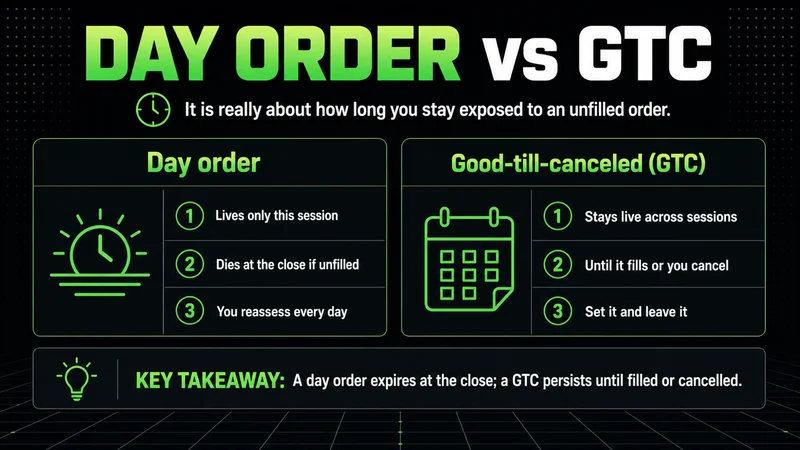
Day order vs good-till-canceled order
The day order vs good-till-canceled order choice is really about how long you want to stay exposed to an unfilled instruction. A day order dies at the close. A good-till-canceled order, often shortened to GTC, stays live across sessions until it fills or you cancel it.
The two tools fit different intentions:
- Day order: for a level you care about today, tied to today's structure, range, or catalyst. When the session ends, the reason for the order usually ends with it.
- Good-till-canceled order: for a level you would still want filled days from now, accepting that it can trigger overnight or on a gap you did not see coming.
The risk profiles diverge most on the open. A GTC limit resting below the market can fill on a gap-down before you have looked at a single chart. A day order cannot surprise you that way, because it never survived the night. For a trader who builds each plan around the current session, that containment is the point.
Where slippage quietly eats your fill
Day order slippage risk shows up in the gap between the price you saw and the price you got. It is largest where attention is lowest: the final minutes before the close, thin pre-holiday sessions, and low-volume names where the book is shallow. A stop day order that triggers into the closing auction is the clearest example. The trigger was clean; the fill arrives into fading liquidity, and the slippage can run several times your normal cost.
A correct order placed into the wrong liquidity still loses money. The order type was never the edge; the conditions around the fill were.
This is where the tool stops behaving the way the textbook describes. A day order reads cleanly in liquid cash-hours conditions. On an illiquid ticker into the close, the same resting order can fill far from your level or only partially, and the neat one-session logic turns into a fill you would not have accepted on purpose. No time-in-force fixes thin liquidity.
When a day order is the right tool
The strongest day order use case is intraday work built around levels that only matter today. A range you are fading, a breakout retest you want to catch, a same-session exit you mapped before the open: each is a today decision, and a day order matches that intent without leaving anything overnight.
It is the wrong tool when your idea has a multi-day horizon. If the level would still be valid on Thursday, forcing it into a day order means re-entering the instruction every morning and risking the day you forget. Match the duration to the idea's lifespan, not to your broker's default.
What mistakes do beginners make with day orders
The common day order mistakes are rarely about mechanics. They are about attention and assumption. Most traders do not have an order-type problem; they have a process problem, and the day order makes it visible. Before you place one, run a short checklist:
- Confirm the duration. Know whether the order is a day order or GTC before you send it; the default is not always what your plan needs.
- Check liquidity at your level. A resting order on a thin name near the close invites slippage and partial fills.
- Decide what a partial fill means. If half your size fills and the rest expires, is the position still valid or does it need managing?
- Match duration to the idea. Today's level gets a day order; a multi-day level does not.
- Do not set and forget. An order that made sense at the open may need canceling by midday.
The set-and-forget habit costs the most. A day order removes the need to watch a single level, but not the need to manage risk. Walk away and a thin-liquidity fill can turn a routine order into a position you did not intend.
FAQs
What is a day order in trading? It is an order to buy or sell at a set price that stays active only for the current session. If it does not fill by the close, the broker cancels it automatically, and it does not carry into the next day or into after-hours.
What is an example of a day order? You place a limit day order to buy at 50 while the stock trades at 51. If price drops to 50 during the session with size available, the order fills. If price never reaches 50 before the close, it expires unfilled.
How does a day order affect trading risk? It contains exposure to one session, so an unfilled order cannot trigger overnight or on a gap. The trade-off is slippage and partial-fill risk if the order rests in thin liquidity, especially near the close.
What is the difference between a day order and a good-till-canceled order? A day order expires at the session close. A good-till-canceled order stays live across sessions until it fills or you cancel it, which means it can trigger overnight or on the open.
When should a trader use a day order? Use it for levels that only matter today, such as an intraday range, a breakout retest, or a same-session exit. For a level you would still want filled days from now, a good-till-canceled order fits better.
Worth the read?