Buy Stop Order Explained — How It Works
A buy stop order triggers above the market and fills at the next ask. Here is how it works, when to use it, and the slippage risk to plan for.
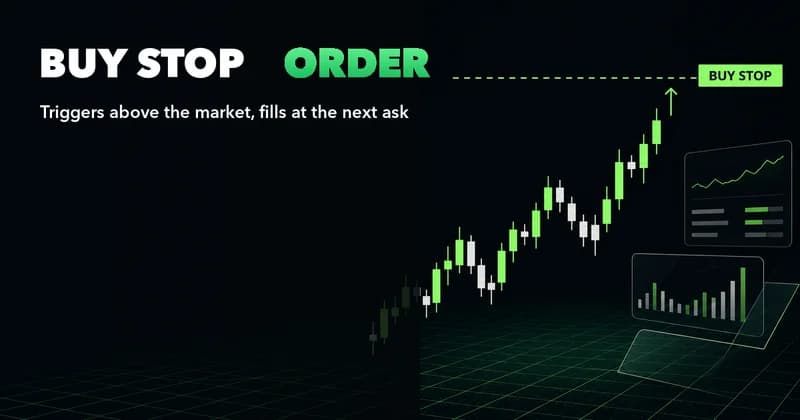
A buy stop order is an instruction to buy once price trades up to a level you set above the current market. It sits dormant until that trigger is touched, then it converts to a market order and fills at the next available ask. Traders use it to enter on strength, usually as price pushes through a level where they expect momentum to continue.
That one detail, the conversion to a market order, is where most beginners misread the tool. The stop price is the trigger, not the price you pay. Understanding the gap between those two numbers is the difference between using a buy stop with intent and being surprised by your own fill.
What a buy stop order actually does
Think of it as a conditional entry. You place the order above the market and define the stop price. Nothing happens while price trades below that level. The moment the last trade reaches or crosses your stop price, the order activates and behaves like a market order to buy.
Because it activates above the current price, a buy stop is built for entering on upward movement, not for buying a dip. If you want to buy below the market, that is a buy limit order, a different tool entirely. The buy stop exists for one purpose: participating once price shows it can trade through a level you care about.
In plain terms, what is a buy stop order in trading? It is a resting instruction that says, "I do not want to be long here, but if price proves it can reach this higher level, put me in."
How does a buy stop order work at the fill
Here is the part most explainers gloss over. When your stop price triggers, the order does not fill at the stop price. It fills at the next ask the market offers. In a calm, liquid market those two numbers are close. In a fast or thin market they can be far apart.
Walk through a simple buy stop order example. Price is trading at 100, and you believe a move through 105 confirms strength, so you place a buy stop at 105. Price climbs, touches 105, and your order goes live as a market buy. If the offer at that instant is 105.10, that is your fill. The 105 was the condition; the 105.10 was the execution.
The buy stop order fill price is whatever the book offers when the trigger fires. That distinction matters most when several orders trigger at once, which is exactly what happens at obvious breakout levels.
Why slippage is the cost you actually pay
Slippage is the difference between your stop price and your fill. With a buy stop it tends to run against you, because you are buying into a market that is already moving up. The faster it moves, the wider the gap.
This is the buy stop order slippage risk in one line: the cleaner the breakout looks, the more crowded the trigger, and the worse the fill can be. When price tags a round number where everyone parked their stop, that pool of orders fires together and lifts the offer before your share executes.
NQ rewards discipline and punishes hesitation here in a way that shows up immediately. On a momentum push through a session high, the offer can climb several ticks between your trigger and your fill, leaving you long at a worse price than the chart suggested. That is not a malfunction. It is the order doing exactly what it promised: buy now, at whatever the market asks.
Buy stop order vs sell stop order
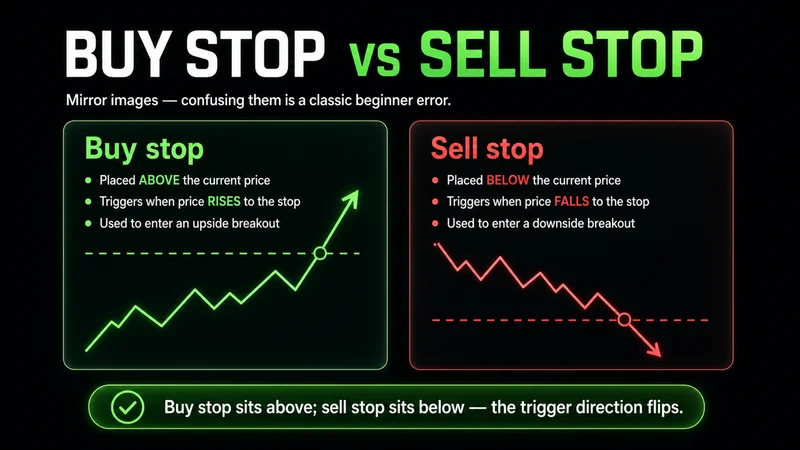
The two are mirror images, and confusing them is a common beginner error. The table below lays out the difference.
| Feature | Buy stop order | Sell stop order |
|---|---|---|
| Placed relative to market | Above current price | Below current price |
| Triggers when price | Rises to the stop level | Falls to the stop level |
| Becomes | A market buy | A market sell |
| Common use | Enter long on an upside breakout | Exit a long, or enter short on a downside break |
A buy stop enters you on strength. A sell stop protects a long or opens a short on weakness. Same mechanism, opposite direction.
When should traders use a buy stop order
The honest answer is narrower than most guides admit. A buy stop earns its place when your plan depends on price confirming a move before you commit capital, and you cannot or do not want to watch the screen to enter manually.
Good buy stop order use cases share a pattern:
- You are trading a breakout and want in only if price actually trades through the level, not before.
- You have identified structure where acceptance above a level changes the picture, and you want automated participation.
- You are away from the screen and need the entry handled without discretion.
The weak use case is placing a buy stop at an arbitrary round number with no structural reason. That is not a setup. That is hoping the level matters because it looks tidy.
This tool also breaks down in specific conditions. In a choppy, range-bound market, a buy stop is a fakeout magnet. Price pokes through your level, fills you long, then rolls right back under. The order worked perfectly and the trade was still wrong, because the context did not support it.
Common buy stop order mistakes beginners make
Most of these come from treating the order as a strategy instead of an execution tool.
- Confusing the stop price with the fill price and being surprised by slippage.
- Placing the stop exactly on the obvious level, where the order pool is thickest and the fill is worst.
- Using a buy stop with no defined invalidation, so there is no plan for when the breakout fails.
- Sizing as if the fill will match the trigger, which understates real risk.
- Setting the stop in dead, low-quality conditions and getting picked off by noise.
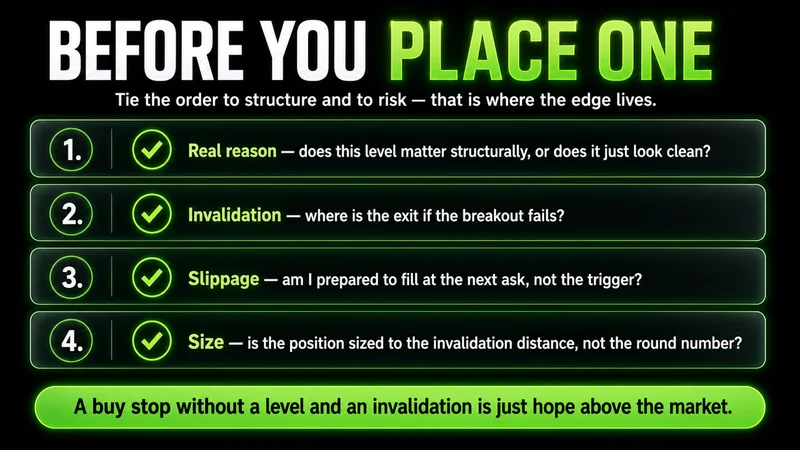
A buy stop order checklist for new traders
Before you place one, run through these questions. They tie the order to structure and to risk, which is where the edge lives.
- Is there a real structural reason this level matters, or does it just look clean?
- Where is my invalidation if the breakout fails, and have I placed a protective stop there already?
- Have I sized the position assuming a worse fill than the trigger?
- Are conditions liquid enough that slippage stays reasonable?
- Does this entry fit the broader market context, or am I forcing it?
If any answer is weak, the problem is rarely the order type. It is the plan behind it.
FAQs
What is a buy stop order in simple terms? It is an instruction to buy once price rises to a level you set above the current market. It stays inactive until that level is touched, then converts to a market order and fills at the next available ask.
How does a buy stop order work when it triggers? The stop price is only the trigger. Once price reaches it, the order becomes a market buy and fills at whatever the offer is at that moment, which may be higher than the stop in fast conditions.
What is the difference between a buy stop and a buy limit order? A buy stop sits above the market and enters you on upward movement. A buy limit sits below the market and enters you on a pullback. They point in opposite directions.
Why did my buy stop fill at a worse price than I set? That gap is slippage. Your stop price is the trigger, not the execution price, and in a fast or thin market the next available ask can sit several ticks above the level.
Is a buy stop order important for beginners to understand? Yes. It is one of the most common ways traders enter on breakouts, and misreading the trigger-versus-fill distinction is a frequent and avoidable mistake.
The takeaway on buy stop orders
A buy stop order is simple in mechanics and easy to misuse. It triggers above the market, converts to a market order, and fills at the next ask, which means slippage is part of the deal, not an exception. The order itself is neutral. What makes it work is the structure you anchor it to, the invalidation you define before you place it, and sizing that respects a worse fill than the trigger. Treat it as an execution tool inside a plan, not as the plan itself, and it does its job well.
Worth the read?