Caterpillar FY2025 Income Statement Analysis — 49x Risk
This Caterpillar FY2025 income statement analysis explains its revenue mix, margins, AI-power catalyst, cyclical risks, and valuation premium.

Caterpillar FY2025 income statement analysis starts with a simple tension: the company produced record revenue and strong profit, but its valuation appears to assume that AI-power demand can outrun the normal machinery cycle. The income statement supports the growth case. It does not remove the price risk.
The useful question is not whether Caterpillar is a good business. It is whether the current earnings mix is durable enough to justify paying a growth-stock multiple for a company whose construction, mining, and equipment-financing operations remain cyclical.
Caterpillar FY2025 income statement analysis starts with the revenue mix
FY2025 revenue reached $67.6 billion. Power & Energy was the largest external sales engine at $27.1 billion, ahead of Construction Industries at $24.8 billion. Resource Industries contributed $12.2 billion, while Financial Products added $4.2 billion before roughly $0.8 billion of eliminations.
That mix matters because investors are no longer valuing the company only as a manufacturer of excavators, loaders, dozers, mining trucks, and shovels. Power & Energy includes Solar Turbines and generator sets exposed to data-center and AI-related power demand. Its rise changes the narrative attached to the same consolidated earnings.
The practical principle is straightforward: identify which segment is changing expectations, then separate that catalyst from the segments still tied to the economic cycle. Revenue size alone does not reveal which dollar is receiving the highest valuation.
The revenue-to-profit bridge shows a profitable operation
The income statement begins with $67.6 billion of revenue and $44.8 billion of cost of goods sold. That leaves $22.8 billion of gross profit, equal to a 33.8% gross margin. After approximately $7.0 billion of selling, general, and administrative expense, $2.1 billion of research and development, and about $2.5 billion of other operating and financing costs, operating profit was $11.2 billion. Net income finished at $8.9 billion.
Read the bridge in sequence. For every $100 of sales, roughly $33.80 remained after direct production costs, $16.50 remained at the operating line, and $13.10 reached net income. Those are substantial margins for a capital-intensive machinery business, but the distance between gross and operating profit also shows why manufacturing costs, tariffs, research spending, and corporate expenses cannot be ignored.
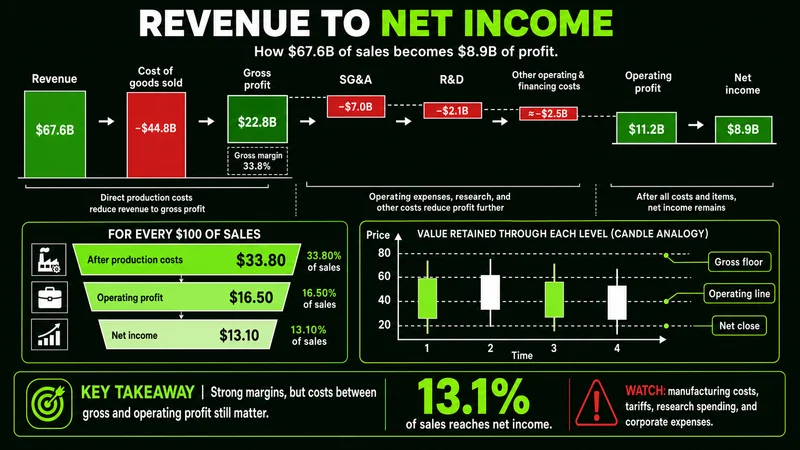 The FY2025 income statement narrows from revenue through costs to net profit.
Margin direction matters more than a single margin snapshot
The reported 16.5% operating margin was below the roughly 20% level shown for 2024. The stated pressure came from tariffs and manufacturing costs as peak pricing began to fade. A profitable year can therefore contain an early warning: earnings remain strong while the incremental economics weaken.
This is where investors often make a common mistake. They treat a 13.1% net margin as a permanent feature instead of asking what happens when price realization slows, input costs rise, or production volume falls. For a cyclical manufacturer, the direction of margin change often matters more than the latest absolute number.
Strong operating cash flow still has strategic value because it can fund buybacks and dividends. However, capital returns do not repair a weakening operating trend. They are most durable when supported by repeatable cash generation rather than a temporary peak in pricing or demand.
AI-power demand is the catalyst behind the premium
Power & Energy is now the largest segment by external sales and is presented as the fastest-growing part of the business. Data-center electricity needs can support orders for turbines and generator sets, while backlog and book-to-bill readings can provide evidence that demand is moving from a narrative into contracted activity.
A concrete way to test the catalyst is to track three steps. First, new AI-power orders should enter backlog. Second, backlog should convert into revenue without extended delays or cancellations. Third, that revenue should produce stable or improving margins after manufacturing costs. If only the first step is visible, expectations may be advancing faster than earnings quality.
The stock can reprice before those earnings arrive because markets discount future cash flows. That is normal. The risk begins when the valuation leaves little room for slower conversion, weaker pricing, or a change in customer spending.
A 49x P/E changes the burden of proof
The valuation comparison places Caterpillar near 49 times next-12-month earnings, against roughly 33 times for Deere, 26 times for Cummins, and 16 times for Komatsu. Caterpillar is not merely trading above the peer group. It is being assigned a separate category of expectations.
| Company | Approximate next-12-month P/E | Market interpretation |
|---|---|---|
| Caterpillar | 49x | AI-power growth plus durable machinery earnings |
| Deere | 33x | Premium machinery franchise with cyclical exposure |
| Cummins | 26x | Power and industrial earnings at a lower multiple |
| Komatsu | 16x | More conventional cyclical valuation |
At 49 times earnings, the implied earnings yield is only about 2%. That does not prove the stock is overvalued, but it makes future execution more important. A high multiple can remain high when earnings estimates rise consistently. It becomes fragile when estimates stop improving, even if the company remains profitable.
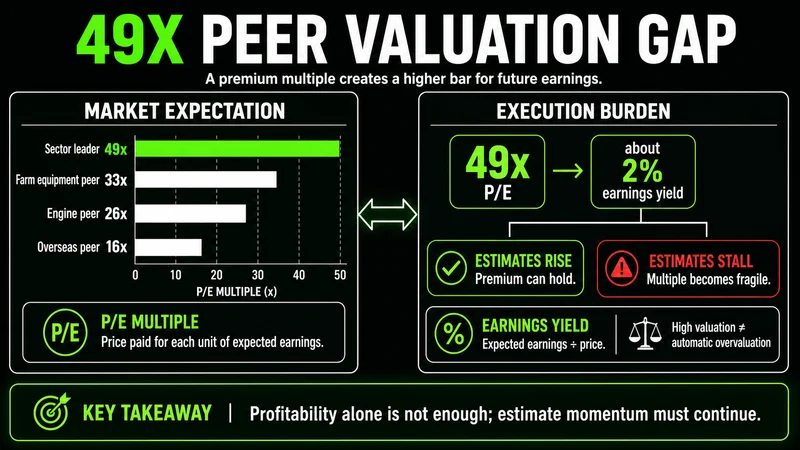 The valuation gap reflects expectations for AI-power growth.
The bear case is cyclical rather than operationally dramatic
The bear case does not require the business to fail. Construction and mining demand can cool, commodity prices can weaken, dealer inventory can build, and higher interest rates can reduce equipment affordability. Global macro conditions and Chinese construction activity add another layer of sensitivity.
At the same time, tariffs and material costs can squeeze price realization. If Power & Energy growth also proves lumpy, the company could face slower sales and lower margins while the market still applies a growth multiple. That combination matters because valuation compression can occur before an obvious decline appears in reported net income.
This is the core contradiction: Caterpillar can be priced like a growth stock while continuing to earn like a cyclical manufacturer. The premium depends on the first description becoming more economically important without the second description turning against it.
The common valuation mistake is using peak earnings mechanically
A P/E ratio looks precise, but its denominator may sit near a cyclical high. Paying 49 times peak earnings is more demanding than paying 49 times temporarily depressed earnings. Investors should therefore avoid comparing multiples without first judging where each company stands in its margin and demand cycle.
A cleaner practical application is to pair valuation with operating evidence:
- Track Power & Energy orders, backlog, and book-to-bill for confirmation of sustained demand.
- Watch operating margin direction, not only revenue growth.
- Compare price realization with tariffs and material-cost pressure.
- Monitor construction activity, mining capital spending, interest rates, and dealer inventory.
- Reassess the premium if earnings estimates stop rising while the multiple remains elevated.
This framework does not produce a perfect fair value. It defines what must continue working for the current price to remain supported.
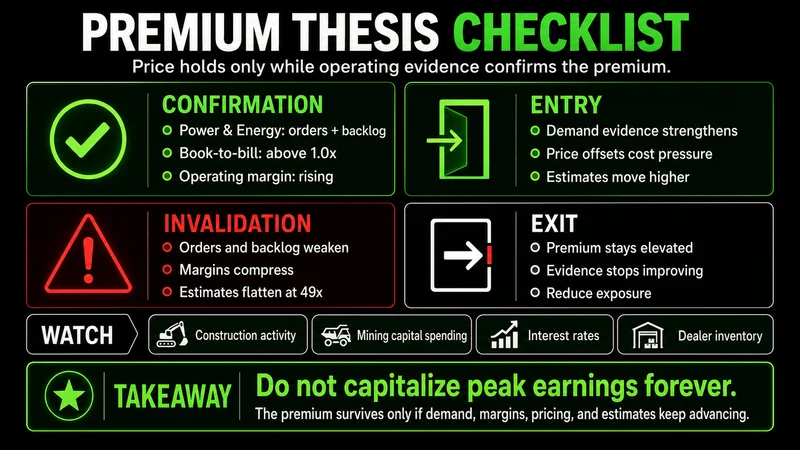 The premium holds only while operating evidence confirms the growth narrative.
Defined invalidation keeps the thesis testable
The premium thesis is confirmed when Power & Energy backlog expands, orders convert into profitable revenue, consolidated margins stabilize, and the traditional machinery segments avoid a deep downturn. Under those conditions, the earnings mix may deserve a higher multiple than Caterpillar’s historical 15–20x range.
The thesis is invalidated when several conditions align: Power & Energy orders lose momentum, backlog conversion weakens, operating margin continues to compress, and construction or mining demand rolls over. A single soft quarter may be noise. A sequence of weakening orders, margins, and estimates is structural evidence that the market priced the catalyst too aggressively.
Defined invalidation matters because it prevents the narrative from changing after the facts change. If every weak result is explained away as temporary, the valuation framework has stopped functioning as analysis.
When this framework does not work
This approach is less useful during a sudden macro shock, major acquisition, accounting change, or one-time cost event that makes current margins and forward earnings unrepresentative. It also loses precision when the peer multiples use inconsistent earnings periods or when estimates move faster than published comparison data.
In those conditions, the 49x figure should not be treated as a stable measurement. The better response is to normalize earnings across a full cycle, separate one-time items, and wait for comparable data. Precision without comparable inputs creates false confidence.
The decision depends on growth delivery and cycle control
Caterpillar’s FY2025 results show a profitable company with record revenue, a leading Power & Energy segment, and enough cash generation to support shareholder returns. They also show operating-margin compression and continued exposure to construction, mining, rates, tariffs, and global demand.
The valuation premium is therefore a demand on future execution, not a verdict on business quality. The disciplined view is to monitor whether AI-power orders become durable, high-margin earnings before the machinery cycle weakens. At 49x, good performance may already be expected. What matters next is confirmation.
Worth the read?