Open Outcry — What It Was and Why It Still Matters
Open outcry was how floor traders shouted bids and signaled trades before screens took over. What it was, how it worked, and why its lessons still hold.
Open outcry is the old method of trading in which floor traders shouted bids and offers and signaled with their hands inside a pit to buy and sell contracts. It was how price discovery worked for centuries before screens replaced the noise. The pits are mostly gone now, but the behavior they exposed has not changed.
That is the part most explanations skip. They treat open outcry as a museum exhibit, a quaint story about men yelling on a floor. The mechanism mattered more than the spectacle. Every shout was a piece of order flow made visible. Every hand signal was positioning you could read in real time. Understanding open outcry is less about nostalgia and more about seeing where modern liquidity behavior came from.
What open outcry meaning actually points to
The open outcry meaning is simple on the surface: a verbal and physical auction conducted in the open, where all participants can hear and see the bids and offers. No private channel. No hidden book. If you wanted to buy, you said so out loud, and the price you were willing to pay competed against everyone else's in the same moment.
That openness was the entire point. A bid only counted if it improved on the last one. An offer only mattered if it was better than the price already in the pit. Price discovery happened through direct competition, with the whole crowd as the order book.
A short open outcry history
The practice goes back to the exchanges that formed in 17th-century Amsterdam, and it carried through the rise of the major futures and equity markets. For most of that span, open outcry was not one option among several. It was the only way an exchange functioned.
The structure was consistent across venues:
- Traders gathered in a designated area of the floor called the pit.
- Buy and sell interest was communicated by voice, and by hand signals when the room was too loud to hear.
- Brokers executed customer orders; locals traded their own capital and provided liquidity.
- Prices were recorded and disseminated from the floor outward.
Through the 1980s and 1990s, telephone and electronic systems began absorbing the volume. By the 2000s, most floors had closed or converted. A handful of pits held on into the last decade, but the model was finished as a primary venue.
How hand signals carried the order flow
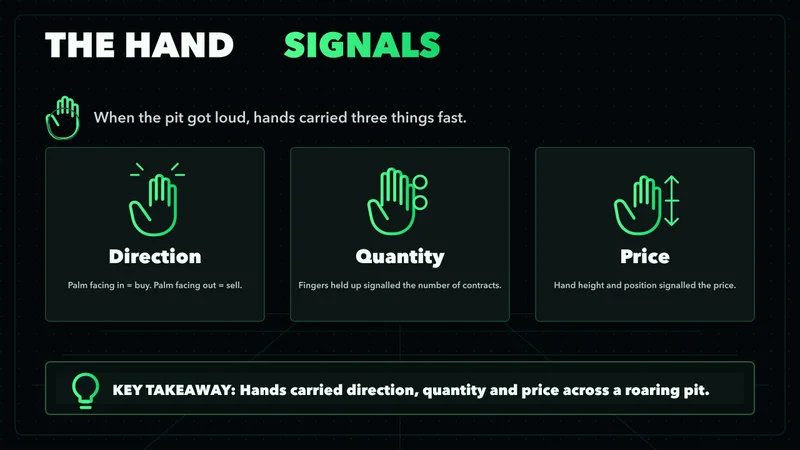
When a pit got loud enough, the voice stopped being reliable, so traders used a standardized signal system. The hands communicated three things quickly: direction, quantity, and price.
- Palm facing in, toward the body, meant buying. Palm facing out meant selling.
- Hands held near the face signaled the price.
- Hands extended away from the body signaled the quantity.
- Fingers indicated the numbers, with position adjusting whether they meant single units, tens, or larger lots.
It was a compressed language built for speed under pressure. A trader could take in dozens of signals at once and form a read on where the crowd was leaning. That read was the early version of what screen traders now reconstruct from the tape and the depth of market.
Open outcry role in markets and price discovery
The open outcry role in markets was to concentrate participation in one place and force it into the open. That concentration produced a kind of information no quote screen showed. You could see who was aggressive and who was hesitant. You could watch a large local start leaning on one side and read the conviction behind it.
This is where one belief I hold sits comfortably: liquidity drives markets more than opinions do. In the pit, that was literal. The loudest fundamental story meant nothing if the crowd was positioned the other way, and the positioning was visible on the faces and in the hands of the people standing across from you. The headline did not move price. The flow did.
An open outcry example you can picture
Here is an open outcry example in stock market terms. A broker walks into the pit holding a large buy order from a client. He signals his interest, and the locals see size arriving. The offers above the market start to lift as sellers pull back, anticipating the demand. The broker fills part of the order, but the visible aggression has already moved the price against the rest of his size.
That is slippage, made physical. The same dynamic exists today, only the size now arrives as a sweep through the book rather than a man shouting across a pit. The cause is identical: visible demand meeting thinning supply.
Open outcry vs electronic trading
The open outcry vs electronic trading comparison is usually framed as old versus new, but the real difference is what each system reveals and hides.
Electronic trading won on the things that scale: speed, cost, access, and an auditable record of every order. It removed the geographic limit of a physical floor and let a trader in any time zone participate. For most market participants, that was a clear improvement.
What it removed was the human read. In the pit, you saw hesitation and greed directly. On a screen, that information is still there, but it is encoded in order flow, in how resting liquidity behaves, and in the speed and size of prints. You have to reconstruct the crowd from data instead of watching it.
This is also where the romantic version of open outcry breaks down. The pit's transparency worked while everyone stood in the same room on a liquid product during active hours. On thin products, in the slow part of the session, the same shouting produced wide, unreliable prices and gave a few well-placed locals an edge that had nothing to do with better information. Transparency in the open outcry sense was conditional, not absolute, and electronic markets fixed some of that while introducing problems of their own.
What open outcry means for investors today
For investors, the open outcry for investors angle is not about wishing the floors back. It is about understanding that the questions have not changed. Where is the liquidity. Who is positioned and how heavily. What happens to price when real size shows up. The pit answered those questions out loud. The screen answers them quietly, and the trader's job is to learn to hear it.
Screen time is the bridge. There is no shortcut around the hours required to read order flow on a chart the way a floor trader once read a pit. Indicators do not supply it. The skill is built by watching price behavior repeat under different conditions until the patterns become recognizable.
Open outcry risks and the mistakes beginners make
The main open outcry risks worth discussing are not historical; they are interpretive. New traders study the era and draw the wrong lessons.
- Treating the pit as proof that "reading the crowd" is a complete strategy. It was one input, not an edge by itself.
- Assuming visible aggression always wins. Plenty of large floor orders moved price against the trader placing them.
- Romanticizing intuition over process. The disciplined locals survived; the loud ones often did not.
The common open outcry mistakes beginners make come down to studying the surface and missing the structure. The shouting was theater. The order flow underneath was the substance, and the substance is what carried over to the screens.
FAQs
What is open outcry in simple terms? It is a method of trading where floor traders shout bids and offers and use hand signals inside a pit, so all participants can hear and see the prices being competed for. It was the primary way exchanges operated before electronic systems replaced the floor.
How does open outcry work? Traders gather in a pit and communicate buy and sell interest by voice and hand signals. A bid only stands if it improves on the prior one, and an offer only matters if it is better than the price already quoted, so price discovery happens through open competition in real time.
Does open outcry still exist? Almost entirely no. Telephone and electronic trading replaced floor trading across most exchanges during the 1980s through the 2000s. A small number of pits operated into the last decade, but open outcry is no longer a primary venue for any major market.
Why does open outcry still matter for traders? Because the behavior it exposed did not disappear with the floors. Liquidity, positioning, and how price reacts to real size still drive markets. Open outcry made that flow visible in the open; screen traders now reconstruct the same information from the tape and the order book.
Worth the read?