Johnson & Johnson Patent Cliff and Talc Litigation Risk
Johnson & Johnson patent cliff and talc litigation risk test whether strong margins, durable cash flow, and a premium valuation can survive FY2025.

Johnson & Johnson patent cliff and talc litigation risk is the central test behind the stock’s premium valuation. The company produced $94.2 billion of FY2025 revenue, strong margins, and durable cash flow, but those figures describe the existing engine. Investors still have to judge whether new medicines and MedTech growth can replace expiring exclusivity while legal uncertainty remains contained.
A profitable company can be a poor purchase when its price assumes a smooth transition. A company facing visible risks can still be attractive when its valuation reflects realistic damage. The work is separating operating quality from the expectations embedded in the stock.
Start with how Johnson & Johnson makes money
Johnson & Johnson has two primary revenue engines. Innovative Medicine generated $60.4 billion in FY2025, while MedTech generated $33.8 billion. Together, they produced $94.2 billion of revenue. Innovative Medicine is the larger contributor, supported by products including Darzalex, Tremfya, and Carvykti. MedTech provides a second source of growth through cardiovascular products, Shockwave, Abiomed, robotics, and other device franchises.
This split creates diversification, but it does not eliminate concentration risk. Innovative Medicine accounts for roughly two-thirds of company revenue, so changes in drug demand, approvals, pricing, and patent protection can outweigh progress elsewhere. MedTech can soften pressure, yet a $33.8 billion segment cannot automatically replace a sharp decline in a major pharmaceutical franchise.
A useful first step is to map each segment to the factor that can change its earnings power:
- Innovative Medicine depends on product growth, late-stage pipeline results, approvals, pricing, and patent protection.
- MedTech depends on procedure volumes, adoption of newer cardiovascular products, robotics, and competitive execution.
- Corporate value also depends on capital allocation, acquisitions, litigation outcomes, and annual guidance.
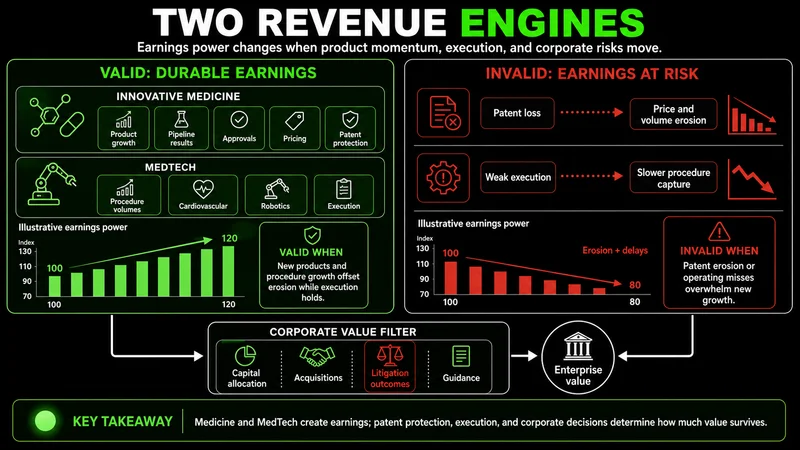 Innovative Medicine remains the larger engine, while MedTech provides a second source of growth.
Strong margins explain why the market pays attention
The FY2025 income statement shows premium pharmaceutical economics. From $94.2 billion of revenue, Johnson & Johnson retained $63.9 billion of gross profit, equal to a gross margin near 68%. Operating income was $25.3 billion, or roughly 27% of revenue. Reported net income was $26.8 billion, or about 28%.
| FY2025 measure | Amount | Share of revenue |
|---|---|---|
| Revenue | $94.2B | 100% |
| Cost of products sold | $30.3B | 32% |
| Gross profit | $63.9B | 68% |
| Operating income | $25.3B | 27% |
| Net income | $26.8B | 28% |
The unusual relationship between operating income and net income deserves attention. Net income was boosted by one-time items, so the 28% net margin should not be treated as a clean recurring baseline. Investors often make the first valuation mistake here: they apply a multiple to a temporarily favorable earnings figure and call the result normalized.
Start with recurring operating economics, then adjust for items unlikely to repeat. Gross margin shows the strength of the product mix. Operating margin shows what remains after selling, administrative, and research costs. Reported net income is useful only after its one-time components are understood.
What moves JNJ stock is more specific than earnings
JNJ stock does not move on revenue alone. It moves when new information changes the market’s estimate of future cash flow. Drug approvals and late-stage pipeline readouts can increase the probability that new products replace aging franchises. Growth from Darzalex, Tremfya, and Carvykti can change pharmaceutical estimates. MedTech performance from Shockwave, Abiomed, and robotics can alter the expected contribution of the second segment.
Negative catalysts work through the same mechanism. Stelara biosimilar erosion can lower expected medicine revenue. Talc settlement headlines can change the range of potential legal costs. Drug-pricing reform can pressure economics in the United States. Foreign-exchange movements can affect translated results because roughly 45% of sales are international. Annual guidance and acquisitions then update management’s view of how these forces combine.
A common mistake is reacting to a headline without asking whether it changes normalized cash flow. A pipeline announcement matters when it changes approval probability, market size, timing, or expected margin. A legal headline matters when it changes the likely cost, timing, or finality of claims. Noise becomes a catalyst only when it changes the earnings path or the discount investors apply to that path.
Johnson & Johnson patent cliff and talc litigation risk
The patent cliff is an operating risk. Talc litigation is a balance-sheet and valuation risk. Both challenge the durability implied by a premium multiple.
Stelara and other key-drug patent cliffs expose established revenue to biosimilar competition. The practical question is not whether erosion occurs. It is whether growth from the remaining portfolio, new approvals, and MedTech can replace the lost contribution without sacrificing margins. A pipeline may look deep on paper, but replacement only counts when products clear clinical, regulatory, commercial, and reimbursement hurdles.
Talc litigation creates a different problem. Tens of thousands of claims can leave the ultimate cost and timing uncertain. Even a company with strong cash generation may deserve a wider valuation discount when the legal range is difficult to bound. Investors should distinguish a manageable cash obligation from an open-ended overhang that repeatedly changes with court decisions and settlement efforts.
The defined invalidation for a constructive thesis is clear: the thesis weakens if replacement products fail to offset major patent erosion, MedTech growth slows, free cash flow deteriorates, or the probable litigation burden expands enough to impair capital allocation. A single weak quarter does not establish that outcome. Sustained evidence across revenue, margins, pipeline progress, and cash flow does.
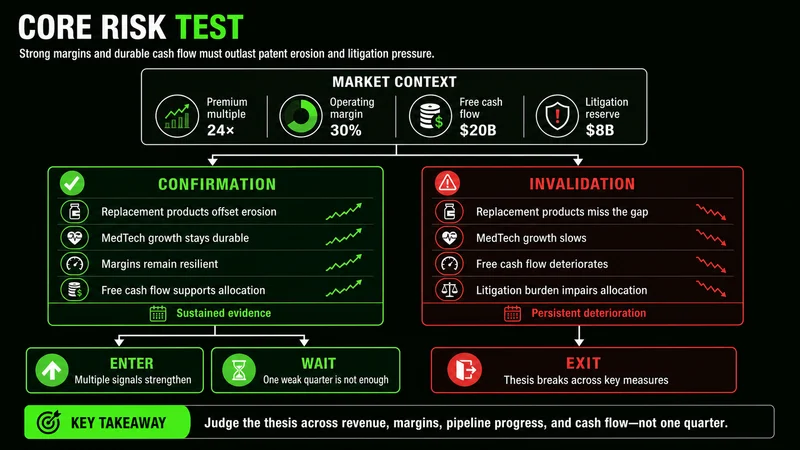 The thesis weakens when replacement growth, cash flow, or legal containment fails to confirm.
Is JNJ overvalued compared with pharma peers
The slide data places JNJ near a 26-times trailing price-to-earnings ratio, above many large pharmaceutical peers. That premium can reflect the company’s strong balance sheet, diversified operations, durable cash generation, and dividend record. Bulls are paying for stability and the probability that the portfolio can renew itself.
Peer comparisons require care. Reported trailing earnings can be distorted by one-time charges, acquisition accounting, litigation items, or other company-specific adjustments. A ranking of headline P/E ratios may compare different earnings bases. The practical comparison uses normalized earnings, free cash flow, expected growth, balance-sheet strength, and risk-adjusted durability.
Consider two simplified cases. In the first, new medicines and MedTech growth replace Stelara erosion, margins remain firm, and legal costs become more measurable. A premium multiple may be justified because uncertainty falls while cash generation holds. In the second, replacement revenue arrives slowly, pricing pressure intensifies, and litigation remains unresolved. The same 26-times multiple would leave less room for execution errors.
Valuation is therefore an expectations test. The stock is overvalued when its price requires a cleaner transition than the operating evidence supports. It is not overvalued merely because its multiple exceeds a peer median.
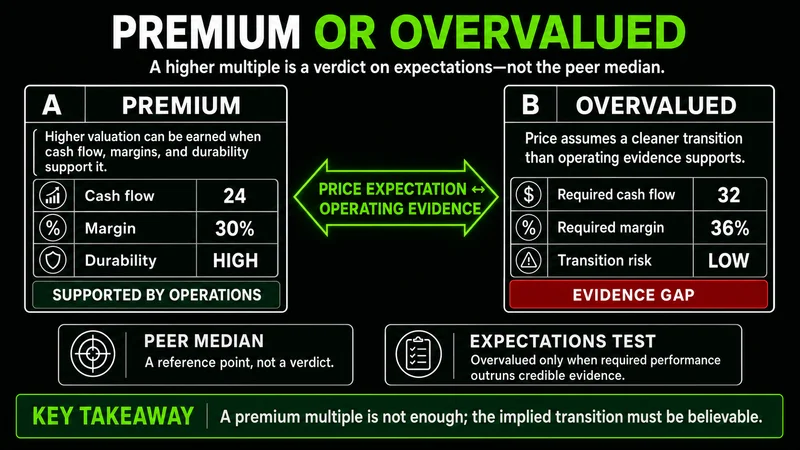 A premium is defensible only when replacement growth and legal clarity support normalized cash flow.
The common mistake is confusing quality with value
Johnson & Johnson can be highly profitable and still offer a weak entry price. Its 68% gross margin, 27% operating margin, and consistent cash generation establish business quality. They do not determine the return available from a specific valuation.
The reverse mistake is treating every visible risk as a reason to avoid the stock. Patent expiration and litigation are not hidden. Their importance depends on the assumptions already priced in. If investors demand a large discount for risks that prove manageable, uncertainty can create opportunity. If they pay a premium while assuming near-perfect replacement, the same risks can create asymmetric downside.
A durable business deserves attention, but a premium valuation still needs defined evidence and defined invalidation.
This framework keeps analysis reactive, not predictive. It does not require certainty about a court decision or drug approval. It requires updating the valuation as the evidence changes.
A practical JNJ review uses four checks
Review the company in a fixed order. First, track segment revenue and determine whether Innovative Medicine growth is broad or dependent on a few products. Second, compare patent-related erosion with growth from Darzalex, Tremfya, Carvykti, and pipeline launches. Third, measure whether MedTech growth and free cash flow remain strong enough to support dividends, investment, and acquisitions. Fourth, update the range of talc liabilities without pretending that one estimate is precise.
Then connect those checks to valuation. Use normalized earnings instead of a one-time boosted net margin. Compare JNJ with peers on consistent measures. Define what operating result would justify the premium and what result would invalidate it. Position sizing should reflect the width of the legal and pipeline outcome range, not confidence in the company’s history.
When this framework does not work cleanly
This framework becomes less reliable when legal outcomes, acquisition accounting, or one-time items dominate reported earnings. It also loses precision when pipeline probabilities cannot be estimated from available evidence. In those conditions, a single P/E ratio creates false confidence.
The answer is not to force a precise fair value. Use a wider range, demand more valuation room, and wait for confirmation from normalized cash flow, replacement-product growth, or a narrower litigation outcome. Patience is part of the analysis when the inputs do not support precision.
The premium must survive the transition
Johnson & Johnson enters the transition with two large operating segments, premium gross margins, strong free cash flow, and established pharmaceutical and medical-device franchises. The risk is paying for those strengths as though patent replacement and litigation resolution are already secured.
The premium holds if new medicines and MedTech replace erosion while cash generation remains durable and legal exposure becomes measurable. It fails if the replacement engine stalls or the overhang consumes more capital than the valuation allows. That is the line to monitor.
Worth the read?