Loss Aversion Distorts Trade Management
Loss aversion makes traders cut winners and protect losers. Learn how MFE, MAE, exits, and hold-time review expose the cost.
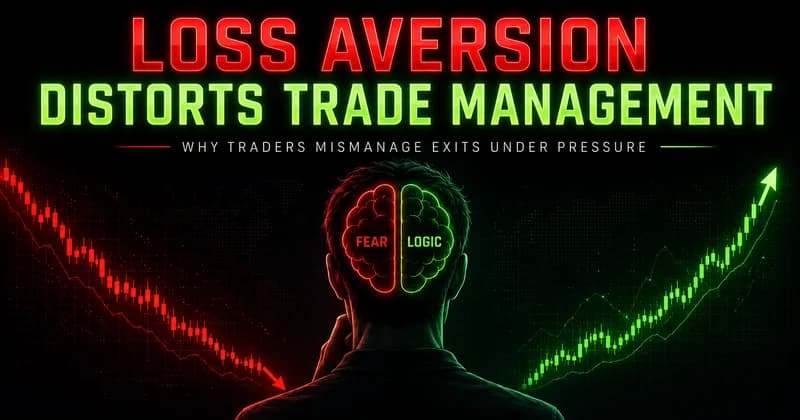
Loss aversion in trading makes the account defend the wrong trades. Winners get closed early to protect the feeling of being right, while losers are held because realizing the loss feels worse than carrying the risk.
Loss Aversion Makes Traders Manage Pain Instead Of Risk
Loss aversion is the bias that makes losses feel more powerful than equivalent gains. The source summarizes the behavioral economics finding clearly: the emotional weight of a loss is about double the reward felt from a comparable gain.
In trading, that imbalance changes management decisions. A winning trade becomes something fragile that must be protected. A losing trade becomes something the trader wants to delay admitting.
The behavior usually appears in four ways:
Taking profits too early because open gains feel at risk
Holding losing trades because closing them makes the loss real
Moving stops farther away to avoid the planned exit
Averaging down to make recovery feel closer
None of these decisions require a bad strategy. A trader can have a reasonable entry system and still damage the account through exit behavior. Risk management matters more than entries because poor management can turn even decent trade selection into negative expectancy.
The Disposition Effect Is Loss Aversion In Market Form
The disposition effect is the market behavior created by that bias: traders often realize gains quickly while delaying the acceptance of losses. In 1998, Terrance Odean studied 10,000 brokerage accounts and documented the same bias: investors realized gains far more readily than losses, with winning positions closed 1.5 times as often as losing ones.
The source also reports a 3-5% annual return drag from the disposition effect. That cost comes from asymmetry. Small gains are realized quickly. Larger losses are allowed to expand. Over time, average win size shrinks while average loss size grows.
This is not the same as risk aversion. Risk aversion prefers certainty. Loss aversion is specifically focused on avoiding the pain of a realized loss. That means a loss-averse trader can become risk-seeking while down and risk-averse while up.
That reversal is the problem. The trader adds risk when risk should be reduced and removes risk when a winner may still have room to work.
Entry Price Becomes A Dangerous Reference Point
Loss aversion depends heavily on the reference point. For many traders, the anchor is the fill price. The position is judged by whether it is above or below that number, not by whether the trade still has a valid thesis.
That creates poor decision-making. A losing trade may be held even after market structure has changed because the trader wants the position to return to entry. A winning trade may be closed early because giving back unrealized profit feels like a loss.
Mental accounting makes this worse. Once capital is assigned to a trade, the trader treats that position like a separate bucket. The goal becomes closing that bucket green, even if a better opportunity exists elsewhere.
Regret avoidance also matters. A realized loss feels like proof of a mistake. An unrealized loss can still be framed as temporary. That framing is emotionally convenient, but it is dangerous when price has already invalidated the idea.
Professional trade management evaluates current merit. The question is not, “Am I up or down from entry?” The question is, “Does this position still deserve risk based on the current information?”
The Math Stops Working When Winners Are Cut Short
Loss aversion damages expectancy because it distorts the risk-reward profile. If a trader repeatedly takes winners at 1R but allows losers to reach 2R or 3R, the system needs a very high win rate just to stay flat. The source estimates that this kind of profile may require a win rate above 65-75% to break even.
Most strategies do not operate with that much accuracy. They need the average winner to be large enough, or the average loser to be controlled enough, for expectancy to work.
The compounding damage is direct:
Winners become smaller because the trader exits early
Losers become larger because the trader delays acceptance
Average win decreases while average loss increases
Required win rate rises beyond what the strategy can realistically produce
This is how loss aversion can make a good setup library look weak. The entry process may be fine, but the exits no longer represent the system that was tested.
MFE And MAE Turn Exit Bias Into Evidence
Maximum Favorable Excursion, or MFE, shows how far a trade moved in the trader's favor before exit. Maximum Adverse Excursion, or MAE, shows how far it moved against the position. Together, they reveal whether trade management is aligned with the opportunity and the risk.
Start with the last 50 winning trades. Compare the actual exit against the MFE. If exits are consistently far below the best favorable move, early profit-taking is likely costing money. Add the missed amount across the sample. That number is the practical cost of cutting winners.
Then review losing trades. If losers have much longer hold times than winners, the disposition effect is probably active. The source states an average loser hold time of 2x winners as a warning sign. A well-managed system often holds winners at least as long as losers, especially when the plan is to let favorable trades expand.
Tags help make this visible. Use labels such as “early close,” “target reached,” and “overstayed.” Over time, those tags create an exit-quality dataset. The source references one MFE/MAE workflow example that showed $300k+ in unrealized potential. The exact amount is case-specific, but the lesson is not: exit bias has to be measured before it can be corrected.
Predefined Exits Move The Decision To A Better State
The strongest fix is pre-commitment. Before entering, define the stop and at least one profit objective. The decision is made while the trader is still neutral, before open P&L starts influencing perception.
Stops must be treated as commitments, not emotional suggestions. Moving a stop farther away because the loss feels uncomfortable is not trade management. It is avoidance.
Trailing stops can also help when the issue is cutting winners too early. A trailing stop gives the trade room to continue while still defining where the idea is no longer worth holding. The distance matters. Too tight and normal volatility removes the position. Too loose and too much open profit is returned.
Losses also need to be reframed. A trading loss is an operating cost. It is the cost of learning that a specific trade idea did not work. When losses are treated as personal failures, the trader will naturally avoid realizing them. When they are treated as business expenses, the emotional intensity drops.
FAQs
What does loss aversion mean for traders? It is the bias that makes realized losses feel more painful than comparable gains feel rewarding. In trading, it often causes early exits on winners and delayed exits on losers.
How does the disposition effect show up? It shows up when profitable trades are realized quickly while losing trades are kept open well past the point where the plan called for an exit. It is one of the main ways loss aversion shows up in actual trade management.
What signs reveal this bias? Look for average losses larger than average wins, losing trades held longer than profitable ones, frequent stop movement, averaging down, and exits that sit far below MFE.
How can I reduce loss aversion? Define exits before entry, use MFE and MAE analysis, review hold times, tag exit quality, and treat planned losses as operating costs. The goal is to manage risk from structure, not from the discomfort of being wrong.
Loss aversion cannot be removed completely. It can be contained by rules, measurement, and pre-commitment. The trader does not need to feel neutral about losses. The trader needs a process strong enough to act correctly while the loss still feels uncomfortable.
Worth the read?