Rational Choice Theory — What It Means for Markets
Rational choice theory is the market's baseline for rational behavior. Here is what it means, where it breaks, and how working traders actually use it.
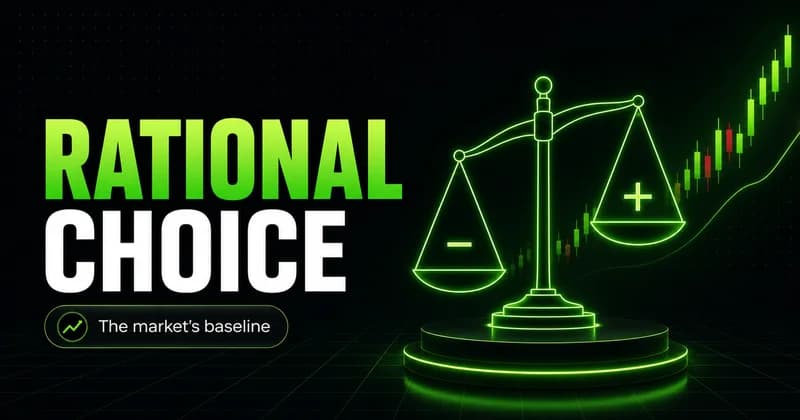
Rational choice theory is the idea that people weigh costs against benefits and pick the option that serves their own interest. In markets, it is the assumption that every buyer and seller acts on clean information and stable preferences. The model is useful as a baseline. It is also the first thing real price behavior breaks.
I have watched the same NQ level get defended rationally for an hour and then get abandoned in ninety seconds when liquidity thinned. The participants did not get less intelligent. The conditions changed, and the tidy cost-benefit math stopped describing what people actually did. That gap between the theory and the screen is where most of the useful work sits.
What rational choice theory means in plain terms
The rational choice theory meaning is straightforward. A decision-maker ranks the available options, assigns a value to each, and selects the one with the highest expected payoff for the lowest cost. Economists call that payoff utility. The actor is assumed to know the options, hold consistent preferences, and choose to maximize.
Three pieces hold the model together:
- Self-interest. The actor chooses what benefits the actor, not the group.
- Consistent preferences. If you prefer A to B and B to C, you prefer A to C. Rankings do not flip at random.
- Utility maximization. Among the choices, the actor takes the one with the best cost-to-benefit ratio.
Applied to a position, the framework says a participant buys when expected reward exceeds expected cost and the probability supports it. That is a clean description of a disciplined entry. It is not a clean description of a crowd.
Where rational choice theory came from
The roots run back to Adam Smith and the notion that individuals pursuing their own interest can, in aggregate, produce a functioning market. Later economists formalized it into the rational actor model that still anchors classical finance. The efficient market hypothesis is a direct descendant: if every participant is rational and prices already hold all known information, then prices are correct and edges should not persist.
That lineage matters because it tells you what the model was built to do. It was built to describe equilibrium, not to describe the messy minutes around a news release. Treating an equilibrium model as a real-time execution tool is a category error, and it is a common one.
A rational choice theory example traders actually see
Here is a rational choice theory example for investors that stays close to the desk. Two stocks sit in the same sector with similar fundamentals. One trades at a clear discount to the other on every multiple that matters. The rational actor buys the cheaper name, because the expected value is higher for the same exposure.
Now add real conditions. The cheaper stock is cheaper because a large holder is unwinding a position, and the order flow is one-directional for reasons that have nothing to do with fundamentals. The rational buyer steps in early, gets run over by supply, and learns that the discount was information, not a gift. The cost-benefit math was sound. The inputs were incomplete.
That is the practical lesson. Rational choice reasoning is only as good as the information feeding it, and in live markets the information is always partial and often late.
How rational choice theory affects stock prices
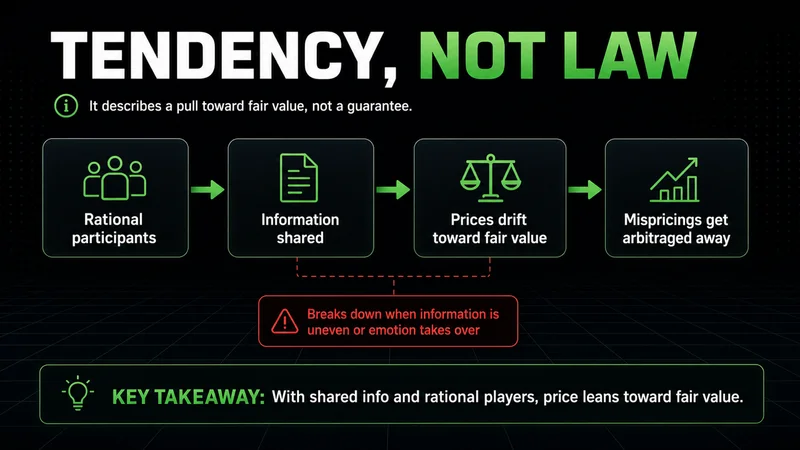
How rational choice theory affects stock prices is best understood as a tendency, not a law. When participants behave rationally and information is broadly shared, prices drift toward something close to fair value, and obvious mispricings get arbitraged away. That force is real. It is why most simple edges decay.
But the force is not constant. Liquidity drives markets more than opinions do, and liquidity is not evenly distributed across the session. In deep, calm conditions, the rational model describes price reasonably well. In thin conditions, around the open, into a settlement, or through a macro print, positioning and forced flow take over. The same level that held on rational defense gets swept because someone had to get out, not because the math changed.
So the honest answer to how the theory moves prices is conditional. It pulls price toward value when the market has the depth to let rational actors express their view. It loses its grip the moment liquidity or emotion overrides that expression.
Rational choice theory vs behavioral finance
The cleanest way to hold both ideas is to treat them as two halves of the same observation. Rational choice theory describes how a disciplined participant should decide. Behavioral finance describes how participants actually decide when fear, anchoring, and overconfidence enter the picture.
The rational choice theory vs behavioral finance debate is not really a contest with a winner. The rational model is the reference line. Behavioral finance measures the distance between that line and real behavior. Bubbles are the obvious case: if everyone were fully rational and prices held all information, a bubble could not form, yet they form regularly. The deviation is the point.
For a working trader, the useful stance is to assume rationality as the baseline and watch for the conditions where it breaks. Many breakouts fail because participants chase the move emotionally instead of waiting for structure to confirm it. That failure is behavioral finance happening in real time, and it is also the edge, because the rational reference tells you where price should be while the behavior tells you where the crowd actually went.
Why rational choice theory matters for investors
Why rational choice theory matters for investors is not that markets are efficient. It is that the model gives you a clean yardstick. When you can describe what a fully rational participant would do at a given level, you can measure how far real price action has drifted from that, and the drift is where opportunity and risk both live.
The market does not reward the most accurate forecast. It rewards the participant who reacts well when the forecast turns out to be wrong.
That is the practitioner read on rational choice theory for investors. Use the model to define the rational baseline. Then trade the gap between the baseline and the behavior, with risk defined in case the gap was telling you something you did not yet understand.
The limitations of rational choice theory
The rational choice theory limitations are not academic footnotes. They are the exact places the model costs traders money.
- It assumes complete information. Real participants act on partial, delayed, and sometimes wrong data.
- It assumes stable preferences. Fear and greed reorder preferences inside a single session, and the reordering is fastest when volatility expands.
- It ignores liquidity. The model treats every trade as frictionless. Real fills move price, and forced flow ignores fair value entirely.
- It assumes unlimited processing. Bounded rationality is the rule. People satisfice, they do not optimize, especially under pressure.
NQ is the clearest teacher here. It rewards discipline and punishes hesitation immediately, and it does not wait for a rational actor to finish computing expected value. The model that looked complete in backtest reveals its gaps the moment real volatility arrives.
A rational choice theory checklist for market analysis
A rational choice theory checklist for market analysis keeps the framework useful without pretending markets are fully efficient. Run these before you lean on a rational read:
- Define the rational baseline. What would a fully informed participant pay here, and why?
- Check the information. Is the price reflecting fundamentals, or is it reflecting flow you cannot see on the chart?
- Read the liquidity. Is this depth that lets rational actors express a view, or thin conditions where forced flow dominates?
- Locate the behavioral gap. How far is real price from the rational baseline, and which emotion explains the distance?
- Define invalidation. If the gap was information rather than mispricing, where are you wrong, and what is the cost?
The checklist does not predict. It frames. The goal is to know when rational reasoning describes the market and when it does not, because a rational read applied to the wrong conditions is just confident guessing.
Common rational choice theory mistakes beginners make
The most common rational choice theory mistakes beginners make come from trusting the model past its range. New traders assume the market is efficient, so they fade every move that looks irrational, and they get run over when forced flow keeps going. Others assume the market is always irrational, so they ignore value entirely and chase noise.
Both errors share a root. They treat rational choice theory as a verdict instead of a baseline. The model is a reference line, not a trade signal. Used as a reference, it sharpens judgment. Used as a prediction, it manufactures false confidence right before the conditions that break it.
FAQs
What is rational choice theory in simple terms? It is the assumption that people weigh costs against benefits and choose the option that gives them the most value for the least cost. In markets, it is the baseline idea that participants act on clean information and consistent preferences to maximize their own outcome.
How is rational choice theory used in the stock market? It underpins classical finance and the efficient market hypothesis, the view that prices already reflect all known information. In practice, traders use it as a reference line to measure how far real price action has drifted from what a fully rational participant would do.
What is the difference between rational choice theory and behavioral finance? Rational choice theory describes how a disciplined participant should decide. Behavioral finance describes how participants actually decide once fear, anchoring, and overconfidence enter. The first is the reference line; the second measures the distance from it.
What are the main limitations of rational choice theory? It assumes complete information, stable preferences, unlimited processing, and frictionless trades. Real markets violate all four, especially in thin liquidity or expanding volatility, which is exactly when the model fails the people relying on it.
Why does rational choice theory matter for investors? It gives you a clean yardstick. When you can describe what a rational participant would do at a level, you can measure how far the crowd has drifted from it, and that drift is where both opportunity and risk sit.
Related reading
If this framing was useful, the natural next steps are the topics that sit right next to it. Read up on the efficient market hypothesis to see where the rational model came from, on behavioral finance to study the deviations it cannot explain, and on liquidity and market structure to understand the conditions that decide when rational reasoning holds and when it does not.
Worth the read?