Analysis Paralysis Delays Valid Execution
Analysis paralysis makes traders miss valid setups while searching for certainty. Learn how checklists, time limits, and logs improve execution.
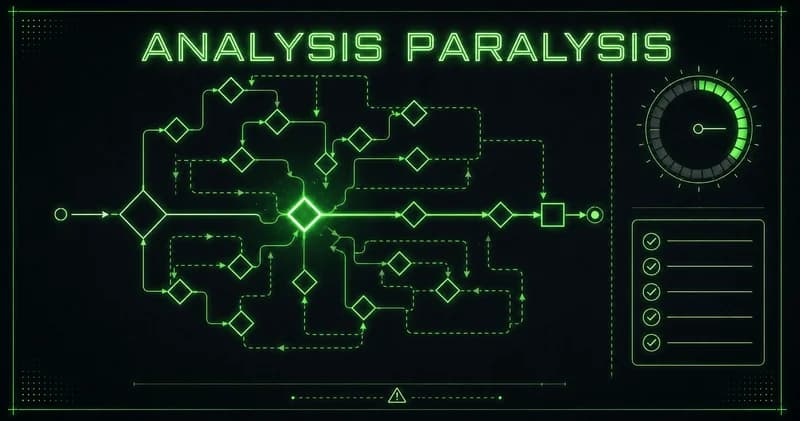
Analysis paralysis in trading looks responsible from the outside. The trader is studying more, checking more, and waiting for confirmation. The problem is that the valid setup often passes while the trader is still trying to remove uncertainty that cannot be removed.
Overthinking Is Still An Execution Error
Over-analysis sits on the other side of impulsive trading, yet it can still damage results. Instead of entering too fast, the trader delays until the opportunity is gone.
The source gives a simple example. A setup matches the criteria, but the trader checks one more indicator, then the news calendar, then a higher timeframe, then waits for more confirmation. By the time the process ends, the trade has moved 2R without participation.
The symptoms are easy to recognize:
Searching for confirmation after the setup already qualifies
Waiting for a better entry that never appears
Getting the direction right but not taking the trade
Entering late after the favorable risk has passed
Changing systems because no approach feels certain enough
This is still an execution problem. The trader may feel cautious, but the result is inconsistent participation. If a strategy has positive expectancy, valid setups need to be taken for the edge to express itself.
More Information Can Create Less Clarity
Modern traders have more data than they can process. Economic calendars, sentiment tools, volume profiles, order flow, social media, analyst notes, and indicators are all available at once. More information feels safer, but it does not always improve decisions.
Beyond a certain point, each additional input adds noise. One indicator supports the trade. Another disagrees. A headline creates doubt. A higher timeframe looks less clean. The trader now has more information but less conviction.
The source frames this as the paradox of information. Decision quality can deteriorate when the trader keeps adding data after the required decision inputs are already present.
Consistent traders solve this by defining sufficiency. They decide in advance what information is enough. Then they ignore the rest during execution. That is not carelessness. It is process discipline.
The Fear Is Usually Being Wrong
Analysis paralysis often presents itself as prudence, but underneath it is usually fear of being wrong. A trade forces the trader to make a probabilistic statement and accept the possibility of loss. Avoiding the decision avoids the immediate pain of being proven wrong.
Perfectionism feeds the same pattern. Some traders want a setup with no conflict, no uncertainty, and no uncomfortable invalidation. That setup does not exist. Trading is probability under incomplete information.
Ambiguity aversion also plays a role. Humans prefer known risks to unknown risks. A coin flip can feel easier than a situation where the odds are unclear. Markets rarely offer exact odds, so research can turn into emotional shelter. The trader may feel safer, even when the added inputs bring no useful edge.
Overcorrection is another cause. A trader who was once too impulsive may decide to slow down. That correction is healthy. It becomes harmful when “think more” turns into “never act until certainty appears.”
Missed Trades Are Part Of Performance
The cost of analysis paralysis is harder to see than the cost of a losing trade. A skipped setup does not print a red number in the account. That invisibility allows the problem to persist.
But missed trades still have expected value. If the setup belongs to a positive-expectancy strategy, repeatedly skipping it changes the live results. The trader is no longer trading the tested system. They are trading a filtered version shaped by hesitation.
That can erode confidence in the strategy. A trader may conclude the system does not work because live results lag the backtest, when the real problem is selective execution.
The psychological cost also matters. Watching a trade reach target without participation can trigger the next emotional mistake. A trader who missed the clean setup may chase the next one, creating a swing from overcaution to FOMO.
A Binary Checklist Removes Debate
The best defense is a clear checklist with 3-5 objective criteria. The criteria need to be objective enough for another trader to inspect the same chart and make the same call.
The source gives an example:
Price is above the 20 EMA
RSI is above 50 but below 70
Volume is above average
A clear support level sits within 2%
If all criteria are met, the trade qualifies. If one is missing, it does not. The checklist does not guarantee a winner. It removes subjective debate at the point of execution.
Time limits add another layer. Give the setup two minutes or five minutes, depending on the style. When the timer ends, decide: execute or pass. No extra deliberation after the limit.
Preparation should also be separated from execution. Do the analysis before the market opens. Build the watchlist, define the levels, and set the conditions. During market hours, the job is narrower: did the setup trigger or not?
Missed-Trade Logs Make Hesitation Measurable
A watched-but-not-traded log is essential. Record the setup, why it was skipped, and what happened afterward. Review the log weekly.
After a month, calculate the hesitation cost. The source notes that many traders find this number larger than expected. The purpose is not to punish every skipped trade. Some passes are correct. The purpose is to separate useful caution from expensive avoidance.
For trades that are taken, review entry timing. If entries are consistently late relative to the planned level, the issue may not be strategy selection. It may be decision delay.
Tag setup quality as well. If A+ setups and B setups produce similar results, the trader may be over-filtering. The extra selectivity may not be adding edge.
Position size can be used as a training tool. If normal size makes execution feel too heavy, trade smaller. The source gives a useful contrast: a 10-share trade actually taken can teach more than a 1,000-share trade imagined but never executed. Execution confidence is built by participating within controlled risk.
A trader can lose 45% of trades and still be profitable if winners are larger than losers. That is the core mindset shift. The goal is not to be certain on one trade. The goal is to execute the edge across many trades.
Execution Needs A Defined Enough Standard
The standard cannot be perfect information. It has to be enough information. A trader should know the minimum evidence required before the session starts: structure, trigger, risk, and invalidation. Anything beyond that must prove it adds edge, not comfort.
This is where many overthinkers get trapped. They believe another input will remove doubt, but it often creates a new objection. The process should define which objections matter. If the planned criteria are met and risk is acceptable, the decision should move from analysis to execution.
When this does not work, the checklist is usually too vague. Terms like “strong trend” or “clean setup” leave room for hesitation. The criteria need to be observable enough that they reduce interpretation under pressure.
FAQs
What does analysis paralysis mean for traders? It means a qualified setup is delayed, skipped, or entered late because the trader keeps searching for more certainty. It usually comes from searching for certainty that trading cannot provide.
What are the warning signs? Common signs include being right about direction without entering, adding indicators for comfort, arriving late, changing systems repeatedly, and watching valid setups hit targets from the sidelines.
How can I measure the cost? Keep a missed-trade log. Record the setup, the reason for passing, and what happened afterward. Review the data monthly to see whether hesitation protected you or cost expected value.
How should analysis connect to execution? Define a 3-5 point checklist, use a hard timer, separate pre-market planning from live execution, and accept that uncertainty remains even in good trades.
Analysis is useful only when it supports execution. Once the required conditions are present, the trader has to act or pass. Staying in the middle is not discipline. It is delayed decision-making, and delayed decisions have a cost.
Worth the read?