Perceived Risk in the Market — What It Costs Traders
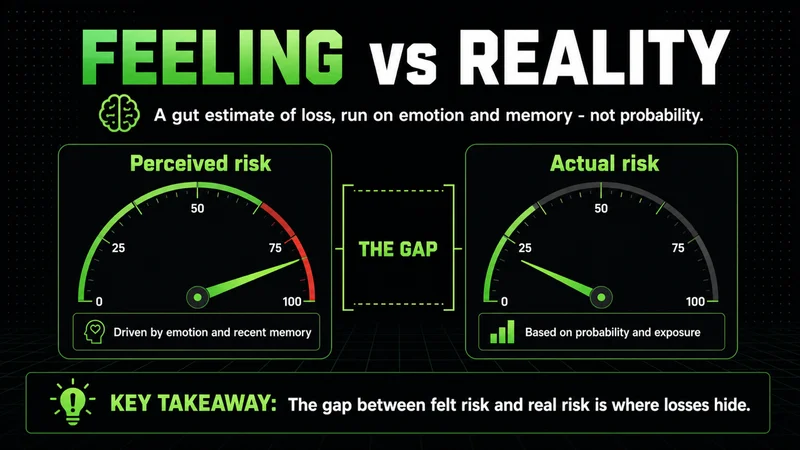
Perceived risk is how risky an investment feels, not how risky it actually is. The gap between that feeling and the real exposure is where losses hide.
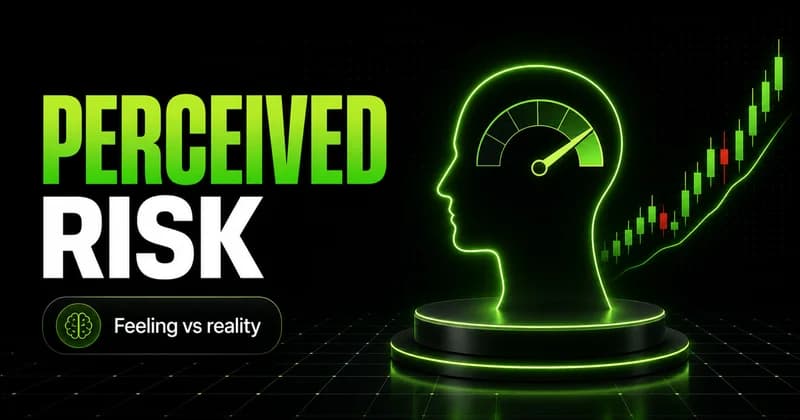
Perceived risk is how risky an investment feels, not how risky it actually is. It is a subjective read shaped by fear, recent outcomes, and whatever story is dominating the market that week. The number on the screen does not change. The way participants feel about that number does, and that gap is where most of the damage and most of the opportunity live.
Most investors treat the feeling as if it were the fact. They size positions against the fear instead of against the structure, and the fear is loudest at exactly the wrong moments. Understanding perceived risk is less about psychology trivia and more about knowing when the crowd's read of danger has drifted away from what the position actually exposes you to.
What perceived risk really means
Perceived risk is the subjective estimate of potential loss attached to a decision. The perceived risk meaning, stripped down, is simple: it is your brain's shortcut for "how much could this hurt me." That shortcut runs on emotion and memory, not on a probability table.
Two people can look at the same chart, the same balance sheet, and the same volatility reading, and walk away with completely different levels of fear. One was holding through the last drawdown and feels the position is dangerous. The other missed that move entirely and feels nothing. The asset is identical. The perception is not.
This matters because perception, not calculation, sets the price most of the time. Buyers and sellers transact based on how risky something feels to them at that moment. When the feeling is extreme, price moves further than the underlying facts justify, in both directions.
How perceived risk and actual risk pull apart
Actual risk is what the position can actually do to your capital. It is grounded in exposure, position size, volatility, and the conditions that would invalidate the trade. Perceived risk versus actual risk is the difference between the story you are telling yourself and the math sitting underneath the position.
The two track together most of the time, which is why the gap is easy to ignore. Then a shock arrives and they separate violently. After a sharp selloff, perceived risk spikes while actual forward risk often falls, because the weak holders have already sold and the price now sits below where the facts say it should. Near the top of a long, quiet uptrend, perceived risk collapses while actual risk climbs, because positioning is crowded and exposure has been quietly building behind the calm.
The mechanism behind this is not mysterious. Fear is recency-weighted. The most recent outcome carries far more emotional weight than the base rate, so a single bad session can reset a participant's entire read of an asset they have held for years. Comfort works the same way in reverse. A long stretch of green sessions trains the brain to expect more of the same, and that expectation shows up as larger size, wider stops, and a quiet willingness to hold through warnings that would have triggered an exit a month earlier.
Perceived risk vs actual risk explained in one line: you get paid for taking risk that people believe is dangerous, not for taking risk that genuinely is. The market discounts what everyone already fears. It does not discount what nobody is looking at.
That is also where the trap lives. Low perceived risk feels like safety. It is usually the opposite. The quiet, comfortable, everyone-agrees environment is where positions are largest and stops are loosest, which is precisely the setup for an outsized loss. The danger is not that the crowd is wrong about the direction. The danger is that the crowd is so confident it has stopped pricing in the possibility of being wrong at all.
Where perceived risk shows up in price
Perceived risk has a direct market impact because it moves the marginal buyer and seller. When fear rises, participants demand a larger discount to hold an asset, so price drops faster than any change in fundamentals would explain. When fear fades, they accept a thinner margin of safety, and price grinds higher on optimism alone.
The perceived risk stock market effect is most visible around liquidity and news. Watch how price behaves after a sweep of an obvious level. The sweep itself is rarely the signal. The reaction is. If price takes out the prior low and then reclaims it with acceptance, the perceived risk that drove the flush was not matched by real selling pressure underneath. The fear was the trade, not the fundamentals.
Intraday, this drift between feeling and fact is constant. A volatility spike makes everything look dangerous for a few minutes. Spreads widen, size thins out, and the screen feels hostile. The first move after major news is often the worst read of risk available, because it is pure reaction before structure has had time to form. Waiting for the second move, the one that shows whether the level held, usually tells you more about actual risk than the initial flush ever could.
On instruments like NQ, this plays out fast and without mercy. Nasdaq futures will sweep liquidity below an obvious low, trigger every stop that was sitting there, and reclaim the level inside a few minutes. In that window perceived risk is at its peak. Every screen says danger. The participants who sold did so because the move felt like the start of something, not because the structure underneath had changed. The ones who waited for acceptance, or rejection, of the reclaimed level got a far cleaner read of what the position actually exposed them to. The feeling was loud. The information arrived a beat later.
You do not get paid for being right about the fundamentals. You get paid for being positioned when perception catches up to them.
A perceived risk example most investors recognize
A clean perceived risk example for investors is a stock that has just reported solid earnings but trades in a sector everyone has decided to hate. The numbers are fine. The forward outlook is reasonable. Yet the price sits well below where comparable businesses trade, because the sector carries a story of danger that no longer matches the individual position.
Here perceived risk is greater than actual risk. The fear is real, but it is attached to the group, not the specific company. An investor who can separate the two is buying a margin of safety that the crowd is handing over for free, simply because the headline feels uncomfortable to own.
The reverse happens just as often. A name everyone loves, in a sector everyone trusts, trading at a price that assumes nothing goes wrong. Perceived risk is near zero. Actual risk is high, because any disappointment removes the only thing holding the price up, which is confidence. Perceived risk for investors is most dangerous precisely when it feels least present.
The useful skill is not predicting which way the perception breaks. It is noticing when perception and fact have separated far enough that the position is priced for a story rather than for its exposure. That separation does not tell you the timing. It tells you the asymmetry. When perceived risk is high and actual risk is contained, the downside is mostly already in the price, and the upside is whatever recovery the facts eventually justify. When perceived risk is low and actual risk is high, that asymmetry runs the other way, and it runs against you.
How traders actually use perceived risk
Traders do not try to predict where fear goes next. That is a losing game. Instead, they read the gap between perceived and actual risk and let it inform sizing and timing.
How traders use perceived risk in practice comes down to a few habits:
- Treat extreme fear as information about positioning, not as a reason to act. When perceived risk is highest, the weak hands are usually already out.
- Size against actual exposure, never against the feeling. The position that scares you is not automatically the dangerous one; the comfortable position often is.
- Use defined invalidation so the trade does not depend on a guess about sentiment. If price reclaims the level, the perceived-risk read was wrong, and you are out for a small, known cost.
- Wait for structure to confirm before fading a fear-driven move. Reactive beats predictive here. The first reaction lies more often than the second.
This is the practitioner's edge: the feeling is loudest at turning points, and turning points are where sizing mistakes are most expensive. Most blown accounts do not come from bad analysis. They come from oversized positions taken when perceived risk felt low and actual risk was high. Risk management matters more than the entry, and perceived risk is the variable that quietly corrupts risk management when nobody is watching it.
Where the perceived risk lens breaks down
Perceived risk is a lens, not a law, and it has real limitations. The most important one: low perceived risk does not always mean the crowd is wrong. Sometimes the thing that feels safe is actually safe, and sometimes the thing that feels dangerous deserves the fear.
This framework reads cleanly when liquidity is normal and the move is sentiment-driven. It inverts when the danger is structural rather than emotional. A company heading toward insolvency, a position facing a genuine regime change, or a market repricing a real shift in rates is not a case of perception drifting from fact. The fact moved. Treating that as a sentiment overreaction, and buying the fear, is how a perceived-risk strategy turns into catching a falling knife.
The other limitation is timing. Even when perceived risk is clearly stretched, the gap can stay open far longer than a position can survive. Fear can deepen for weeks before it reverses. Reading the gap correctly and sizing it wrong still ends the account. The lens tells you where the asymmetry sits. It does not tell you when it pays out, which is why defined risk and patience are not optional add-ons to this approach. They are the approach.
There is also a measurement problem worth naming. Perceived risk is not something you can read off a single number. Implied volatility, sentiment surveys, and positioning data all hint at it, but each one is noisy, and a crowd that looks fearful by one measure can look complacent by another. Anyone who claims a clean, repeatable signal for the gap between feeling and fact is selling certainty that the market does not offer. The honest version of this work is reading several imperfect signals together, holding the read loosely, and letting price action confirm or reject it before committing size. Treating a rough estimate as a precise edge is its own kind of overconfidence, and the market charges for that just as readily as it charges for fear.
A perceived risk checklist before you size a position
A simple perceived risk checklist for market analysis keeps the feeling from setting the size. Run it before committing capital, not after:
- Name the feeling. Does this position feel risky or safe right now, and why? Write down the story driving that feeling.
- Separate the story from the structure. Is the fear attached to this specific position, or to a group, a headline, or a recent loss of your own?
- Measure actual exposure. What does this position do to your capital if the invalidation level breaks? That number is the real risk, regardless of the feeling.
- Check positioning. If everyone already fears this, the selling may be done. If nobody fears it, the danger is probably hidden.
- Define invalidation before entry. Decide what price action proves the perceived-risk read wrong, and accept that cost in advance.
- Confirm structure before acting on a fear-driven move. Wait for the reaction, not the spike.
The checklist is not there to make you fearless. It is there to make sure the size on the position reflects what the position can actually do, not how the screen happens to feel that afternoon. Run it consistently and the feeling stops driving the decision, which is the entire point. Perception will always be part of trading. It only becomes a problem when it sets the size without anyone checking the math underneath.
FAQs
What is perceived risk in simple terms? It is how risky an investment feels rather than how risky it actually is. The feeling is shaped by fear, recent outcomes, and the dominant market story, so it often drifts away from the real exposure a position carries.
What is the difference between perceived risk and actual risk? Perceived risk is the subjective sense of danger. Actual risk is what the position can genuinely do to your capital, measured through exposure, sizing, and the level that invalidates the trade. They track together until a shock pulls them apart.
How does perceived risk affect stock prices? It moves the marginal buyer and seller. When fear rises, participants demand a deeper discount and price falls faster than fundamentals justify. When fear fades, they accept a thinner margin and price drifts higher on confidence alone.
Why does perceived risk matter for investors? Because price is set by perception most of the time, the gap between feeling and fact is where margin of safety appears. Buying when perceived risk is greater than actual risk builds that margin in; ignoring the gap is how comfortable positions quietly become the largest losses.
Worth the read?