FOMO Trading Punishes Late Decisions
FOMO trading turns urgency into poor execution. Learn how to identify late, emotional entries and replace chasing with process-driven rules.
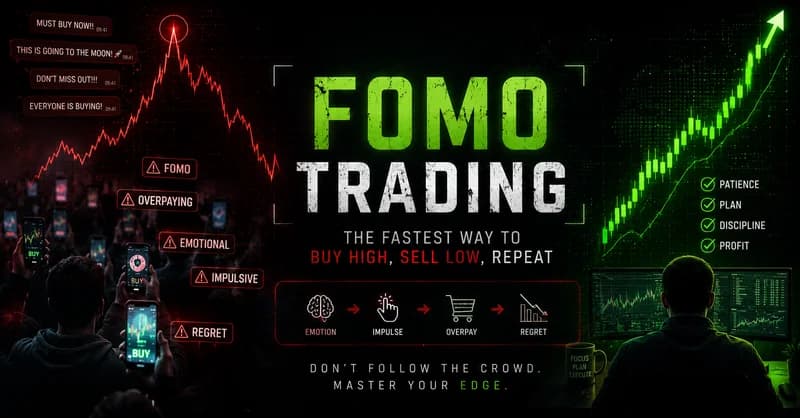
FOMO in trading is not a lack of information. It is a failure of execution under urgency. The trader sees price moving, imagines everyone else getting paid, and abandons the process that was supposed to protect the account.
FOMO Starts When Urgency Replaces Criteria
Fear of missing out shows up when a trader enters because movement is already visible, not because a planned setup has triggered. The trade may be a stock that is already up 15%, a pre-market gap that keeps extending, or a ticker being pushed across scanners and social feeds.
The common thread is urgency. The entry is no longer based on a defined plan. It is based on the discomfort of watching price move without participation.
Typical FOMO behavior includes:
Entering after the main displacement has already happened
Ignoring entry criteria because momentum feels too strong to miss
Increasing size to compensate for gains that were never booked
Trading instruments outside the normal playbook because they are trending
Leaving a prepared watchlist to chase the most active name on the screen
That is why FOMO is more than a timing problem. A late entry can still be valid when risk is defined and the setup fits the plan. A FOMO entry is different because the process has already been discarded.
A Reactive Trade Can Still Be Valid
Not every trade taken after movement begins is emotional. Markets move quickly, and some strategies require confirmation before entry. The distinction is not whether the trader was early. The distinction is whether the trader can explain the risk.
A reactive but valid entry still has structure. The setup meets the rules. Position size comes from the same formula used on other trades. The stop is known before the order is placed. The trader can describe why the reward still justifies the risk.
An emotional chase has no such structure. The trader is trying to relieve regret before it arrives. The size is often tied to the feeling of being late. The stop is vague or missing. The exit plan depends on price continuing immediately.
This is where many traders confuse momentum with opportunity. Momentum can create opportunity, but only when the entry still has defined invalidation. Chasing a move because it is visible on social media is not the same as executing a breakout plan.
Social Proof Makes Bad Entries Feel Rational
FOMO gets stronger when the information environment is noisy. Twitter, Discord, chat rooms, and trading communities show winners in real time. They rarely show the 10 losses that came before the screenshot.
That creates survivorship bias. Seeing 20 traders post gains on a ticker can make it feel as if the whole market is profiting without you. In reality, you are seeing a filtered sample of people who happened to be on the right side of that move.
Recency bias adds pressure. A stock that has closed green for five straight days can feel as if continuation is obvious, even when the edge has not improved. Kahneman and Tversky's work on the availability heuristic explains why recent, vivid events feel more probable than they are. Yesterday's 10% move becomes the mental anchor for tomorrow's expectation.
Loss aversion also plays a role. The source article notes that the pain of missing a possible $5,000 gain can feel similar to losing $5,000. That emotional symmetry is dangerous. It can make an unplanned trade feel like damage control even though the trader has not lost anything yet.
The Damage Shows Up In Execution Quality
The cost of fear-of-missing-out behavior is measurable because it changes the trade before it begins. Barber and Odean's 2000 research found a 6.5% annual performance gap for the highest-activity traders compared with passive investors. Excess activity is not always FOMO, but FOMO is one of the emotional patterns that pushes traders into unnecessary activity.
Odean's 1998 work also found that closing profitable positions happened 1.5 times as often as closing losing positions. Kahneman and Tversky's 1979 research showed that losses are felt about twice as strongly as equivalent gains. Those findings matter because FOMO often enters through the same emotional doorway: avoiding the pain of being left behind.
FOMO trades usually perform poorly for four practical reasons:
The entry is worse because the trader arrives after the favorable risk has already changed
The stop is weaker because the trade was not planned before execution
The exit becomes emotional because there is no clear thesis to manage against
The size gets distorted because the trader wants to recover the part of the move already missed
This is why a strong move can still be a low-quality trade. Price can keep going and the decision can still be poor. Execution quality is judged by process, risk, and repeatability, not by whether one chase happened to work.
Data Reduces The Pull To Chase
FOMO weakens when it becomes visible in the journal. Tag every trade that was unplanned, chased, or entered without a predefined stop. Then review the last three months and isolate that group.
The important number is not how many FOMO trades happened. The important number is the expectancy of those trades. Many traders find that the emotional entries have negative expectancy and pull down the account even when the rest of the strategy is sound.
A simple tag group can separate entry quality:
Planned: the trade was on the watchlist with criteria defined before entry
Reactive: the trade developed during the session but still fit the strategy
FOMO: the trade was taken because price was moving and the trader did not want to miss it
Impulsive: the trade had no clear thesis or risk plan
Compare win rate, average R-multiple, hold time, and time of day for each tag. FOMO often clusters near the open, after major news, or when a watched ticker runs without the trader.
The source article gives one tagged-review example where fear-of-missing-out trades produced a $6,888 monthly drag. The specific amount will vary by account, but the lesson is stable: emotional entries become easier to control when their actual cost is visible.
Prevention Requires Friction Before The Click
The cleanest FOMO rule is a delay. If a trade was not on the pre-market watchlist, require a five-minute pause before entry. FOMO depends on immediacy. Even a short pause gives the trader enough distance to check risk, structure, and sizing.
A watch-but-do-not-trade list also helps. When the urge appears, log the ticker, the price, and the reason it feels urgent. Track what would have happened without taking the trade. After a few weeks, the list becomes an evidence file. Many setups that felt impossible to miss either fail, pull back, or never offer the entry price the trader imagined.
Information control matters too. If social media triggers FOMO, reduce exposure during market hours. Mute accounts that post only wins. Close trading chats while positions are active. There is no edge in letting someone else's highlight reel set your execution tempo.
Reviewing winners is another practical reset. Pull the best trades from the past month and ask how many were FOMO entries. For most traders, the answer is close to none. The edge usually came from preparation, patience, and risk-defined execution.
The market rewards patience far more than activity. Missing one trade has no material effect on long-term performance. Repeatedly abandoning process does.
Cash Can Be A Deliberate Position
One of the harder parts of FOMO is accepting that unused buying power is not wasted capital. The source makes this point directly: cash can be a strategic choice. A trader who stays flat during low-quality conditions is still making a decision.
That distinction matters during fast markets. A stock can gap 5% before the open and add another 10% in the first hour. By the time the move is visible to everyone, the best risk-reward may already be gone. Sitting out at that point is not weakness. It is recognition that opportunity and trade quality are not the same thing.
FAQs
What does FOMO mean for traders? It means the trader is entering mainly to avoid the discomfort of watching price move without them. It usually leads to late entries, weak risk planning, and trades outside the normal strategy.
How can I tell if a trade is FOMO? Check whether the trade was planned, whether the stop was defined before entry, and whether the size came from your normal formula. If the main reason for entry is urgency, regret, or comparison, the trade is probably FOMO.
Why do FOMO trades often lose money? They usually start from poor locations, skip proper stop planning, and rely on continued momentum. When price pulls back normally, the trader has no clear management plan and often exits emotionally.
How do I reduce FOMO? Tag FOMO trades, use a five-minute delay on unplanned setups, keep a watch-but-do-not-trade list, and limit social media during market hours. The goal is to add friction before urgency becomes execution.
FOMO is not solved by promising to be more disciplined. It is solved by forcing every urgent trade back through structure. If the setup still has defined risk after the pause, it can be considered. If it only works when entered immediately and emotionally, it was never a process-driven trade.
Worth the read?