Stop Limit Order — How the Fill Price Is Decided
A stop limit order controls your fill price but not whether you fill. Here is how the stop triggers, the limit decides, and liquidity has the last word.

Stop Limit Order — How the Fill Price Is Decided
A stop limit order is a conditional instruction with two prices: a stop price that activates the order and a limit price that sets the worst fill you will accept. When the market trades through your stop, the order does not hit the market as a market order. It becomes a resting limit order. That single detail decides everything about how, and whether, you get filled.
Most explanations stop at the definition. The part that actually matters is the trade-off you accept the moment you choose this order type. You are trading certainty of execution for control over price. In calm conditions that trade looks free. In fast conditions it is the difference between being in the trade and watching it leave without you.
What a stop limit order means in plain terms
The stop limit order meaning comes down to sequencing. There are two events, and they happen in order.
First, price reaches your stop. This is the trigger. Nothing has been bought or sold yet. The stop price is a switch, not an execution.
Second, the order converts into a limit order at your limit price. From that point it behaves like any limit order: it fills only at your limit or better, and it rests in the book until it does or until it expires.
The reason traders reach for this structure is control. A plain stop order triggers and then takes whatever the next available price is, which can be far from where you expected during a fast move. The stop limit order refuses to accept a price worse than the limit you set. That refusal is the feature. It is also the risk, and the two cannot be separated.
How stop limit order execution actually works
Walk through the mechanics on a sell stop limit, the version most traders use to exit a long position.
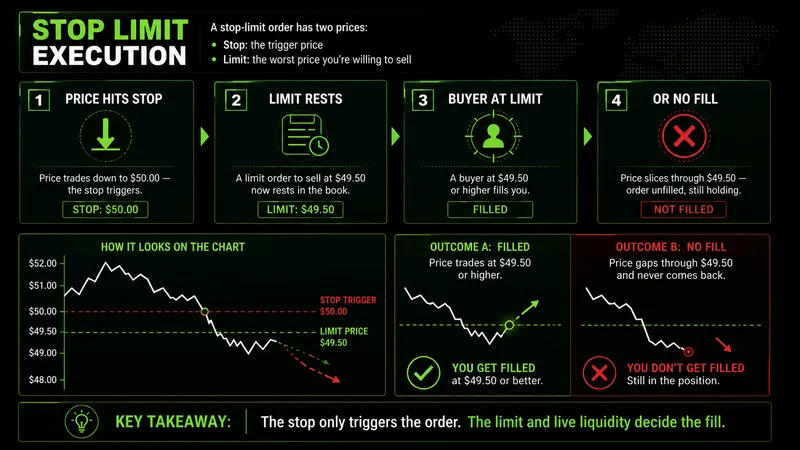
You hold a stock at 52. You want out if it breaks down, but you do not want to be dumped at any price during a flush. You set a stop at 50 and a limit at 49.50. Here is the sequence:
Price trades down to 50. The stop triggers.
A limit order to sell at 49.50 is now resting in the book.
If a buyer is available at 49.50 or higher, you fill.
If price slices through 49.50 before any buyer meets you there, the order sits unfilled and you are still holding the position.
That last line is where stop limit order execution diverges from every other exit. A stop market order would have you out somewhere below 50, price uncertain. The stop limit order protects you from a terrible fill and exposes you to no fill at all. You chose which risk you wanted when you set the limit.
The buy side mirrors this. A buy stop limit triggers above the current price, usually to enter on a breakout, and will not pay more than your limit. If the breakout runs away from the limit, you stay flat. You avoided chasing, and you also missed the move. Both outcomes are the order doing exactly what you told it to.
A stop limit order example worth keeping
A concrete stop limit order example makes the fill logic stick. Take a position bought at 100 with a clear invalidation under a prior swing low at 94.
You set the stop at 94 and a limit at 93. Two scenarios play out.
In an orderly decline, price grinds from 96 to 95 to 94. The stop triggers, and there is still resting liquidity between 94 and 93. You fill near 93.80. The structure broke, you got out close to plan, and the limit never had to defend you because the move was slow enough to find buyers.
In a violent decline, price gaps from 95 to 91 on a single print. The stop triggers at 94, but the next available buyers are sitting at 90. Your limit at 93 will not sell down there. The order rests, price keeps falling, and your protective exit never executed. You are now holding a loser that is larger than the one you planned for.
That second scenario is the entire lesson. The limit that protects your fill price in normal conditions is the same limit that abandons you in the conditions you most wanted protection from.
How the stop limit order fill price is set
The stop limit order fill price is never the stop price. The stop only triggers. Price discovery happens at the limit, against whatever liquidity is resting in the book at that moment.
Three things decide where, and whether, you fill:
The gap between your stop and your limit. A tight gap protects price tightly and fills rarely in fast moves. A wide gap fills more often but gives back more of the protection you wanted.
Available liquidity at and beyond the limit. Thin books skip levels. A limit that looks reasonable on a liquid name can be unreachable on a thin one.
Speed of the move through your zone. Slow moves leave resting orders to interact with. Displacement prints through levels before the book can refill.
This is why a fixed tick gap is a weak default. The correct offset is a function of how the specific instrument moves. On a deep, liquid name in regular hours, a tight limit is fine because the book refills quickly. On a thin name, or overnight, the same tight limit is a near-guarantee of a missed fill. Execution quality comes from matching the offset to the conditions, not from a habit.
Stop limit order vs stop order — the trade-off in one decision
The stop limit order vs stop order choice is the cleanest way to understand both. They share a trigger. They differ entirely in what happens after.
Stop order (stop market): triggers, then fills at the next available price. Execution is effectively guaranteed. Price is not. You will get out, but a fast move can fill you well past your stop.
Stop limit order: triggers, then rests as a limit. Price is controlled. Execution is not. You will never fill worse than your limit, and in a fast move you may not fill at all.
There is no universally correct answer. The decision depends on what you are protecting against.
If the position is small relative to the account and the priority is being out no matter what, the stop order is the honest choice. If the position is on a liquid instrument during active hours and a bad slippage fill would do real damage, the stop limit order earns its place. Choosing the order type without naming which risk you are accepting is how traders end up surprised by the behavior they explicitly requested.
Stop limit order slippage risk and the non-fill that replaces it
People reach for a stop limit order to control slippage risk. It does, partially, and it swaps it for a different exposure that is easy to underestimate.
A stop order's slippage is visible and bounded by reality: you get filled, just at a worse price. A stop limit order's failure mode is a non-fill, and a non-fill on a protective exit is open-ended. The position you meant to close is still on, and it keeps moving against you with no order standing in front of it.
This is the part most beginners miss. They believe they removed risk by adding the limit. They moved it. The slippage risk became a fill risk, and during the exact volatility events where protection matters most, fill risk is the more dangerous of the two. What fills the order is the liquidity resting at your limit, not the care you took setting it, and a thin book during a flush has none to offer.
When traders should use a stop limit order
The use case for a stop limit order is narrower than its popularity suggests. It fits specific conditions and fails outside them.
It belongs when:
You trade a liquid instrument where the book refills fast enough to meet a reasonable limit.
You are in regular trading hours, not the thin liquidity of pre-market or overnight.
A bad slippage fill would cause more damage than a missed fill, and you have a manual plan for the missed-fill case.
It does not belong when:
The instrument is thin or the session is illiquid, where a triggered limit may never fill.
The position is your hard protective stop and being out matters more than the exit price. A protective stop that can fail to execute is not protection.
You will not be watching and cannot intervene if the limit goes unfilled.
This is the honest boundary. The stop limit order is an execution tool for liquid, attended conditions. As an unattended disaster brake on a thin name, it can quietly fail at the worst moment. No order type works in all conditions, and pretending otherwise is how the tool gets misused.
Common stop limit order mistakes and how to avoid them
The recurring stop limit order mistakes are not about the definition. They come from treating the order as a guarantee it never offered.
Using it as a hard protective stop on a thin name. During a gap the limit goes unfilled and the protection you counted on simply is not there.
Setting the limit too tight out of habit. A one-tick gap looks precise and skips constantly in fast moves. The offset should reflect how the instrument actually trades.
Assuming the fill price will be near the stop. The stop only triggers. The fill happens at the limit against live liquidity, which can be far away.
Leaving it unattended overnight. Conditions that produce gaps are exactly when a limit fails to fill, and you are asleep while it happens.
Confusing it with a stop order. Many traders set a stop limit order believing it behaves like a stop market order, then are stunned by a non-fill they explicitly requested.
The fix for all five is the same: decide in advance which risk you are accepting, slippage or non-fill, and choose the order type that matches. Trading without that context is gambling with better vocabulary.
How a stop limit order affects your overall trading risk
A stop limit order does not reduce risk on its own. It reshapes it. The protection it adds to your fill price is paid for with exposure to a non-fill, and where that exposure lands depends entirely on conditions you do not control.
In high-probability conditions — liquid name, active session, orderly move — the reshaping favors you. You get a clean, price-controlled fill and the non-fill scenario never materializes. In low-quality conditions — thin liquidity, gaps, displacement — the reshaping works against you, and the order can leave a position unmanaged precisely when management mattered most.
That is the whole framework for new traders to carry: the order is only as reliable as the liquidity behind your limit. Capital preservation comes from understanding that dependency before you place the order, not from discovering it during a flush.
What to keep from all of this
A stop limit order gives you control over price and takes away certainty of execution. The stop triggers, the limit decides the fill, and live liquidity decides whether the limit is ever met. None of that is a flaw to engineer around. It is the trade you agreed to.
The order earns its place on liquid instruments, in active hours, when a bad slippage fill would hurt more than a missed one and you are present to handle the miss. It becomes a liability as an unattended protective stop on a thin name, where a gap can leave it unfilled and your position exposed.
Decide which risk you are accepting before you set the two prices. Match the limit offset to how the instrument actually moves. Treat the order as a precision tool for the conditions it suits, not a guarantee for the conditions it does not. That is the difference between using a stop limit order and being surprised by one.
Worth the read?