Trendline Trading and Gap Formation Explained
Trendline trading and gap formation become useful when structure, confirmed closes, acceptance, and defined invalidation guide every decision.

Trendline trading is not about buying or selling because price touched a diagonal line. The line defines context. The trade comes from the reaction around it, a confirmed candle close, and an invalidation level that proves the idea wrong. Gaps follow the same logic: location and subsequent acceptance matter more than the empty space itself.
That distinction keeps technical analysis practical. A trendline can frame a retracement, while a gap can show a change in pressure or continuation of an existing move. Neither should be treated as a signal in isolation.
Trendline trading begins with market structure
A downtrend line connects meaningful lower highs. An uptrend line connects meaningful higher lows. The selected swings should belong to the same visible structure. Forcing a line through unrelated pivots may make the chart look organized, but it does not create a tradable condition.
Two respected contacts can establish a working line. A third reaction can add evidence, provided price reaches the area without already breaking the underlying sequence of highs and lows. The line is best viewed as a zone because markets rarely turn at one exact price.
The slope also matters. An extremely steep line often describes short-term momentum rather than durable structure. It can break even while the broader trend remains intact. A more gradual line tied to clear swings usually carries better context, but confirmation is still required.
MRPNL principle: A line provides context; the close and the reaction determine whether the idea is valid.
Trendline entries require rejection or breakout confirmation
A trend-following entry and a breakout entry express different ideas. In a downtrend, the trend-following case waits for a retracement into the descending line and then looks for rejection. The breakout case waits for price to close above that line and show that sellers no longer control the same structure.
For a trend-following short, rejection should be visible through the candle body, follow-through, or failure to hold above the line. A wick through the line is not sufficient by itself. The invalidation belongs beyond the rejected swing because a sustained move above that point contradicts the lower-high premise. A prior swing low can provide a logical target, although the distance must still justify the risk.
For a breakout long, wait for at least one completed candle to close above the descending line. Stronger confirmation may include a retest that holds, a higher low, or clean displacement away from the break. Invalidation sits below the failed retest or the structure that should now act as support. If price closes back below the line and cannot recover, the breakout premise has failed.
The same reasoning reverses in an uptrend. A trend-following long needs rejection from rising support. A bearish breakout needs a close below the trendline, followed by acceptance beneath it. In both directions, the setup is defined by behavior around structure rather than by contact with the line alone.
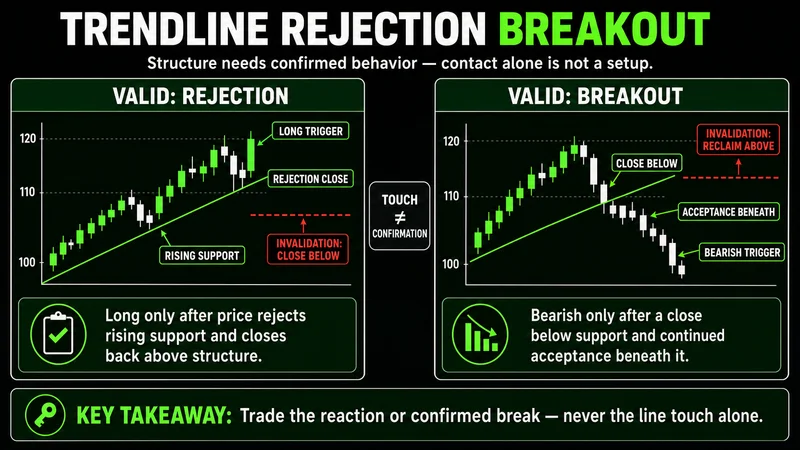 A trendline touch is context; the completed close determines the setup.
Gap formation must be read in context
A gap forms when one trading period opens away from the prior period’s range, leaving an area with little or no overlapping price activity. The useful question is not whether every gap will fill. It is where the gap appeared, what structure it crossed, and whether price accepted beyond that structure.
A breakaway gap forms as price leaves a base or clears a major support or resistance level. In an uptrend case, price gaps above resistance and then holds above the former ceiling. In a downtrend case, price gaps below support and remains beneath the former floor. A confirming candle and stronger participation add weight, but the decisive evidence is continued acceptance beyond the broken level.
A continuation gap develops during an established trend. In a rising market, it may appear after the trend has already produced higher highs and higher lows. In a falling market, it may interrupt an existing sequence of lower highs and lower lows. It suggests that momentum may extend, but it is not automatically a new entry. Chasing far from a defined invalidation can turn a correct trend read into poor execution.
A runaway gap is the bullish continuation label shown during an existing uptrend. The management logic is more important than the name: protect the position beneath confirmed higher lows instead of assuming the gap will remain open indefinitely. In a downtrend, the corresponding continuation gap can be managed above confirmed lower highs.
An exhaustion gap appears late in an extended move. It may look like fresh strength at first, but reversal risk rises if the gap fills quickly and price closes back through nearby support or resistance. A bullish reversal after a mature decline needs confirmation before a bearish gap is faded. A bearish reversal after a mature advance needs the same discipline in reverse.
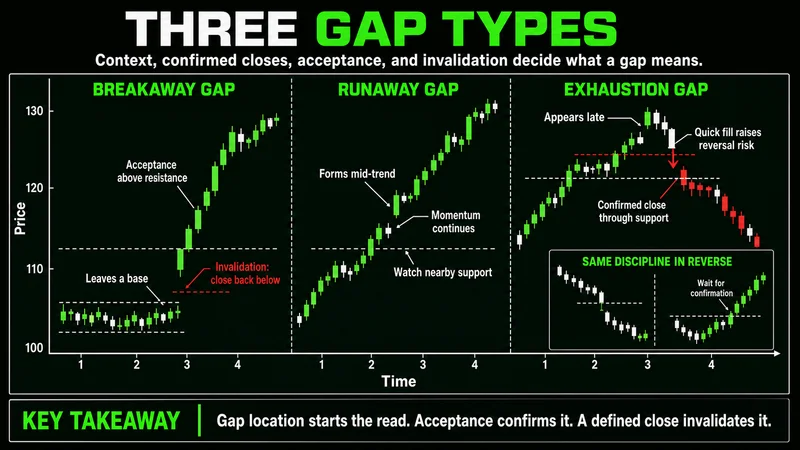 Gap location and subsequent acceptance determine the working classification.
Breakaway, continuation, and exhaustion gaps differ by location
The visual shape of a gap does not classify it reliably. Location within the trend provides the distinction.
| Gap type | Typical location | Confirmation | Defined invalidation |
|---|---|---|---|
| Breakaway | Beyond major support or resistance | Price closes and holds beyond the broken level | Return through the gap and acceptance back inside the prior structure |
| Continuation or runaway | Inside an established trend | Trend structure remains intact after the gap | Break of the swing structure used to manage the trend |
| Exhaustion | Late in an extended directional move | Gap fills and reversal structure develops | Recovery beyond the spike extreme that formed before reversal |
The labels should remain provisional while the move develops. What first appears to be continuation may become exhaustion if price fills the gap, loses the supporting swing, and accepts back inside the prior range. Classification improves as price supplies more evidence.
A concrete example combines trendline and gap confirmation
Assume price has formed three lower highs beneath a descending trendline. It retraces toward the line, trades slightly through it, and leaves an upper wick. Selling immediately would be premature because the candle has not confirmed rejection.
The candle then closes below the line, and the next candle fails to recover the rejected swing. A short can now be framed with invalidation above that swing and an initial target near the prior low. The risk is measurable before entry.
Now assume price instead closes firmly above the trendline. It retests the line from above, holds, and forms a higher low. The trend-following short is no longer valid. A breakout long becomes possible because both the diagonal line and the recent lower-high sequence have changed.
If that breakout also gaps above a well-defined resistance area, the gap may be classified as breakaway only while price holds above the former resistance. A fast gap fill and a close back below the level invalidate that interpretation. The same price feature can support one thesis and then disprove it when acceptance changes.
The common mistake is treating contact as confirmation
Most weak executions begin with anticipation. A trader sees price touch a trendline and enters before the candle closes. Another sees a gap and assumes continuation without checking whether the move is early, mature, or already extended.
A cleaner process separates observation from action:
- Identify the active swing structure before drawing the line.
- Mark the trendline as an area rather than an exact trigger.
- Wait for rejection, a confirmed close, or a hold after retest.
- Classify a gap by its location within the broader move.
- Define invalidation beyond the structure that supports the trade.
- Compare the available target distance with the required risk.
This sequence reduces reactive entries. It also makes review easier because every trade has a stated premise and a visible failure condition.
Practical application uses a confirmation checklist
Before acting, determine whether price is trending or ranging. Confirm that the trendline connects comparable swings. Then decide whether the setup is a rejection trade, a breakout trade, or a gap-based continuation or reversal idea. These are different trades and should not share vague risk rules.
For rejection trades, require a completed response away from the line. For breakout trades, require a close through the line and preferably evidence of acceptance or a successful retest. For gaps, mark the nearby support or resistance, identify the stage of the trend, and watch whether price holds beyond or returns through the gap.
The invalidation must follow the thesis. A rejection trade fails beyond the rejected swing. A breakout fails when price loses the breakout area and accepts back through the line. A breakaway gap fails when price returns inside the prior structure. An exhaustion reversal fails beyond the spike extreme if the anticipated reversal cannot hold.
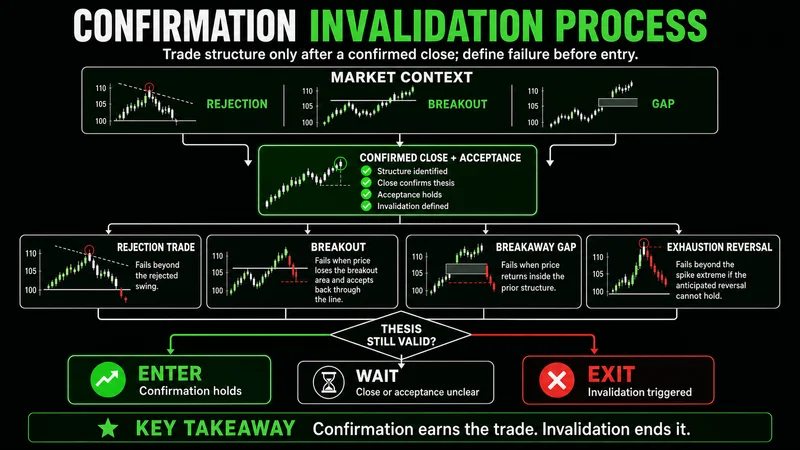 Classify the setup, wait for confirmation, and place invalidation where the premise fails.
When trendlines and gaps do not work cleanly
This framework loses quality in thin liquidity, unstable opening conditions, and range-bound price action. A trendline drawn inside a noisy range can produce repeated breaks with no meaningful structural change. Small gaps may also close quickly because they reflect temporary order imbalance rather than sustained directional pressure.
Steep trends create another problem. Price can break a steep trendline, consolidate, and then resume in the original direction without changing the broader swing structure. Treating every diagonal break as a reversal ignores the hierarchy between short-term momentum and the larger trend.
Major volatility expansions can also overwhelm normal confirmation. A candle may close beyond a line or level and reverse immediately as liquidity normalizes. Under those conditions, smaller risk, stronger acceptance criteria, or no trade may be the highest-quality decision.
Trendlines and gaps are useful because they organize price behavior. They are not decision-makers. Structure defines the context, confirmation controls the timing, and invalidation limits the cost of being wrong.
Worth the read?