How to Spot Climax Volume Before a Reversal
Learn how to spot climax volume before a reversal by reading trend maturity, abnormal participation, price response, and invalidation without guessing.
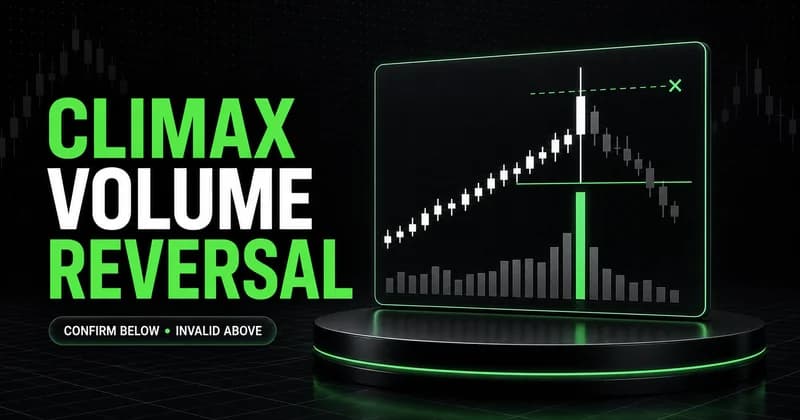
Knowing how to spot climax volume before a reversal starts with context, not the size of one volume bar. Climax volume is an abnormal surge after an extended move. It signals urgency and possible exhaustion, but the reversal case only becomes valid when price stops progressing and confirms rejection.
Volume measures participation. Price shows the result of that participation. Read together, they can separate a supported move from one that is losing conviction. Read in isolation, a large volume bar can be mistaken for either strength or weakness.
How to spot climax volume before a reversal
A useful climax-volume sequence has three parts: a mature trend, an exceptional burst of participation, and a weak price response after that burst. The order matters. High volume near the beginning of a move can confirm expansion. The same behavior after a long run can show that late buyers or sellers are spending their remaining urgency.
Watch the relationship between effort and result. Volume is the effort. Price progress is the result. If participation expands sharply but price gains little additional ground, stalls, or closes back inside the prior range, the market may be absorbing that effort rather than rewarding it.
The sequence is strongest when price has already traveled through several directional swings, the largest volume bar appears near the extreme, and the next candles fail to continue. A reversal is not confirmed by the spike itself. It is confirmed when price loses the structure that supported the trend and cannot reclaim it.
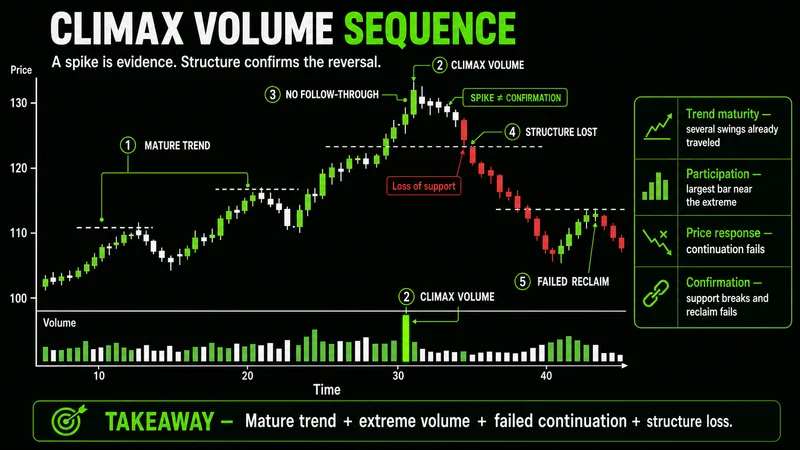 A volume spike becomes a reversal signal only after price loses structure.
A bullish trend offers a clean example. Price makes a sustained series of higher highs and higher lows. Near the top, one wide candle prints with the largest volume of the run. The next candles stop extending, trade below the climax candle’s midpoint, and then break the most recent higher low. That structure break converts an exhaustion warning into actionable confirmation.
The same logic applies in reverse during a decline. A heavy volume surge at the low can reflect capitulation, but buyers still need to create rejection and reclaim nearby structure. Without that response, the volume may represent aggressive continuation rather than exhaustion.
Breakout volume confirmation separates strength from failure
Volume should expand when price breaks a meaningful support or resistance level. A breakout accompanied by roughly twice the recent average volume shows that participation increased as price left the range. It does not guarantee continuation, but it gives the move more structural credibility.
Low-volume breaks deserve doubt. If price moves above resistance while participation contracts, there may not be enough demand to hold the new area. A quick return below the broken level invalidates the breakout and often traps traders who entered from price movement alone.
Compare two otherwise similar breaks. In the first, price clears resistance on quiet volume, stalls, and rolls back into the range. In the second, price clears the same type of level as volume expands well above average, then holds above resistance. The first lacks follow-through. The second shows acceptance and gives buyers a defined level to defend.
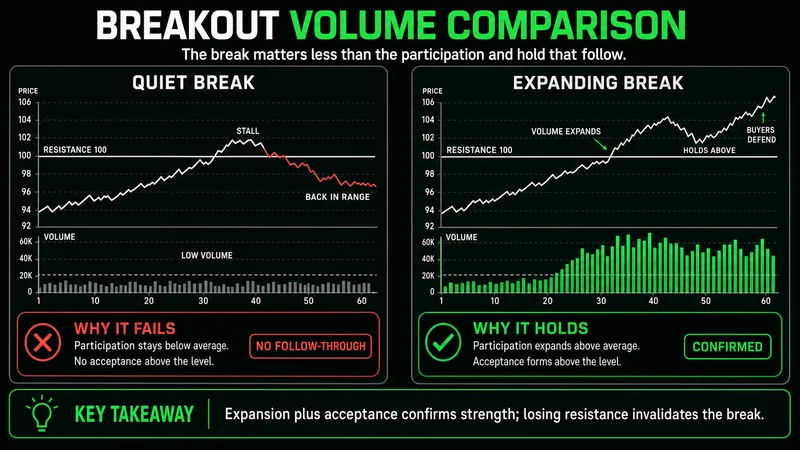 Low-volume breaks often fail, while expanding volume supports acceptance.
This is also why a large bar cannot be labeled climax volume without considering location. At resistance after a long advance, it may warn of exhaustion. At resistance after a tight base, it may confirm a new expansion phase. Trend maturity changes the meaning.
Falling volume can make a pullback constructive
A healthy pullback often develops on declining volume. Price gives back part of the prior advance, but participation fades as it moves against the trend. That behavior suggests the dominant side is resting rather than being displaced by aggressive opposition.
Confirmation arrives when volume returns with the trend. In an uptrend, a continuation candle should emerge from the pullback area with stronger participation. If volume instead expands while price falls through support, the quiet-rest interpretation is invalid. Sellers are no longer passive.
This distinction prevents a common error: treating every decline in volume as weakness. Falling volume during a directional breakout is a concern. Falling volume during a controlled countertrend pullback can be constructive. The location, direction, and price response decide which reading applies.
Price and volume divergence warns before structure breaks
Divergence appears when price makes higher highs while volume makes lower highs. The rally still looks strong on the chart, but each push is attracting less participation. Demand may be weakening beneath the surface.
Divergence is a warning, not an automatic exit or reversal entry. Price can continue higher on declining volume, especially when supply remains limited. The practical response is to tighten the decision process: stop chasing extensions, identify the nearest structural low, and wait for price to confirm the warning.
A bearish reversal case improves when declining volume accompanies successive price highs, a late volume spike fails to create meaningful progress, and price then breaks a recent higher low. If price holds structure and participation expands again on the next advance, the divergence thesis is invalidated.
Apply volume through a repeatable decision process
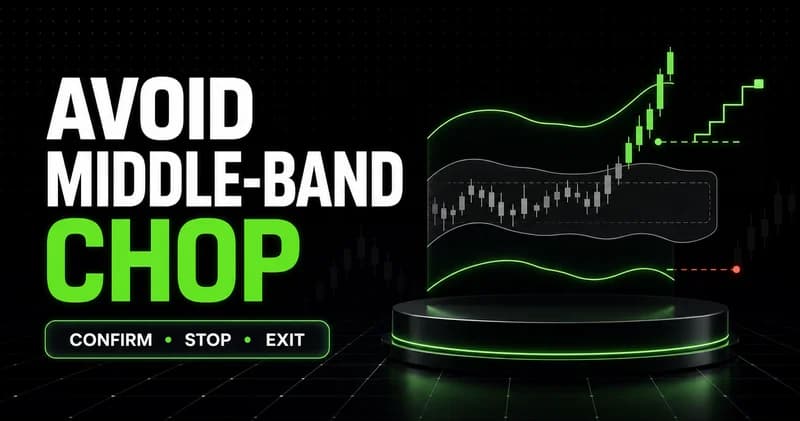
Start with price structure because volume needs a reference point. Identify whether the market is trending, ranging, breaking out, or pulling back. Then compare current volume with the recent local average. The comparison should use a consistent window rather than whichever group of bars supports a preferred opinion.
Use this sequence before acting:
- Mark the active support, resistance, and most recent structural swing.
- Decide whether the move is early, mature, or already extended.
- Compare current participation with recent average volume.
- Judge the price result produced by that participation.
- Wait for acceptance, rejection, or a structure break.
- Define the level that would invalidate the reading.
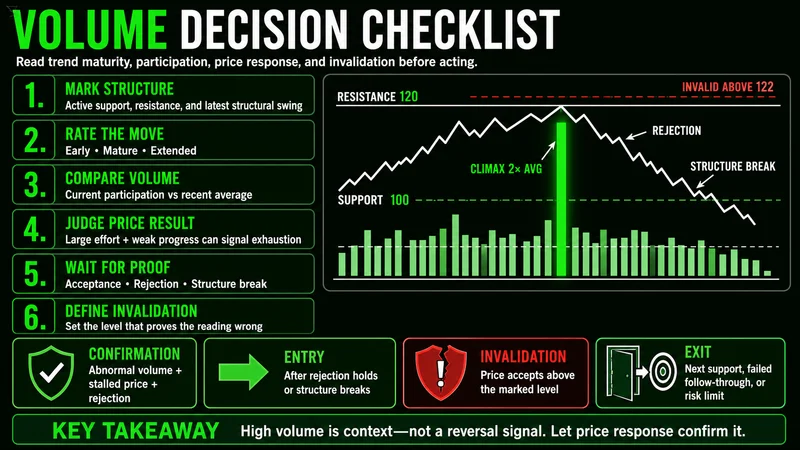 A repeatable sequence keeps volume analysis tied to price behavior and risk.
For a possible bearish climax, the invalidation level is usually above the exhaustion extreme or above the failed reclaim that follows it. If price accepts above that area and volume supports continuation, the reversal thesis is wrong. For a bullish capitulation setup, acceptance below the climax low invalidates the idea.
Defined invalidation matters because volume analysis is probabilistic. A trader can read the context correctly and still face continuation. The purpose of the framework is not to predict every turn. It is to organize evidence before taking risk.
Common volume-reading mistakes create false certainty
The first mistake is assuming every high-volume candle confirms the current direction. A high-volume advance can represent strong demand, late-stage urgency, or distribution. Its location and the next price response determine which interpretation fits.
The second mistake is entering on the climax bar. That is usually the moment of maximum uncertainty. Waiting for rejection, loss of structure, or a failed reclaim gives up a small part of the move in exchange for clearer risk.
The third mistake is comparing volume across unrelated conditions. Opening activity, quiet periods, and event-driven sessions can have different baselines. Compare like with like when possible, and avoid treating a fixed threshold as universal.
The fourth mistake is ignoring the opposing signal. If a suspected reversal immediately attracts fresh participation in the original trend direction, the market is rejecting the thesis. Protecting capital requires accepting that evidence quickly.
As the MRPNL framework emphasizes, volume creates a warning; price behavior decides whether the warning becomes a trade.
When this framework does not work cleanly
Volume signals become less reliable when the local average is distorted, participation is fragmented, or one unusual event creates a bar that cannot be compared with normal trading. Thin conditions can also produce apparent breakouts and spikes without stable follow-through.
Climax volume is especially easy to misread during the early stage of a genuine expansion. A large bar after compression may be the start of price discovery, not the end of a trend. If price holds beyond the breakout level, forms acceptance, and continues with sustained participation, the reversal framework does not apply.
The method also loses value when price structure is unclear. Inside a noisy range, repeated volume spikes may reflect two-sided trade rather than exhaustion. Wait for a defined boundary, a directional attempt, and a measurable response.
FAQs
Does high volume always mean a reversal is near? No. High volume can confirm a breakout or signal exhaustion. Trend maturity, location, and the price response after the surge determine its meaning.
How much volume should confirm a breakout? Volume around twice the recent average is a useful reference from this framework, but it is not a universal threshold. The break must also hold beyond the level and show follow-through.
What invalidates a climax-volume reversal? Continued acceptance beyond the climax extreme invalidates the reversal thesis. Strong participation in the original trend direction adds further evidence that the move is continuing.
Is declining volume always bearish? No. Declining volume during an advance can warn of fading demand, while declining volume during a controlled pullback can show that countertrend pressure is weak.
Let price confirm what volume warns about
Volume is most useful as evidence of participation, not as a standalone signal. Read the trend first, compare effort with result, and require price confirmation. A mature move, abnormal volume, failed progress, and broken structure form a coherent reversal case. If price accepts beyond the extreme, step aside. The invalidation is part of the setup.
Worth the read?