How Broadcom Makes Money and Bears Valuation Risk
How Broadcom makes money through AI chips and VMware software, why its margins are strong, and what a premium valuation demands from execution.
The answer to how Broadcom makes money is not simply “AI chips.” Broadcom combines a $36.9 billion semiconductor engine with $27.0 billion of infrastructure software revenue. That mix produced $63.9 billion in FY2025 revenue, a gross margin near 68%, and a business investors valued at roughly 65 times earnings.
The important question is not whether those numbers look strong. They do. The question is how much future execution the valuation already assumes. Broadcom can keep earning a premium if AI semiconductor growth, hyperscaler spending, networking demand, and VMware subscription conversion develop together. If one pillar weakens, the multiple leaves less room for a routine disappointment.
How Broadcom makes money through chips and software
Broadcom has two large revenue engines. Semiconductor solutions generated $36.9 billion in FY2025 and remained the larger segment. This engine includes AI accelerators, custom silicon, networking products, application-specific integrated circuits, and optics tied to data-center buildouts. Infrastructure software contributed another $27.0 billion, or roughly 42% of total revenue, with VMware leading that side of the business.
That split matters because the segments play different roles. Semiconductors provide the faster AI growth narrative and direct exposure to hyperscaler capital spending. Software provides recurring subscription economics and helps support the margin profile. Broadcom is therefore neither a pure chip-cycle business nor a pure software company. It is a hybrid whose valuation depends on both sides working as expected.
A useful way to read the business is to separate growth from durability. AI chips and networking can expand the top line quickly when demand and data-center investment are strong. VMware can make revenue and cash generation more durable if customers adopt the subscription model without excessive churn or resistance to price increases. The quality of the combination matters more than either segment in isolation.
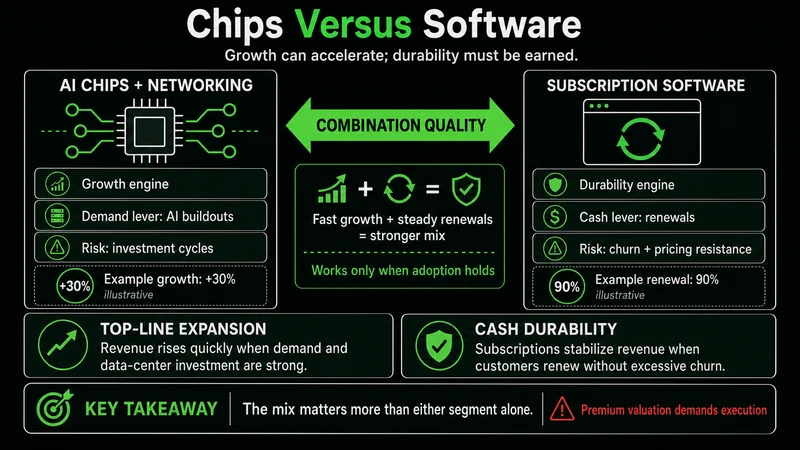 Semiconductors supply the larger growth engine, while infrastructure software supports recurring economics and margins.
The common mistake is to describe all $63.9 billion as AI revenue. FY2025 AI semiconductor revenue was about $20 billion, according to the figures presented, while total semiconductor solutions revenue was $36.9 billion. Infrastructure software supplied $27.0 billion. Treating the entire company as one AI chip stream hides both the software support and the non-AI semiconductor exposure.
Broadcom’s income statement shows unusual profitability
Broadcom reported $63.9 billion of revenue against $14.5 billion of cost of revenue. That left $43.3 billion of gross profit, equal to roughly 68% of revenue. Research and development was the largest operating-expense item at $11.0 billion, while selling, general, and administrative expense was $4.2 billion. Operating profit reached $25.5 billion, or about 40%, and net income reached $23.1 billion, or about 36%.
Put those percentages into a simple example. For every illustrative $100 of revenue, about $32 is absorbed before gross profit, leaving roughly $68. After operating expenses, about $40 remains as operating profit. Approximately $36 reaches net income. These are rounded teaching figures, but they show why the software mix and disciplined expense structure matter to the investment case.
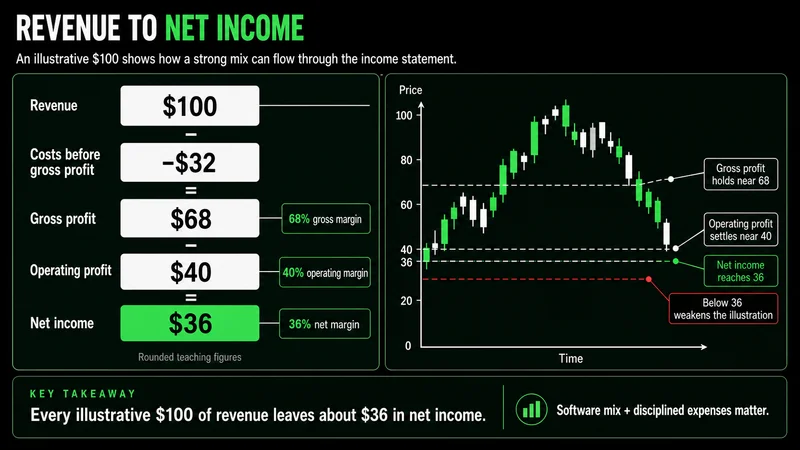 A $100 revenue example traces Broadcom’s approximate gross, operating, and net profit margins.
The company also produced a record $26.9 billion of free cash flow and $43.0 billion of adjusted EBITDA in FY2025. Strong accounting margins are more persuasive when accompanied by cash generation. That cash can support debt service and business investment, although the $69 billion VMware transaction means the balance-sheet burden still belongs in the analysis.
MRPNL principle: A strong margin is evidence of business quality, but it is not protection against paying too much for that quality.
Another common mistake is to treat a high gross margin as permanently fixed. The 68% result reflects the current mix. A greater software contribution can lift the consolidated margin, while weaker software economics or a different semiconductor mix can pressure it. Investors should watch the path of the margin, not promote one annual percentage into a permanent rule.
AI revenue and VMware execution move the stock
The first catalyst is AI semiconductor revenue. FY2025 revenue from that activity grew about 65% to roughly $20 billion. Management’s Q1 FY2026 AI guidance was approximately $8.2 billion, representing about 106% year-over-year growth. The market is likely to compare reported progress with elevated expectations, so the direction and quality of guidance can matter as much as the absolute result.
The second catalyst is hyperscaler capital spending. Large technology customers fund the custom accelerators, networking equipment, ASICs, and optics used in data-center expansion. New custom-silicon wins can extend Broadcom’s opportunity, but concentrated demand also creates dependency. A few customers can drive meaningful upside, and the same concentration can amplify downside if their spending plans change.
The third catalyst is the stated ambition for more than $100 billion of AI revenue in 2027. That figure is a runway, not a booked outcome. Investors should track customer wins, deployment timing, networking demand, and management guidance rather than assuming the ambition arrives in a straight line.
VMware is the fourth catalyst. Subscription conversion and VMware Cloud Foundation adoption can improve recurring economics and support margins. The confirmation is not a price increase by itself. Confirmation is sustained annual recurring revenue alongside acceptable retention, adoption, and customer behavior. Price hikes that produce churn or integration backlash weaken the quality of the result.
Broadcom’s valuation demands consistent confirmation
Broadcom traded at roughly 65 times earnings in the comparison shown. That stood above Nvidia at about 30 times and Qualcomm at about 23 times, but below Marvell at roughly 104 times and AMD at about 179 times. These figures describe a relative snapshot, not a complete valuation model, because growth rates, business mixes, and earnings quality differ across the group.
The premium reflects two expectations. First, Broadcom remains a leader in AI accelerators, custom silicon, and networking. Second, VMware supplies sticky software cash flows that make the company look less cyclical than a conventional semiconductor business. The market is pricing Broadcom more like an AI compounder than a normal chip cycle.
That framing creates a narrow margin for error. A lower multiple than two faster-priced peers does not automatically make Broadcom inexpensive. The relevant test is whether future earnings can grow fast enough to justify the current multiple. Relative valuation is context, not confirmation.
The practical mistake is asking only whether 65 times earnings is high. A better question is what operational path must occur for 65 times to remain reasonable. AI revenue must keep advancing, hyperscaler spending must remain supportive, VMware must convert without damaging retention, and margins must hold near the quality that attracted the premium.
The bear case defines the thesis invalidation
The bear case starts with expectations priced for near-flawless AI execution. Customer concentration increases the impact of a delayed order or lower hyperscaler spending. Semiconductor demand remains cyclical, so cooling capital expenditure can expose the chip-cycle risk beneath the compounder narrative. Competition from Nvidia, Marvell, and in-house hyperscaler silicon can also pressure win rates or economics.
VMware adds a separate risk channel. Integration problems, price-hike backlash, and churn could weaken the recurring software argument. Heavy debt from the $69 billion transaction reduces flexibility if operating performance disappoints. These risks do not prove the thesis is wrong, but they identify where confirmation must appear.
Defined invalidation occurs when the facts stop supporting both sides of the hybrid model. The bullish framework is invalidated if AI semiconductor growth materially trails guidance while hyperscaler capital spending cools, or if VMware subscription progress comes with persistent churn and weaker margins. A single noisy quarter may not settle the issue. A repeated pattern across guidance, customer behavior, margins, and cash generation would.
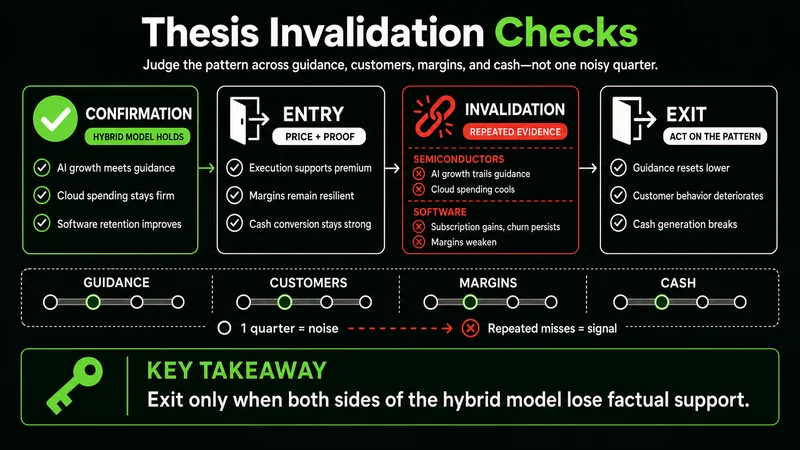 AI growth, hyperscaler spending, VMware retention, margins, and cash generation define the evidence checklist.
When this framework does not work
This framework becomes less useful when the inputs are stale or when earnings change faster than the valuation reference. A 65-times multiple can move sharply as price or expected earnings changes. Peer comparisons also break down when investors use different earnings periods or when one company’s software contribution makes its economics materially different from another chip company’s.
It also does not work as a short-term price forecast. A sound income statement cannot identify the next market reaction by itself. Positioning, expectations, and the gap between guidance and consensus can dominate a single earnings event. The framework is designed to organize evidence, not predict every move.
A disciplined Broadcom review follows the evidence
Start with the revenue split. Track AI semiconductor revenue, custom-silicon wins, networking demand, and hyperscaler spending. Then test VMware annual recurring revenue, subscription adoption, retention, price response, and integration progress. Finally, follow gross margin, operating margin, free cash flow, debt, and the earnings multiple.
Broadcom’s FY2025 results show a highly profitable company with two complementary engines. The valuation says the market already recognizes much of that quality. The edge is not declaring the stock cheap or expensive from one ratio. It is defining the conditions that confirm the premium, identifying the conditions that invalidate it, and updating the view as execution changes.
Worth the read?