Adverse Selection — What It Costs You in the Spread
Adverse selection is the hidden cost you pay in the bid-ask spread when the other side of your trade knows more. Here is how it works and how to manage it.
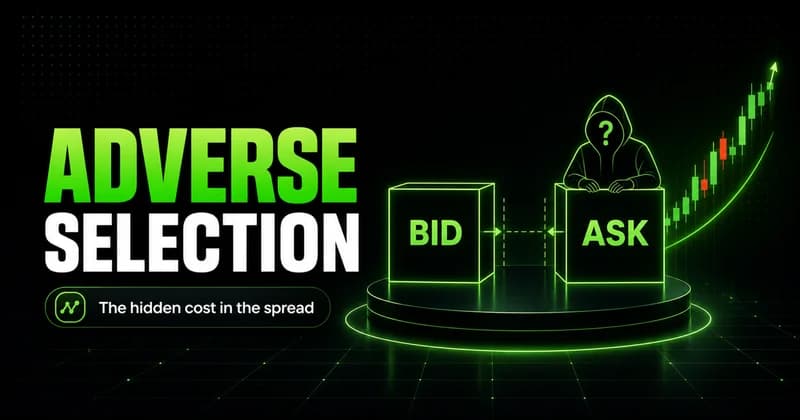
Adverse selection is what happens when the person on the other side of your trade knows something you do not, and the price already reflects it. It is an information problem first and a pricing problem second. In markets, the better-informed party transacts when the terms favor them and steps aside when they do not, so the less-informed party ends up holding the trades that were worst for them. Understanding adverse selection is the difference between reading a quote as an opportunity and reading it as a warning.
Most retail traders meet this idea through insurance textbooks, where high-risk drivers buy the most coverage. That framing is correct, but it buries the part that matters at the screen. Every time you cross the spread to take liquidity, you are accepting a small, structural disadvantage against whoever is willing to trade with you. The market maker who fills you is not a charity. The spread you pay exists in part to cover the times they get run over by someone who knew more than both of you.
What adverse selection means in plain terms
The adverse selection meaning is straightforward once you strip out the jargon. When two parties trade and one holds private information about value or risk, the informed party selects only the trades that benefit them. The uninformed party is left with a sample skewed toward bad outcomes. The selection is adverse because the deals you get are systematically worse than the deals you wanted.
George Akerlof framed this in his 1970 paper on the used-car market. Sellers know whether a car is sound or a lemon; buyers do not. Buyers, unable to tell the difference, will only pay an average price. Owners of good cars refuse that price and leave the market, which lowers the average quality of what remains, which lowers the price buyers will pay again. The mechanism feeds on itself. In the extreme, the market thins out or collapses, not because the cars do not exist, but because the information does not flow.
Markets do not need a villain for this to happen. Adverse selection is a structural outcome of asymmetric information, not a conspiracy. That distinction matters, because traders who treat every adverse fill as manipulation stop looking for the actual edge, which is reading the conditions that make adverse selection more or less likely.
How adverse selection works in the stock market
In equities and futures, adverse selection lives inside the bid-ask spread. A market maker quotes a price to buy and a price to sell. Most of the flow they trade against is uninformed, traders rebalancing, hedging, or guessing. That flow is profitable. The problem is the slice of flow that is informed: someone trading ahead of news, ahead of a large order, or ahead of a structural shift the quote has not caught up to yet.
The market maker cannot tell in the moment which trade is which. So they widen the spread enough to lose a little on the informed trades and make a little on the uninformed ones. The spread is a toll, and adverse selection is one of the main reasons the toll exists. Glosten and Milgrom showed formally that a spread would persist even with zero processing or inventory cost, purely because of the risk of trading against better-informed counterparties. Empirical work on Nasdaq names has attributed a large share of the quoted spread to this component alone.
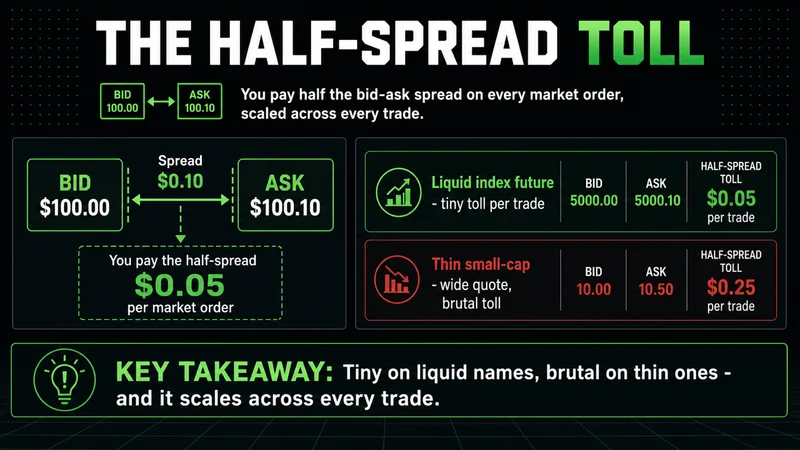
This is where the textbook framing fails the trader. The cost is not abstract. It is the half-spread you pay on every market order, scaled across every trade you take in a year. On a liquid index future the toll is small per trade. On a thin small-cap with a wide quote and sparse depth, the toll is large, and it widens further precisely when informed flow is most active, around earnings, halts, and macro releases. The quote gets worse exactly when you most want to trade it.
Why adverse selection matters for investors and traders
For a long-term investor, adverse selection is mostly a transaction cost to minimize. Use limit orders, avoid the open and close when spreads gap, and the drag stays small. The damage compounds slowly, through worse fills rather than dramatic losses.
For an active trader, the stakes are sharper. The adverse selection stock market effect shows up as fills that look fine in the moment and turn out to be the worst available price a few seconds later. You buy the offer, and the offer was sitting there because someone informed was willing to sell it to you. Liquidity drives markets more than opinions do, and the liquidity you can see on the book is the liquidity that was left for you, not the liquidity the informed side already used. Resting size is a sample, and adverse selection is the reason that sample is skewed against the person crossing the spread to hit it.
The market does not owe you a clean fill. The spread is the price of not knowing what the other side knows.
The practical lesson is not to stop trading. It is to recognize that taking liquidity is an active decision with a built-in cost, and that cost is not fixed. It rises with uncertainty and falls with depth. A trader who internalizes that will pay the spread when the edge is worth it and wait when it is not.
Adverse selection vs moral hazard
Adverse selection and moral hazard both come from information problems, but they happen at different times, and confusing them leads to the wrong fix.
Adverse selection happens before the transaction. The hidden information already exists, and it determines who chooses to trade. The used-car seller knows the car is a lemon before the sale. The informed trader knows the news before they lift your offer. The problem is selection into the deal.
Moral hazard happens after the transaction. Once a party is protected or committed, their behavior changes because they no longer bear the full consequences. A trader using house capital who knows losses are capped may take risks they would never take with their own money. The problem is incentive after the deal is struck.
The distinction is practical. You fight adverse selection with better information and screening before you commit, tighter quotes, smarter order types, and reading the conditions around a fill. You fight moral hazard with structure after you commit, position limits, hard stops, and rules that keep your behavior honest once the trade is live. Treating one with the other's tool wastes effort on the wrong stage.
A checklist for spotting adverse selection conditions
You cannot see informed flow directly. You can read the conditions that make it more likely and price your aggression accordingly. Run a quick adverse selection checklist before you take liquidity:
The spread has widened relative to its recent normal, with no obvious reason on your screen. A quote that gaps out is often a quote that knows something.
Displayed depth thinned out just before you wanted to trade. Liquidity pulling ahead of your order is a tell that someone repositioned first.
A scheduled catalyst is near, earnings, an economic release, an open or close. Informed flow concentrates around known information events.
The name is illiquid, where a single informed participant moves the quote and there is no crowd of uninformed flow to dilute them.
Price is at a level where a large resting order or a structural decision is plausible, and the book in front of it looks unusually thin.
None of these prove informed flow. Together they raise the odds that crossing the spread now will leave you holding an adverse fill. The response is rarely to skip the trade entirely. It is to use a limit instead of a market order, to size down, or to let the catalyst pass and trade the reaction instead of the anticipation.
This framework has a clear boundary. It reads cleanly in liquid names during regular hours, where the spread and depth carry real information. In thin overnight sessions, or in the first seconds after a major release, the quote is so noisy that none of these signals mean much, and the same widened spread that warns you during the day means almost nothing at 3 a.m. on a handful of contracts. Outside normal liquidity, the checklist inverts from a filter into noise, and the only honest read is that the cost of trading is high and the information content is low.
How traders use adverse selection to their advantage
The most useful shift is to stop seeing adverse selection as something done to you and start treating it as a cost you can manage. Three habits do most of the work.
First, default to providing liquidity rather than taking it when conditions allow. A resting limit order earns the spread instead of paying it, which flips the adverse-selection math, though it accepts the risk of being filled exactly when an informed move runs through your price.
Second, scale aggression to conditions. When the spread is tight, depth is healthy, and no catalyst is near, the adverse-selection cost is low and crossing the spread is cheap. When the opposite holds, the same market order is expensive in a way that does not show up until later.
Third, respect the times the market is telling you it knows more than you do. A spread that refuses to tighten, depth that keeps pulling, a level that will not break or hold cleanly, these are the conditions where the informed side is most active. Patience here is not passivity. It is declining to pay the highest adverse-selection toll the market offers.
FAQs
What is adverse selection in simple terms? It is when one party in a trade knows more than the other, and the better-informed party only transacts when the terms favor them. The less-informed party ends up with a sample of trades skewed toward bad outcomes, which is why the selection is called adverse.
How does adverse selection affect stock prices and spreads? Market makers cannot tell informed flow from uninformed flow in the moment, so they widen the bid-ask spread to cover losses to better-informed traders. That widening is a real cost paid by everyone who crosses the spread, and it grows in thin names and around scheduled catalysts.
What is the difference between adverse selection and moral hazard? Adverse selection happens before a transaction, when hidden information determines who chooses to trade. Moral hazard happens after, when being protected or committed changes a party's behavior. One is a screening problem; the other is an incentive problem.
Adverse selection is not a flaw you can remove from markets. It is a permanent feature of trading against people whose information you cannot see. The realistic goal is to recognize the conditions that raise the cost, pay the spread when the edge justifies it, and wait when the market is signaling that the other side knows more than you do. Process over outcome applies here as everywhere: you cannot control whether a given fill was adverse, only whether you took it under conditions that made the toll worth paying.
Worth the read?