Bracket Order in Trading — Definition, Example, and Risks
A bracket order combines an entry, take-profit, and stop-loss into one linked order. Learn how it works, when to use it, and where the automation breaks down.
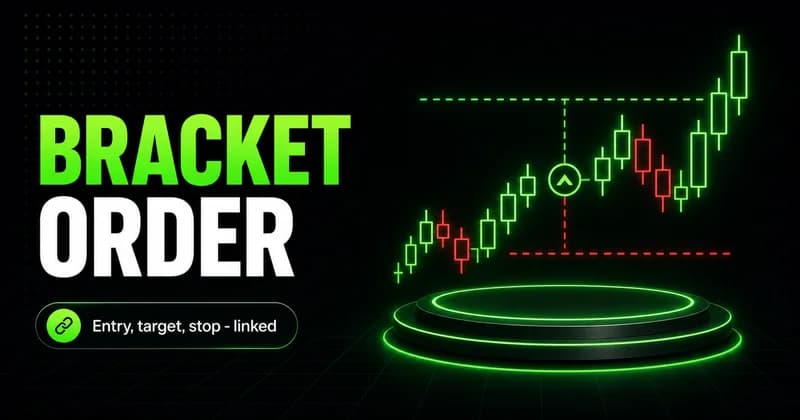
A bracket order is not a strategy. It is an execution tool that removes the two most dangerous moments in a trade — the decision to take profit and the decision to cut a loss — by automating both before the entry fills. Most traders who lose money do not fail at analysis. They fail at execution. A bracket order addresses that failure at the mechanical level.
The concept is simple: you place an entry order, then attach a profit target and a stop-loss on either side. When one fills, the other cancels automatically. The position is "bracketed" between defined risk and defined reward. No second guessing. No manual exit decision under pressure. The order does the work that discipline alone often cannot sustain.
What Is a Bracket Order in Trading
A bracket order is a conditional order type that combines three linked orders into a single submission. The parent order is your entry — a buy or sell at a specified price or market. Attached to that entry are two child orders: a take-profit limit order and a stop-loss order. These three orders function as a unit.
The defining feature is the one-cancels-the-other relationship between the two exit orders. When the take-profit fills, the stop-loss is canceled. When the stop-loss triggers, the take-profit is canceled. You never end up with a live exit order hanging after the position is already closed.
Most major brokerages support bracket orders, though the terminology varies — some call them "bracket orders," others use "OCO orders" or "auto-order." The mechanics are the same regardless of the label.
How a Bracket Order Works — Entry, Target, and Stop
The bracket order execution sequence follows a specific chain.
- Parent order submission. You define the entry — a limit order at a specific price, or a market order for immediate execution. This is the order that activates the bracket.
- Child order attachment. The take-profit and stop-loss orders are linked to the parent but remain inactive until the entry fills. They sit in the system as pending.
- Entry fills. The moment the parent order executes, both child orders become active simultaneously. The take-profit limit order sits at your target price. The stop-loss order sits at your risk threshold.
- One side fills. Price reaches either the target or the stop. That order executes, closing the position. The remaining child order is immediately canceled by the system.
The fill price on the exit orders depends on market conditions. A take-profit limit order fills at your specified price or better. A stop-loss order converts to a market order when triggered, which means the actual fill price may differ from the stop level — particularly in fast markets.
Bracket Order Example Step by Step
Consider a trader looking at the E-mini S&P 500 futures (ES), currently trading at 5,320.
The trader identifies a long setup and wants to enter with defined risk. They submit a bracket order:
- Entry: Buy 1 ES contract at 5,320 (market order)
- Take-profit: Sell 1 ES contract at 5,340 (limit order, 20-point target)
- Stop-loss: Sell 1 ES contract at 5,305 (stop order, 15-point risk)
The entry fills at 5,320. Both exit orders are now live. Price moves higher over the next hour. At 5,340, the take-profit limit order fills, closing the position for a 20-point gain. The stop-loss order at 5,305 is automatically canceled.
If price had reversed and hit 5,305 first, the stop-loss would have triggered, closing the position for a 15-point loss, and the take-profit at 5,340 would have been canceled. The outcome is binary — one side wins, the other disappears.
| Component | Order Type | Price | Result |
|---|---|---|---|
| Entry | Market | 5,320 | Fills immediately |
| Take-profit | Limit | 5,340 | Fills if price reaches target |
| Stop-loss | Stop | 5,305 | Triggers if price drops to stop |
The risk-to-reward on this bracket is 15 points of risk for 20 points of potential reward — roughly 1:1.3. That ratio was decided before the trade was placed. The bracket enforced it mechanically.
Bracket Order vs. Manual Exit — Why Automation Matters
The difference between a bracket order and a manual exit is not about intelligence. It is about consistency under pressure.
When a trader manages a position manually, every exit decision is made in real time, under the influence of open PnL, market noise, and emotional state. A trader watching a position move against them may widen the stop "just a little." A trader in profit may close early out of fear of giving back gains. These are emotional reactions, not strategic decisions.
A bracket order removes that decision point. The exit parameters are set before the entry, when the trader is thinking clearly about risk and structure — not when the position is moving and adrenaline is involved.
Most traders do not have a strategy problem. They have a discipline problem. Breaking rules during drawdown periods destroys more accounts than poor analysis.
The trade-off is rigidity. A bracket order cannot adapt to new information. If market structure shifts after entry — a news event, a liquidity sweep, a change in momentum — the bracket does not adjust. It holds to the original plan regardless of context. For some traders, that rigidity is exactly the point.
Slippage Risk and What Bracket Orders Cannot Protect You From
A bracket order automates your exits. It does not guarantee them.
The stop-loss component of a bracket order converts to a market order when triggered. In a liquid market during regular hours, the fill price is usually close to the stop level. But there are conditions where slippage becomes significant.
- Fast-moving markets. During high-volatility events — earnings releases, Fed announcements, sudden liquidity withdrawal — the price at which your stop converts to a market order may be far from where it triggered. A stop at 5,305 might fill at 5,298 if selling pressure is aggressive.
- Overnight gaps. If you hold a bracket order overnight and the market opens below your stop level, the stop triggers at the opening price, not at your specified level. The bracket cannot fill at a price that no longer exists.
- Low-liquidity instruments. Small-cap stocks, options with wide spreads, and thinly traded futures contracts all carry higher slippage risk on stop orders. The bracket executes, but the execution price may disappoint.
This is where the tool reveals its limits. A bracket order controls decision-making. It does not control the market.
Common Bracket Order Mistakes Beginners Make
Understanding the mechanics is not enough. Execution errors with bracket orders are common, and most of them happen before the order is even submitted.
Setting the stop too close to the entry is the most frequent mistake. A stop-loss triggered by normal market noise means the bracket worked perfectly — it just worked against the trader. Give the trade room to breathe within the structure of the setup.
Ignoring the risk-to-reward ratio is equally costly. A bracket with a 30-point stop and a 10-point target requires a 75 percent win rate to break even. The bracket enforces the ratio, but the trader chose it. Many beginners place brackets without calculating what the numbers actually demand.
Using bracket orders in illiquid markets introduces slippage that undermines the defined-risk promise. In thin markets, the stop-loss may fill far from the trigger level. If slippage on a losing trade consistently exceeds the expected risk, the bracket is miscalibrated for that instrument. A bracket order left active overnight or over a weekend also carries gap risk — the bracket does not pause when the market closes. And a bracket order manages a single trade, not a portfolio. Traders who use brackets without considering overall exposure, correlation, or daily loss limits are automating the wrong thing.
When a Bracket Order Does Not Work
Bracket orders break down in specific, identifiable conditions. Recognizing those conditions is part of using the tool correctly.
During the March 2020 crash, ES futures moved 100+ points in minutes. Stop-loss orders that triggered during those moves filled at prices 20 to 40 points worse than the trigger level. The bracket executed as designed, but the slippage turned a planned 15-point loss into a 50-point loss. In that environment, the bracket provided the illusion of defined risk without the reality of it.
The same pattern repeats during flash crashes, liquidity vacuums, and gap openings after overnight news. The bracket order is built for normal market conditions. When conditions are not normal, the stop-loss becomes a market order in a market where the nearest bid might be far below where you expected.
This is not a reason to avoid bracket orders. It is a reason to understand what you are actually automating — a decision, not a guaranteed outcome.
FAQs
What is a bracket order in simple terms? A bracket order is three linked orders — an entry, a take-profit, and a stop-loss — submitted together. When one exit fills, the other cancels automatically.
How does a bracket order work in trading? You place an entry order and attach a profit target and stop-loss. Once the entry fills, both exits become active. Whichever exit triggers first closes the position, and the other is canceled.
What is the difference between a bracket order and a manual exit? A bracket order automates the exit decision before the trade begins. A manual exit requires the trader to decide in real time, which introduces emotional bias and inconsistency.
Can a bracket order lose more than expected? Yes. Stop-loss orders convert to market orders when triggered. In fast or illiquid markets, the fill price can be worse than the stop level. Overnight gaps can also cause fills well below the stop.
When should traders use bracket orders? Bracket orders work best in liquid markets during regular trading hours when the trader wants to enforce a specific risk-to-reward ratio without manual intervention. They are less reliable during high-volatility events or in thinly traded instruments.
What to Remember About Bracket Orders
A bracket order is a risk-management tool, not a trading strategy. It enforces discipline at the execution level by automating the profit target and stop-loss before the entry fills. The value is consistency — every trade carries the same defined risk and defined reward, regardless of what the trader feels in the moment.
The limitation is equally clear. A bracket order does not adapt to changing conditions, and the stop-loss does not guarantee a specific fill price. In fast markets, during gaps, or in low-liquidity instruments, the actual loss can exceed the planned risk. The traders who benefit most from bracket orders are the ones who already have a plan and want to make sure they follow it.
Worth the read?