Position Size — What It Is and How to Calculate It
Position size is the quantity you hold and the one variable that sets how much a losing trade costs. Here is how to calculate it and size with control.
Your position size is the number of shares, contracts, or units you hold in a single trade, and it is the one variable that decides how much a loss actually costs you. Most traders obsess over the entry. The position size meaning is simpler and more important: it is the dial that converts a price move into real money gained or lost. Get it wrong and a normal losing trade turns into an account problem.
Entries get the attention. Sizing decides whether you survive long enough for the entries to matter. A mediocre entry with controlled size lives to trade again. A precise entry with oversized risk eventually takes the account apart, and it usually happens during the exact session when you felt most certain.
What position size actually means
Position size is how much exposure you carry in one trade. On 100 shares of a stock, your position size is 100 shares. On three NQ futures contracts, it is three contracts. The number itself is neutral. What gives it meaning is the distance between your entry and your stop, because that distance is what turns size into risk.
Two traders can both buy the same stock at the same price and take completely different risk. One sizes so a stop-out costs a small, planned amount. The other sizes by gut feel, and a single stop wipes out a week of progress. Same entry, same chart, different outcome. The difference is sizing, not analysis.
This is why position size belongs to risk management, not to your trade idea. The idea tells you what to trade and where the structure breaks. The size tells you how much that break is allowed to hurt. Keeping those two decisions separate is the foundation everything else rests on.
The position size formula
The core position size formula is short, and it works the same across stocks, futures, and forex once you adjust for what one unit represents.
Position size = (account equity × risk percent) ÷ (entry price − stop price)
Three inputs drive the whole calculation:
- Account equity — the capital you are actually trading, not a number you hope to reach.
- Risk percent — the share of equity you are willing to lose if the stop is hit, expressed as a decimal.
- Risk per unit — the distance from your entry to your stop, which is the most you expect to lose per share or contract.
The numerator, equity times risk percent, is your dollar risk for the trade. The denominator is the risk per unit. Dividing one by the other gives you the number of units that keeps the trade inside your risk limit. The position size calculation is mechanical once those three numbers are defined. The discipline is in defining them before you click, not after.
Notice what the formula does. It starts from the loss you can accept and works backward to the size. Most struggling traders run it in reverse. They decide the size first, usually based on how confident they feel, and discover the risk only when the trade goes against them.
How to calculate position size, step by step
Here is how to calculate position size on a real trade, in the order you should run it.
- Fix your dollar risk. Take your account equity and multiply by your risk percent. On a 50,000 account risking 1%, that is 500.
- Mark your entry and your stop from structure, not from the dollar figure. Say you enter a stock at 100 and your invalidation sits at 96.
- Find the risk per share. Entry minus stop is 100 minus 96, or 4 per share.
- Divide dollar risk by risk per share. That is 500 divided by 4, which gives 125 shares.
- Check the notional. 125 shares at 100 is 12,500 of exposure on a 50,000 account, which is reasonable. If the notional looks absurd for the account, the stop is too tight, not the math.
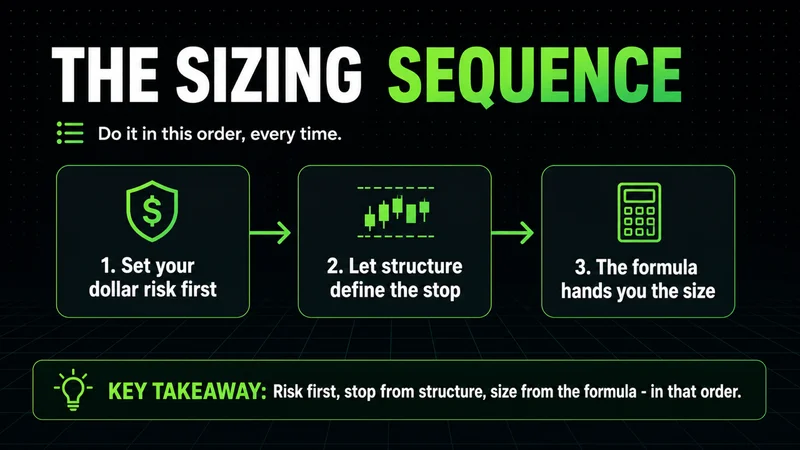
The order matters. Structure defines the stop, the stop defines risk per unit, and risk per unit defines size. When traders skip step two and place the stop wherever the size feels comfortable, they have inverted the process and are no longer trading risk-defined.
A worked position size example
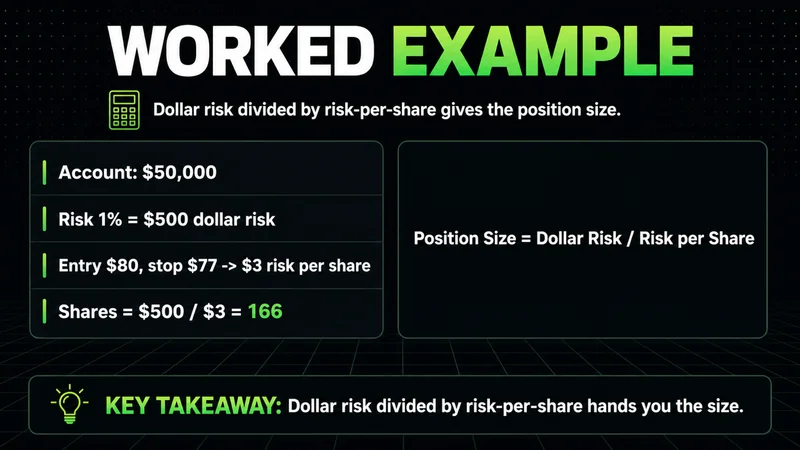
A position size example makes the mechanics concrete. Keep the same 50,000 account and the same 1% risk, so dollar risk is 500 again.
You want to trade a stock showing acceptance above a prior range. Entry is 80. The structure that invalidates the idea sits below 77, so your stop is 77. Risk per share is 80 minus 77, or 3. Dollar risk divided by risk per share is 500 divided by 3, which rounds down to 166 shares. You round down, never up, because rounding up quietly pushes you over your risk limit.
Now change one input. Suppose the only valid stop is at 75 instead of 77, because that is where the structure actually breaks. Risk per share becomes 5, and 500 divided by 5 is 100 shares. The wider stop forced a smaller position. That is the formula protecting you. A position size example for beginner traders should always include this second case, because it shows that a wider stop does not mean more risk when the size adjusts to absorb it.
Position size versus risk per trade
These two terms get used interchangeably, and the confusion costs people money. Position size is the quantity you hold. Risk per trade is the dollar amount you stand to lose if the stop is hit. They are related through the stop distance, but they are not the same thing, and that distinction is why position size matters in risk management.
You can hold a large position with small risk if your stop is tight, and a small position with large risk if your stop is wide and you ignored it. The number of shares tells you nothing on its own. Risk per trade is the figure that should stay constant from trade to trade. Position size is the output that moves around to keep it constant.
The table below shows the same 500 risk budget producing very different share counts as the stop distance changes.
| Entry | Stop | Risk per share | Dollar risk | Position size |
|---|---|---|---|---|
| 100 | 96 | 4 | 500 | 125 shares |
| 80 | 77 | 3 | 500 | 166 shares |
| 80 | 75 | 5 | 500 | 100 shares |
| 250 | 245 | 5 | 500 | 100 shares |
Risk per trade is held at 500 across every row. Only the size changes. That is the whole point. When you anchor on risk per trade and let size float, your worst-case loss stays predictable no matter what you trade.
When fixed-percent sizing breaks down
The percent-risk model is the right default, but it is not a law of nature, and it stops behaving when volatility expands. The formula assumes the price between your entry and your stop is the price you actually get. In fast conditions, it is not.
Gold trades technically for hours and then invalidates an entire move within minutes during macro-driven sessions. When that happens, your stop at 75 fills at 73 because there is no liquidity at your level. The risk per share you calculated was 5; the risk you took was 7. The formula was correct, but the market did not honor the inputs. Around major news, opening auctions, and thin overnight liquidity, slippage and gaps push your realized loss past the planned one, and the clean 1% becomes 1.4% without you doing anything wrong.
The fix is not to abandon the formula. It is to size down before conditions you already know are dangerous, and to treat the calculated risk as a floor on the bad outcome rather than a ceiling. NQ punishes this lesson quickly. A size that is comfortable in a quiet range is too large the moment volatility expands, and the gap between the two shows up in the account before it shows up in your reasoning.
Common position size mistakes
The same position size mistakes show up again and again, and most of them are decisions about discipline rather than math.
- Sizing by conviction. Adding size because a trade feels obvious is the fastest route to an oversized loss. The strongest feeling often precedes the worst fill.
- Moving the stop to fit the size. If you widen the stop after entry to avoid being stopped out, you have abandoned your risk per unit and your position is now larger than planned.
- Risking too much per trade. If one losing trade affects your next decision emotionally, the position was too large. That reaction is the most honest sizing feedback you will get.
- Rounding up. Rounding 166.6 up to 167 looks harmless and silently breaches your limit on every trade. Always round down.
- Adding to losers without a plan. Averaging into a losing position multiplies size at the worst moment, turning a defined risk into an open-ended one.
Most blown accounts do not come from bad analysis. They come from good analysis sized badly during an emotional session. The common position size mistakes beginners make are rarely technical; they are the result of letting feeling set the quantity.
What a good starting position size looks like
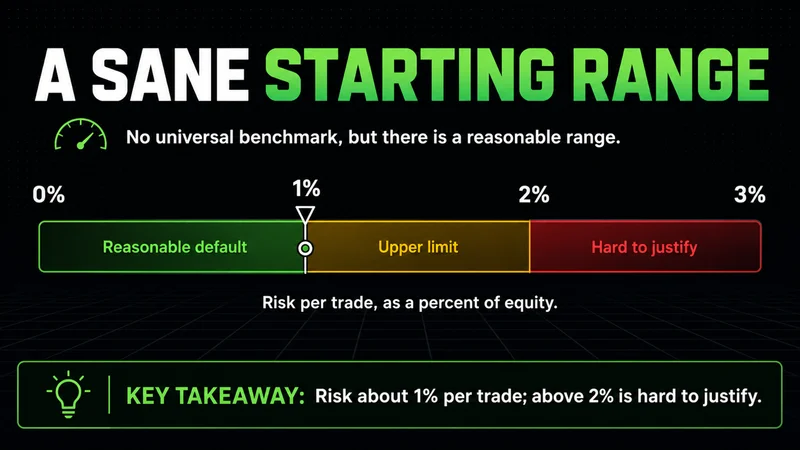
There is no universal position size benchmark, but there is a sane starting range. Risking 1% of equity per trade is a reasonable default for most accounts, and risking more than 2% on a single idea is hard to justify while you are still building consistency. The lower number is not timid. It is what lets you take a string of losses and still have a functioning account and a functioning mind.
A good position size for new traders is usually smaller than they want it to be. The instinct is to size up to make the wins meaningful. The professional move is the opposite. You size so that a normal losing streak is survivable and emotionally quiet, because the streak is coming whether you plan for it or not. Capital preservation is the first objective; the returns are what survive once you stop taking large, undefined losses.
If you are unsure where to start, begin below the level that feels right. You can always scale exposure up as your process proves itself. Scaling down after a drawdown you sized into is far more expensive, and it usually arrives with damaged confidence attached.
How to review and improve your sizing over time
Position size improvement is a review habit, not a one-time setting. The way to improve position size over time is to measure what your sizing actually did, not what you intended it to do.
Keep a simple position size template in your trade log with these fields:
- Account equity at the time of the trade
- Intended risk percent and intended dollar risk
- Entry, stop, and calculated risk per unit
- Realized loss or gain in dollars and in R multiples
- Whether the stop filled where you placed it
Over a sample of trades, that record exposes the gap between planned and realized risk. If your realized losses keep running larger than your calculated risk, you are either sizing into illiquid conditions or moving stops, and the log will show which. A position size checklist for trading review turns sizing from a feeling into a measurable, correctable part of your process.
The bottom line on position size
Position size is the quantity you hold, and it is the variable that decides how much any single trade can cost you. Set your dollar risk first, let structure define your stop, and let the formula hand you the size that keeps the loss inside your limit. Hold risk per trade constant and let size float to match the stop distance.
Respect the conditions where the formula stops protecting you. When volatility expands, your calculated risk becomes a floor, not a ceiling, so size down before the session that demands it rather than after. Keep the risk small enough that a losing streak stays survivable and quiet, log what your sizing actually produced, and correct the gap between planned and realized risk. Done consistently, sizing stops being math you tolerate and becomes the part of the process that keeps you in the game.
Worth the read?