Capital Protection in Trading — A Beginner's Guide
Capital protection in trading keeps losses small so no single trade ends your account. Learn the rules, a checklist, and where they break down.

Capital protection in trading is the practice of keeping losses small enough that no single trade, and no bad week, can end your ability to keep trading. It comes before profit, before strategy, and before any setup you are excited about. The math is the reason: a 50% loss requires a 100% gain to recover, and most accounts never get the chance because the trader has already run out of capital or composure.
Most traders treat protecting capital as something they will get serious about later, once they are profitable. That order is backward. Survival is the thing that makes profitability possible, not the reward for reaching it.
What capital protection means in trading
Capital protection is the decision to prioritize keeping your existing account intact over chasing the largest possible return. The capital protection meaning is simple in words and hard in practice: you accept smaller, more controlled outcomes so that a difficult stretch of trades does not remove you from the game.
This is the same idea professionals call capital preservation, and it is not a mode you switch on during scary markets. A capital protection strategy is the constant condition under which every other decision gets made, and it rests on three things:
- Position size that caps your risk per trade at a small, fixed percentage of the account.
- A defined stop placed with the entry, marking the price that proves the idea wrong.
- The discipline to sit out low-quality sessions instead of forcing trades.
All of it serves one goal: staying solvent and staying clear-headed.
Protecting capital is the first objective. Consistency is built by surviving difficult periods, not by maximizing the good ones.
The reason it sits first is structural, not emotional. An account that drops 25% needs a 33% gain to get back to even. Drop 50% and you need 100%. The deeper the hole, the steeper the climb, and the steeper the climb, the more pressure you feel to force trades, which usually digs the hole deeper. Protecting capital keeps you on the shallow part of that curve, where recovery is realistic.
Capital protection trading basics every beginner needs
The capital protection trading basics come down to a few mechanical rules that you set before the trade, not during it.
- Risk a fixed, small percentage per trade. Most professionals risk 1% to 2% of account equity on any single position. At 1%, even ten losing trades in a row pull the account down by under 10%, which is survivable.
- Define your exit before you enter. Every position gets a stop-loss placed with the entry, at the price that proves the idea wrong, not at a round number that feels comfortable.
- Size from the stop, not the other way around. Decide the dollar risk first, measure the distance to your stop, and let those two numbers set how many shares or contracts you take.
- Treat a stop as information, not failure. Getting stopped out means the market disagreed with your read. That is data, and the trade did its job by costing you a small, defined amount.
These rules feel restrictive at first. That is the point. They convert the vague intention of not blowing up into concrete numbers you check before risking anything.
A capital protection example you can actually picture
A capital protection example makes the math concrete. Say you have a 10,000 account and you decide to risk 1% per trade, which is 100. You find a setup where your stop sits 50 cents below your entry. The position size that risks exactly 100 is 200 shares, because 200 shares times 0.50 equals 100. If the trade fails and your stop fills, you lose 100, or 1% of the account.
Now run the same setup without a plan. You buy 1,000 shares because the idea feels strong, with no defined stop. The stock drops 1.50 before you panic out, a 1,500 loss, or 15% of the account, from one trade. Same chart, completely different survival profile.
This is the capital protection example for beginner traders that matters most: the difference was never the analysis. It was the sizing and the stop, both decided before the entry.
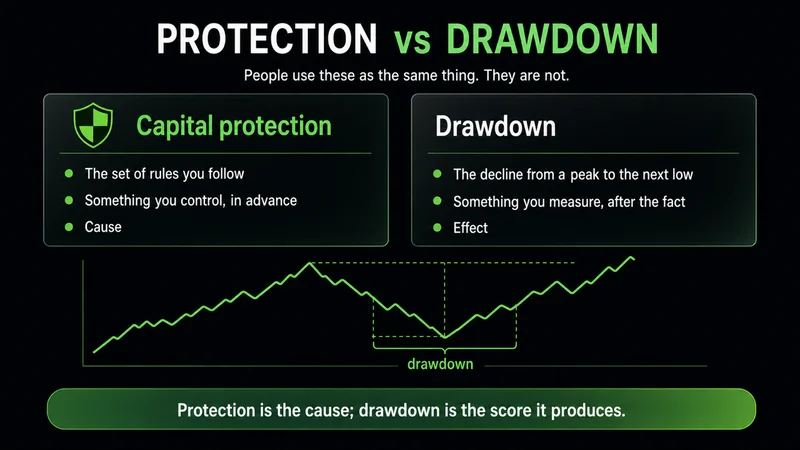
Capital protection vs drawdown — how they relate
People use these terms as if they were the same thing. They are not. Capital protection is the set of rules you follow. Drawdown is the result you measure.
Drawdown is the decline from your account's peak to its lowest point before a new peak, the scoreboard for how well your protection rules are working. The capital protection vs drawdown relationship is cause and effect: tight, consistent protection produces shallow drawdowns, and shallow drawdowns are recoverable. Loose or absent protection produces deep ones, and deep drawdowns are where accounts die.
| Concept | What it is | What it tells you |
|---|---|---|
| Capital protection | The rules you apply: fixed risk, defined stops, position sizing | Whether your process is disciplined |
| Drawdown | The measured drop from peak to trough | How much damage the process is actually doing |
| Recovery gain needed | The percentage gain required to return to the prior peak | How costly a given drawdown really is |
The practical takeaway of capital protection vs drawdown explained this way is that you control the protection directly and the drawdown only indirectly. You cannot promise yourself a shallow drawdown. You can promise yourself fixed risk and a stop on every trade, and the shallow drawdown tends to follow.
When should traders use capital protection
The short answer to when should traders use capital protection is always, on every trade. It is not a defensive mode you toggle on during volatility; it is the baseline. Still, the discipline matters more in some conditions than others, and three make it non-negotiable:
- During a losing streak, when the urge to size up and win it all back is strongest and oversizing finishes accounts. A losing day does not require an immediate green recovery.
- In high-volatility sessions, when the same percentage move costs more in dollars. Fixed-percentage risk automatically tightens position size as volatility rises.
- Around major news, where the first move after a release is often the least clean opportunity of the day. Protection keeps you from reacting to a spike before structure develops.
The market rewards patience far more than activity. Most beginners think they need more setups; most need fewer trades and tighter risk control.
A capital protection checklist for new traders
This is the part the top guides skip. They explain the principles and never give you something to run before you click buy. Here is a capital protection checklist for new traders, meant to be answered in order, every time, before a position goes on.
- What is my dollar risk on this trade? A fixed percentage of equity, decided before I looked at the chart.
- Where is my stop, and what does it invalidate? A specific price that proves the idea wrong, not a comfortable round number.
- What is my position size? Calculated from the dollar risk divided by the distance to the stop.
- Is my stop entered with the position? Not mental, not planned for later. Working in the market now.
- Am I trading the setup or my emotions? If I am sizing up to recover a loss, I close the platform instead.
If any answer is missing, the trade is not ready. The checklist is boring on purpose. Boring is what survives.
Capital protection risks and mistakes beginners make
There is a quieter side to this. Capital protection has its own risks when applied without judgment, and the common capital protection mistakes beginners make tend to come from misunderstanding the tool rather than ignoring it.
- Moving the stop. A trade goes against you, you slide the stop lower to give it room, and the small defined loss becomes a large emotional one. The stop existed to make the loss small and decided in advance. Widening it deletes the protection.
- Treating protection as a guarantee. Following every rule lowers your risk of ruin, but it does not erase it. Markets gap, and liquidity vanishes. A stop is an instruction to exit at a price, not a promise the price will be there.
- Over-protecting. A trader who cuts every trade at the first wiggle, or sizes so small that no outcome matters, is not preserving capital so much as guaranteeing they never build it. Capital protection risks becoming a way to avoid trading entirely.
The goal across all three is controlled exposure, not zero exposure.
Where capital protection stops working
Every rule here assumes the market lets you exit near your stop. That holds in liquid, regular-hours conditions. It breaks in specific, predictable ways, and pretending otherwise is how disciplined traders still get hurt.
Gap risk is the clearest case. A stop at 50 below entry does nothing if the instrument opens 4 below it after an overnight headline. Your fill is wherever the market reopens, not where your stop sat. The 1% rule was never a 1% rule on a gap.
Correlated positions are the second. Five trades each risking 1% feel like 5% of total risk. If all five are long the same index complex and it sells off together, you lose all five at once. Your real risk was never 1% per idea; it was 5% on one idea wearing five costumes.
Thin overnight liquidity is the third. The same protection that reads cleanly in cash hours means almost nothing when the book is empty and one order walks price through three stops. Capital protection is a framework, not a force field, and knowing its edges is part of using it well.
FAQs
What is capital protection in trading in simple terms? It is keeping each loss small enough that no single trade or bad stretch can end your account. You do this by risking a fixed small percentage per trade and using a defined stop, so survival always comes before profit.
How does capital protection work in trading? You decide your dollar risk before the trade, place a stop at the price that proves the idea wrong, and size the position from that risk and stop distance. The stop converts an abstract intention into a concrete, pre-committed exit.
Is capital protection important for beginners? Yes, more than for anyone else. Beginners take the most low-quality trades and feel the most emotional pressure during losses, which is exactly when fixed risk and defined stops keep a normal losing stretch from becoming a blown account.
What is the difference between capital protection and drawdown? Capital protection is the set of rules you apply, and drawdown is the measured result. Disciplined protection produces shallow, recoverable drawdowns; loose or absent protection produces deep ones that are hard to climb back from.
How does capital protection affect trading risk? It caps the damage from any single trade and slows the compounding effect of consecutive losses. It lowers your risk of ruin without removing it, since gaps and vanishing liquidity can still produce a worse fill than your stop.
What is the most common capital protection mistake? Moving a stop to give a losing trade more room. It turns the small, defined loss you planned for into a large, emotional one, which deletes the protection the stop was placed to provide.
Related reading
If this was useful, the natural next steps build directly on these rules. Read up on position sizing and the risk-reward ratio to make the sizing math automatic. Study stop-loss and take-profit placement to refine where your exits actually belong. Then look at how a trading journal and performance metrics turn a vague sense of how you are doing into a measured drawdown you can manage. Each one extends the same idea: protect the capital first, and the rest of the process has room to work.
Worth the read?