Commission in Trading — What It Actually Costs You
Commission is the broker's fee to execute a trade. Here is what commission actually costs you, how it differs from other fees, and when it matters most.
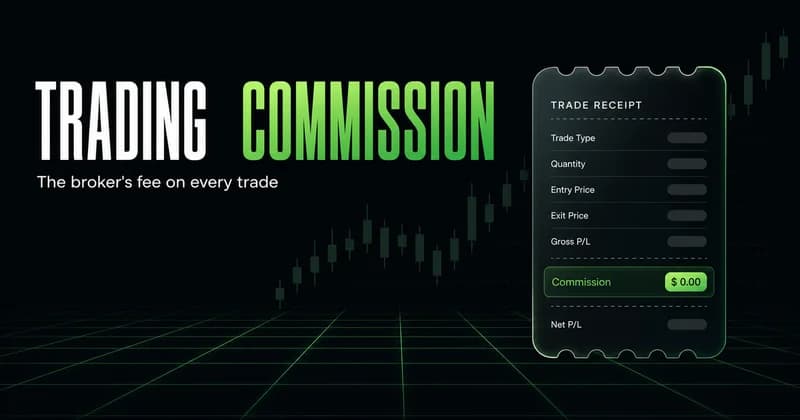
Commission is the fee a broker charges to execute your order, usually a flat amount per trade or a per-share or per-contract rate. It is the price of access to the market, paid whether the trade wins or loses. For a beginner, the number looks small. For an active trader, it is one of the quiet costs that decides whether a strategy survives over a few hundred trades or bleeds out slowly.
Most articles treat commission as a line item to minimize and move on. That framing misses the point. The real question is not whether your commission is low. It is whether the cost of doing business fits the way you actually trade. A scalper paying two dollars a round turn and a long-term investor paying the same two dollars are not in the same situation at all.
What commission means in plain terms
Commission is what you pay the broker for routing and filling your order. It is separate from the price of the asset. If you buy 100 shares at 50 dollars, the shares cost 5,000 dollars and the commission is charged on top of that. The broker earns it regardless of direction, so it is a fixed cost of participation, not a variable tied to whether you are right.
There are three common structures:
- Flat per trade. A set fee for the whole order, for example 5 dollars, no matter the size.
- Per share or per contract. A small rate multiplied by quantity, such as a fraction of a cent per share or a fixed amount per futures contract.
- Percentage of notional. A percentage of the total trade value, more common in some managed or international contexts.
Each structure favors a different trader. Flat fees punish small orders and reward large ones. Per-share pricing scales with size and suits traders who vary their position sizing. The structure that looks cheapest in isolation is not always the one that costs you the least once your real order pattern is accounted for.
Commission versus the other fees you actually pay
This is where most beginners get the picture wrong. Commission is one cost among several, and on liquid instruments it is rarely the largest. The full cost of a trade also includes the spread, the gap between the bid and the ask, and slippage, the difference between the price you expected and the price you got. Regulatory and exchange fees sit on top of those, usually as fractions of a cent.
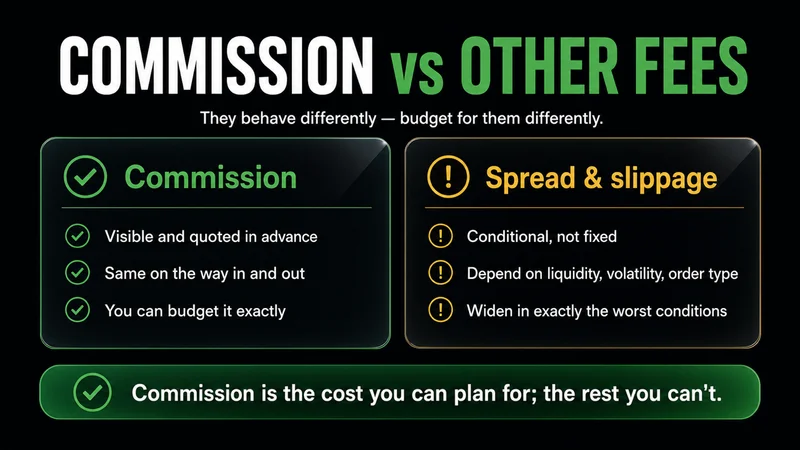
The distinction between commission and fees matters because they behave differently. Commission is visible and quoted in advance, so you can budget for it exactly. Spread and slippage are conditional. They depend on liquidity, volatility, and your order type, and they widen in exactly the conditions where execution gets hard. A trader who obsesses over a low commission while routing market orders into thin, fast conditions is saving pennies and paying dollars.
| Cost | When it is charged | Predictable? |
|---|---|---|
| Commission | On every execution, per the broker's rate | Yes, quoted up front |
| Spread | Built into the entry and exit price | Partly, varies with liquidity |
| Slippage | When the fill price differs from the expected price | No, conditional on conditions |
| Exchange and regulatory fees | On execution, set by the venue | Yes, but small |
Liquidity drives the real cost of a trade more than the commission rate does. On a deep, tight market the spread is a fraction of a tick and commission dominates the cost. On a thin market or during a volatility spike, the spread and slippage can dwarf whatever you saved on commission.
A commission example for beginner traders
Numbers make this concrete. Say you buy 100 shares at 50 dollars and sell at 51 dollars. The gross gain is 100 dollars. With a flat 5 dollar commission on each side, you pay 10 dollars round turn, so the net gain is 90 dollars. Commission took 10 percent of the move.
Now run the same trade with 1,000 shares. The gross gain is 1,000 dollars and the commission is still 10 dollars, roughly 1 percent of the move. The trade did not change. The commission did not change. What changed is the size relative to the fixed cost. This is why commission feels heavy to small accounts and nearly invisible to large ones.
The more useful way to read commission is as part of your break-even. Every trade starts underwater by the round-turn commission plus the spread. Before the position can show a profit, the asset has to move far enough to cover both. For a frequent trader, that buried cost repeats on every entry, and it compounds across the year in a way a single trade never reveals.
How commission affects trading risk and your edge
Commission does not change your risk on any single trade in the way a stop does, but it changes the math of your edge over a sample. An edge is the average profit per trade after all costs. Push commission up and the average net result per trade falls, which means you need a higher win rate or a larger average winner just to stand still.
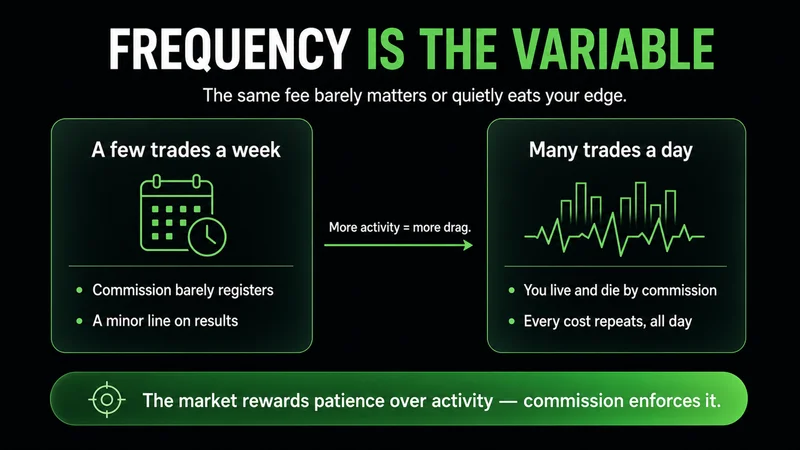
This is where frequency becomes the real variable. A trader taking three positions a week barely notices commission. A trader taking thirty a day lives and dies by it. The market rewards patience over activity more often than newer traders expect, and commission is one of the mechanisms that enforces it. More trades mean more fixed cost paid into the same edge, and a marginal edge can flip negative purely on transaction costs.
There is a condition where this framing breaks down, and it is worth naming. On large positions held over longer horizons, commission becomes a rounding error, and optimizing for it is wasted effort. A swing trader sizing into a multi-day move on a liquid future is far better served watching spread, slippage, and position sizing than shaving a dollar off the commission. Cut commission analysis where it stops mattering. The cost only deserves attention in proportion to how often you pay it.
Most blown accounts do not die from one bad trade. They bleed out from costs and overtrading that quietly outrun a thin edge, long before the trader notices the pattern.
When should beginner traders actually worry about commission?
Commission deserves real attention when your trading is high frequency, your account is small, or your average move per trade is tight. In those cases the fixed cost is a meaningful slice of every result, and it should shape how often and how large you trade. It deserves less attention when your positions are large, your horizon is long, or you trade liquid instruments where spread and slippage are the dominant costs anyway.
Use this as a rough checklist before you let commission drive a decision:
- Estimate your round-turn cost, commission plus typical spread, per trade.
- Compare it to your average expected move on a winning trade.
- If the cost is more than a small fraction of that move, frequency or sizing is the problem, not the broker.
- If the cost is a rounding error, stop optimizing it and focus on execution quality and risk.
The answer to whether commission is important for beginners is conditional. It matters when it is large relative to your edge and your size. It fades when it is not. Treating it as always critical or always irrelevant are both mistakes.
Common commission mistakes new traders make
The first mistake is chasing zero commission without reading how the broker is paid instead. Free trading is rarely free. The cost often moves into wider spreads, payment for order flow, or weaker fills, which can cost more than a transparent commission would have. The headline of zero is not the full price.
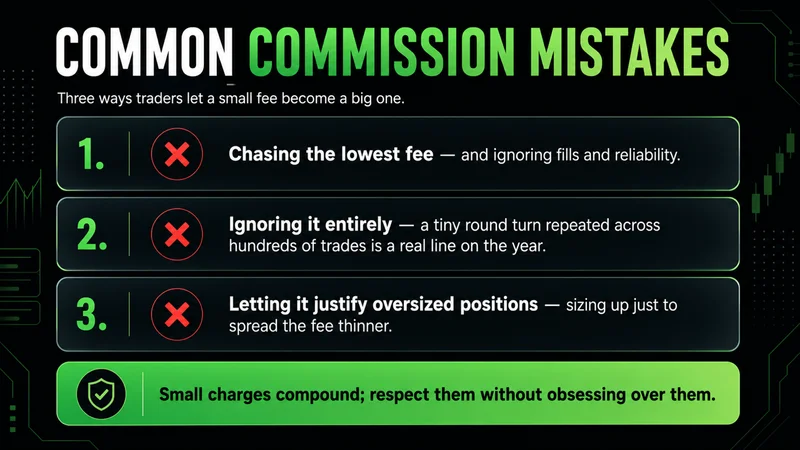
The second is ignoring commission entirely because each charge looks trivial. A two dollar round turn feels like nothing until it repeats across a few hundred trades, at which point it is a real line on the year's results. The third is letting commission justify oversized positions, sizing up specifically to dilute the fixed cost. That trades a small known cost for a large unknown risk, and it is exactly the kind of emotional sizing that does real damage.
The disciplined approach is plain. Know your true round-turn cost, including spread and slippage, not just the commission. Match your trading frequency and size to that cost. Treat commission as one input into execution quality, never as the whole story and never as a reason to take a position you would not otherwise hold.
FAQs
What is commission in trading? It is the fee a broker charges to execute your order, charged whether the trade wins or loses. It is usually a flat amount per trade or a per-share or per-contract rate, and it is separate from the price of the asset itself.
How does commission work in trading? The broker applies its rate to your order at execution and adds it to the cost of the trade. On a buy, you pay the asset price plus commission. On a sell, the commission comes out of your proceeds. Across a round turn, you pay it on both the entry and the exit.
What is the difference between commission and fees? Commission is the specific charge for executing a trade and is quoted in advance. Fees is a broader term that also covers the spread, slippage, and exchange or regulatory charges. Commission is predictable, while spread and slippage shift with liquidity and volatility.
Is commission important for beginner traders? It depends on how you trade. For small accounts and high-frequency styles, commission is a meaningful share of every result and should shape your sizing and frequency. For large positions held over longer horizons, it is close to a rounding error next to spread and slippage.
How does commission affect trading risk? Commission does not change the risk on a single trade the way a stop does, but it lowers your average net result per trade. Over a large sample, higher commission means you need a stronger win rate or larger winners just to break even, so it quietly tightens the margin a thin edge has to work with.
The cost that decides whether a strategy survives
Commission is the visible, quoted price of executing a trade, and it is only part of what a trade actually costs. The full picture includes the spread, slippage, and exchange fees, and on liquid instruments those conditional costs often outweigh the commission itself. What matters is not the headline rate but how that fixed cost lands against your frequency, your size, and your edge.
The practical takeaway is to size your attention to the cost. When you trade often or trade small, commission is worth managing carefully because it eats directly into a narrow edge. When you trade large and slow, it fades into the background and your focus belongs on execution quality and risk. Know your true round-turn cost, match your activity to it, and treat commission as one disciplined input among several rather than the whole question.
Worth the read?