Expectancy in Trading — The Only Number That Matters
Expectancy in trading is the average profit or loss per trade across a sample. Here is the formula, a worked example, and what a good number looks like.
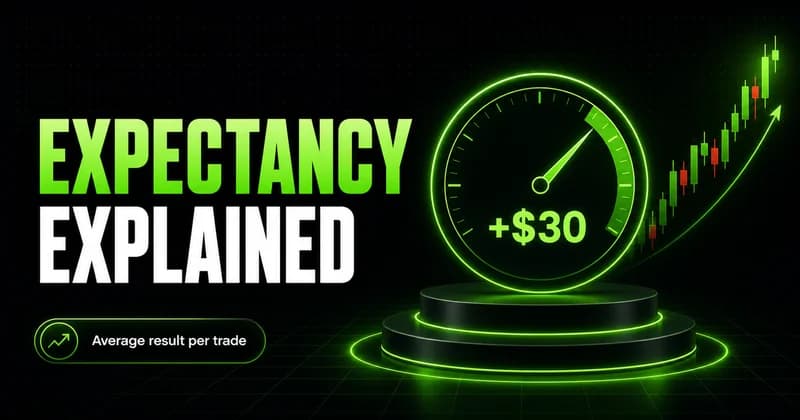
Expectancy is the average amount a strategy wins or loses per trade once you run it enough times for luck to wash out. It is the number that tells you whether a system makes money over a sample, not whether your last trade felt good. A win rate flatters you. Expectancy does not. It blends how often you win with how much you win and lose into a single figure, and that figure decides whether the account survives the year.
Most traders never calculate it. They track win rate because it is emotionally easier to read, then wonder why a strategy that wins most of its trades still bleeds the account dry. The market does not pay out on frequency. It pays out on the size of wins relative to the size of losses, weighted by how often each happens. That is exactly what expectancy measures.
What expectancy means in plain terms
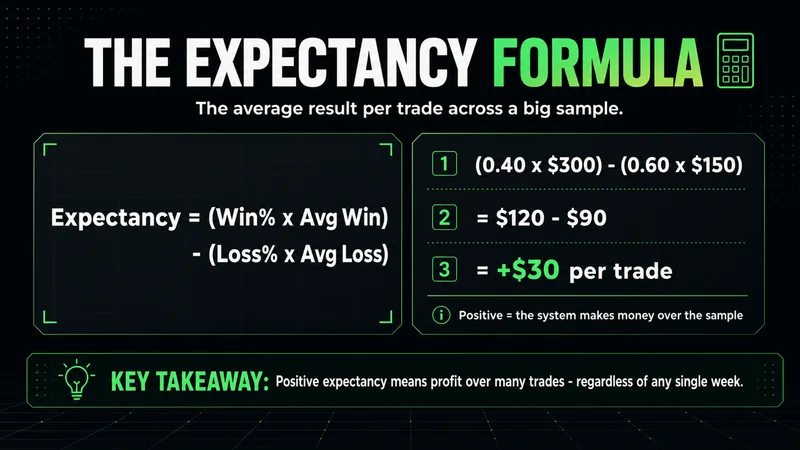
Expectancy answers one question. If I take this setup many times, what is the average result per trade? A positive number means the system makes money across the sample. A negative number means it loses, no matter how clean any single week looks. This is the expectancy meaning that matters in practice, stripped of jargon: it is your edge expressed in money or in risk units.
It is not a prediction about the next trade. The next trade is noise. Expectancy only describes behavior across a large enough sample, which is why a single green day tells you almost nothing about whether your process is sound.
The expectancy formula
The expectancy formula is straightforward:
Expectancy = (Win% × Average Win) − (Loss% × Average Loss)
Four inputs, nothing more. Your win percentage, the average size of your winners, your loss percentage, and the average size of your losers. The formula weights each side by how often it occurs, then nets them against each other. The result is the average outcome you can expect per trade if conditions hold steady.
Many traders prefer to express the inputs in R-multiples, where one R is the amount risked on the trade. Stated that way, expectancy reads as the average number of R you keep per trade, which makes systems with different position sizes directly comparable.
How to calculate expectancy step by step
Expectancy calculation needs a sample of closed trades, ideally several dozen or more. The expectancy example below uses round numbers to keep the arithmetic visible.
Suppose you have logged 50 trades. Twenty-four were winners and 26 were losers, so the win rate is 48% and the loss rate is 52%. Your average win was $150 and your average loss was $90. Run the formula:
Expectancy = (0.48 × $150) − (0.52 × $90) = $72.00 − $46.80 = +$25.20 per trade.
That is a positive expectancy of $25.20 per trade despite winning fewer than half the time. Over 50 trades, the system produced roughly $1,260 in expected return. The losing majority did not sink it, because the winners were large enough relative to the losers to carry the math.
Why win rate alone is misleading
This is the part most beginners miss. Expectancy vs win rate is not a close contest. A 70% win rate sounds like a strong system, but if the average loss is three times the average win, the expectancy is negative and the account dies slowly. The opposite holds too. A 35% win rate can be highly profitable if the winners dwarf the losers.
Win rate measures how often you are right. Expectancy measures whether being right pays. The market rewards patience and asymmetry far more than it rewards frequency, and the math here is the cleanest proof of that I know. Most traders do not have a strategy problem. They have a measurement problem, anchoring to the comfortable number instead of the honest one.
What is a good expectancy for new traders
This is where the vague advice usually stops. Most articles tell you positive is good and leave it there. A more useful expectancy benchmark for a new trader is to express the number in R and look for something durable rather than spectacular. A consistent expectancy of around 0.2R to 0.3R per trade, sustained across a real sample that includes losing stretches, is a genuinely workable edge for someone early in the curve.
The number itself matters less than its stability. A jittery 0.5R that swings to negative the moment volatility expands is worse than a steady 0.2R you can actually execute under pressure. Chase stability before you chase magnitude.
When expectancy lies
Here is the condition where the metric breaks down, and it gets skipped almost everywhere. A positive expectancy is only valid inside the market regime that produced it. If you measured your edge during a calm, range-bound stretch and volatility then expands, the average loss can widen faster than the average win, and the same formula that read positive last month reads negative now. The inputs are not fixed; they drift with conditions.
Gold trades technically for hours and then invalidates an entire move within minutes when macro volatility hits. An expectancy built only on the quiet hours does not survive contact with that. Treat the number as a reading of recent conditions, not a permanent property of your system. Recompute it across different regimes, and watch what happens to the average loss when liquidity thins out.
Common expectancy mistakes beginners make
A few expectancy mistakes show up repeatedly:
- Calculating it on too few trades, so a couple of lucky winners distort the average beyond anything reliable.
- Excluding losing trades or fees, which inflates the result into a number the account will never actually deliver.
- Treating one positive sample as permanent and ignoring how the inputs shift across regimes.
- Confusing a high win rate with a profitable system when the loss size quietly undoes it.
Each of these produces a number that looks like an edge but is not one. The fix is the same in every case: a larger, honest sample and a willingness to recompute when conditions change.
How to improve expectancy over time
Expectancy improvement comes from three levers, and only three. Raise the win rate, increase the average win, or cut the average loss. Most traders reach for the first because it feels like skill, but the third is usually the cheapest and most reliable. Tightening risk-defined invalidation so losers stay small does more for the bottom line than chasing a higher hit rate.
| Lever | What changes | Typical difficulty |
|---|---|---|
| Raise win rate | More trades close green | Hard — requires better selection |
| Increase average win | Hold winners longer with structure | Moderate |
| Cut average loss | Tighter, disciplined stops | Easiest and most durable |
The durable path runs through execution quality, not prediction. Smaller losses, winners managed against structure instead of emotion, and a sample large enough to trust. That is an expectancy checklist for trading review worth running every month, and it improves the number without forcing a single extra trade.
FAQs
What is expectancy in trading in simple terms? It is the average profit or loss per trade over a large sample, blending how often you win with how much you win and lose. A positive figure means the system makes money across enough trades; a negative one means it does not, regardless of any single good week.
How do you calculate expectancy? Use the formula Expectancy = (Win% × Average Win) − (Loss% × Average Loss). Pull the four inputs from a sample of closed trades and net the two sides against each other to get the average result per trade.
Can a low win rate strategy still be profitable? Yes. A system winning 35% of the time is profitable when the average winner is large relative to the average loser. Expectancy weights size against frequency, which is why asymmetry can outweigh a low hit rate.
How many trades do you need to measure expectancy reliably? Enough that a few lucky outcomes cannot dominate the average — several dozen at a minimum, and more is better. Small samples produce a number that reflects luck more than edge.
Why does expectancy matter in risk management? It tells you whether your edge actually pays before you size up on it. Risking real capital on a strategy with negative or unstable expectancy is the fastest way to lose an account, no matter how good individual trades feel.
Worth the read?