Tesla 2025 Revenue Breakdown — Profit Versus Promise
Tesla 2025 revenue breakdown: how automotive, energy, and services produce thin margins while AI expectations support a premium valuation.
Tesla 2025 revenue breakdown starts with a simple tension. Tesla produced $94.8 billion in FY2025 revenue, but only $3.8 billion reached net income. Automotive still funds the business, while much of the valuation depends on energy growth, autonomy, robotaxi, and Optimus becoming larger profit engines.
That distinction matters. Revenue explains the company Tesla is today. The valuation reflects the company investors believe it may become. A disciplined analysis must keep those two pictures separate, then define what evidence would bring them together.
“Tesla trades on the future, not this year’s earnings.” — FY2025 financial breakdown
Tesla 2025 revenue breakdown starts with the mix
Automotive generated $69.5 billion, or roughly 73% of total revenue. Energy generation and storage contributed $12.8 billion, while services and other produced $12.5 billion. The smaller divisions are no longer immaterial: energy increased 27%, and services and other increased 19%. Even so, neither has replaced the automotive operation as Tesla’s economic center.
This mix creates two different analytical jobs. First, measure whether the automotive business can defend volume and margin against price cuts and competition. Second, test whether energy and services can grow quickly enough to reduce dependence on vehicle economics. Treating every revenue dollar as equally valuable misses the issue because each segment has a different growth rate, margin profile, and capital requirement.
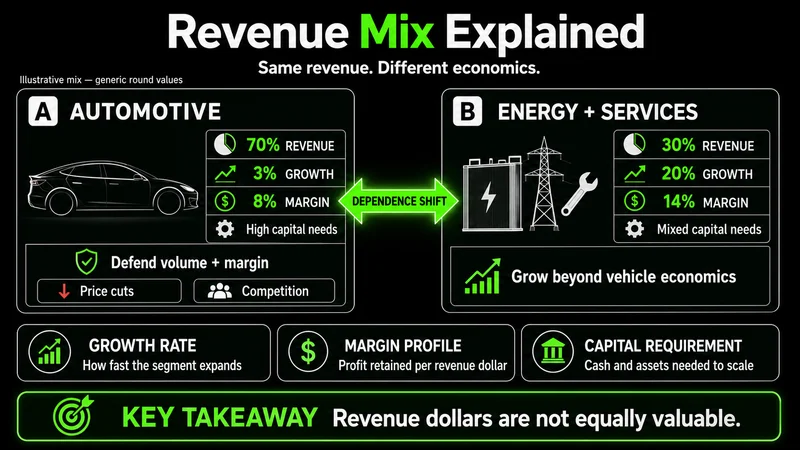 Automotive remains Tesla’s economic center despite faster growth in energy and services.
The practical principle is straightforward: follow the mix before following the narrative. If automotive revenue contracts while energy expands, total revenue may appear stable even though the company’s core engine is weakening. The reverse can also happen. Strong deliveries can lift the top line while aggressive incentives reduce the profit earned on each vehicle.
The margin funnel shows what revenue does not
Tesla reported $77.7 billion in cost of revenue, leaving $17.1 billion in gross profit and an approximately 18% gross margin. Operating income was $4.4 billion, or about 5% of revenue. Net income was $3.8 billion, which translates to a net margin near 4%.
For every illustrative $100 of revenue, about $18 remained after direct costs, roughly $5 survived at the operating level, and close to $4 reached net income. That is the concrete margin funnel behind the headline revenue number. It also explains why small changes in pricing, manufacturing costs, or operating expenses can create much larger percentage changes in earnings.
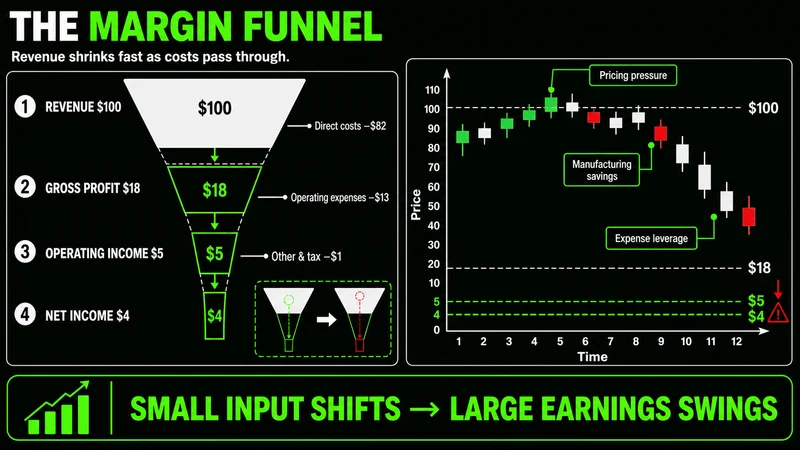 Direct costs and operating expenses reduce each illustrative $100 of revenue to about $4 of net income.
Research and development totaled $6.4 billion, while selling, general, and administrative expense was $5.8 billion. Those costs fund the autonomy, artificial intelligence, and robotics ambitions embedded in the valuation. They also weigh on current earnings. Net income fell 46% to $3.8 billion even though the company remained free-cash-flow positive.
The common mistake is to describe an 18% gross margin as if Tesla keeps 18 cents of every revenue dollar. It does not. Gross margin excludes operating costs such as research, administration, and other expenses below gross profit. The operating and net margins provide the stricter view of what remains for shareholders.
What moves Tesla stock beyond current earnings
Quarterly deliveries versus expectations remain a direct operating catalyst. A delivery beat can support confidence in demand and production. A miss can raise concerns about inventory, incentives, and pricing. The reaction should still be read beside automotive gross margin because volume bought through price cuts can weaken earnings quality.
Margin is the second confirmation point. Automotive gross margin excluding credits helps separate vehicle economics from regulatory support. If deliveries improve while margin stabilizes, the operating signal is stronger. If deliveries rise while margin falls, the market must decide whether Tesla is building durable demand or purchasing volume through lower prices.
FSD and robotaxi rollout progress, Optimus milestones, and energy-storage growth affect the future-business narrative. Elon Musk-related headlines, interest rates, and broader macro conditions can also shift sentiment. These factors often move the valuation multiple before they change reported profit. That makes the stock reactive to evidence, timelines, and credibility rather than earnings alone.
Why the valuation depends on an AI premium
The supplied comparison places Tesla near 370 times earnings, versus approximately 11 times for Toyota, 22 times for BYD, and 31 times for GM. The exact gap is the point: investors are not valuing Tesla as a conventional automaker. They are paying for possible economics from autonomy, robotaxi, Optimus, and energy storage.
The valuation gap is an AI-story premium. The bull case requires future businesses to produce enough revenue, margin, and cash flow to justify paying far more for each dollar of current earnings. The bear case argues that present car-company profits cannot support a software-like multiple. Both cases can be stated clearly without pretending the outcome is certain.
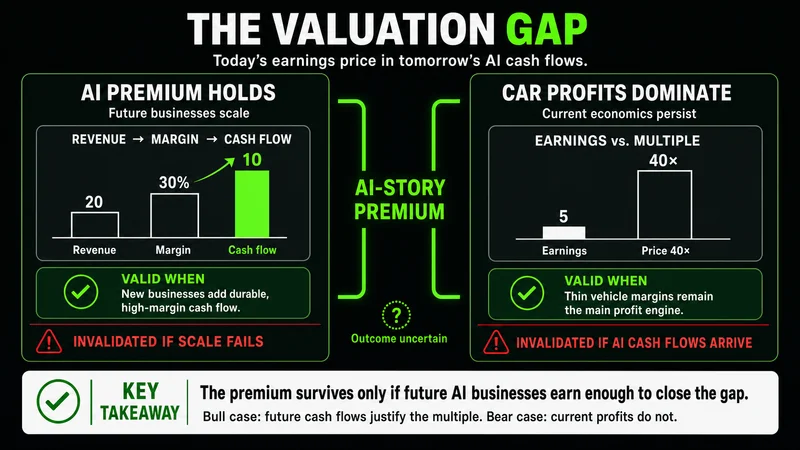 Tesla’s valuation gap represents expectations for autonomy, robotics, and energy profits.
A high multiple is not automatically proof that a stock must fall. It is evidence that expectations are demanding. When expectations are demanding, missed milestones can compress the multiple even if the company remains profitable. The stock can decline because investors lower the price they will pay for each dollar of earnings, not because earnings disappear.
The bear case begins with shrinking automotive economics
The operating risks are connected. Automotive revenue fell 10%, according to the breakdown, while price cuts and demand incentives pressured margins. BYD and legacy automakers can compete on price. Regulatory changes can alter subsidy or credit support. Execution delays can push FSD and robotaxi economics farther into the future.
Key-person risk also matters because company perception and strategic credibility are closely associated with Elon Musk. A distracting headline does not alter factory economics by itself, but repeated controversy can affect sentiment, customer behavior, regulatory relationships, or the multiple investors accept.
The most dangerous mistake is analyzing each risk in isolation. Weaker deliveries can lead to more incentives. More incentives can reduce margin. Lower margins can reduce current earnings. If autonomy milestones slip at the same time, investors may also reduce the future premium. Operating pressure and multiple compression can therefore reinforce each other.
The bull case needs measurable confirmation
The bull case becomes stronger when optionality turns into reported economics. Energy growth already provides one observable path toward a broader business mix. The next step is evidence that autonomy, robotaxi, or robotics can create durable revenue with attractive margins rather than remaining expensive development programs.
Useful confirmation would include stable or improving automotive margins, credible product milestones, fewer timeline slips, continued energy growth, and a clearer contribution from non-automotive profit. A single demonstration or announcement is weaker than repeatable commercial adoption. Execution quality matters more than the size of the promise.
Defined invalidation works in both directions. The bearish valuation thesis weakens if AI-related businesses begin producing material, repeatable profit while automotive margins stabilize. The bullish thesis weakens if deliveries deteriorate, price cuts keep compressing margins, and autonomy or robotics timelines continue slipping without commercial proof.
When this framework does not work cleanly
This framework is less reliable during short periods dominated by sentiment, macro shocks, or company-specific headlines. Interest-rate changes can reprice long-duration growth stocks even when Tesla’s operating data is unchanged. A sharp headline-driven move can also overwhelm the slower evidence from revenue and margins.
It also does not produce a precise fair value. A price-to-earnings comparison is most useful when businesses have comparable growth, risk, and earnings quality. Tesla’s automotive base and AI optionality make direct comparisons with Toyota, BYD, and GM informative but incomplete. The comparison identifies how much expectation is embedded in the price; it does not prove what that expectation is worth.
A disciplined reading separates facts from optionality
Start with the $94.8 billion revenue base and its segment mix. Follow the 18% gross margin through the 5% operating margin to the 4% net margin. Then judge deliveries, pricing, and competition against measurable progress in energy, autonomy, robotaxi, and robotics.
The central issue is not whether Tesla is only a car company or already an AI company. It is whether the future businesses can generate enough durable profit to close the gap between car-company earnings and an approximately 370-times-earnings valuation. Until that evidence appears, the multiple remains both the source of upside and the clearest invalidation risk.
Worth the read?