Indirect Investment — Meaning, Types, and Real Risks
Indirect investment means owning a fund that holds the asset for you. Here is what it means, the main types, the benefits, and the risks beginners miss.
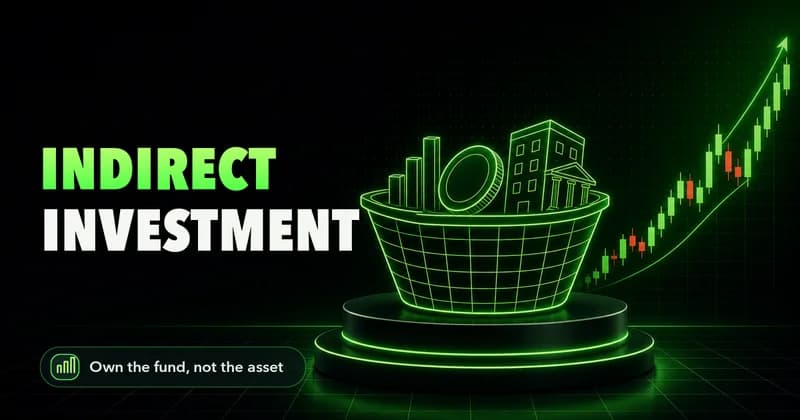
Indirect investment means you put capital into a fund or vehicle that owns the asset, instead of owning the asset yourself. You hold a share of a mutual fund, an exchange-traded fund (ETF), or a real estate investment trust (REIT), and that wrapper holds the stocks, bonds, or property. The exposure is real. The ownership is one step removed.
That gap matters more than most beginners think. When you buy an indirect investment, you are not just buying the underlying market. You are buying a manager's decisions, a fee schedule, and a set of rules about when you can get your money back. Understanding indirect investment starts with seeing what sits between you and the asset.
What indirect investment really means
The simplest indirect investment meaning is exposure through an intermediary. A pooled vehicle collects capital from many investors, buys a portfolio, and issues you a proportional claim on it. You own the fund. The fund owns the market.
This is the default path for most people, and for good reason. Diversification, professional management, and small minimums are hard to replicate on your own. The trade-off is control. You do not pick the individual positions, and you do not set the timing of what gets bought or sold inside the wrapper.
How indirect investment works under the wrapper
Capital flows in one direction and claims flow back the other way. You send money to the fund. The fund deploys it across holdings according to a stated mandate. You receive units or shares whose value tracks the net asset value of everything the fund holds, minus costs.
Those costs are the part beginners underestimate. An expense ratio, a management fee, and in some cases a performance fee all come out before your return is calculated. Indirect investing is mostly buying someone else's discretion and cost structure, then renting their diversification on top. That is not a criticism. It is the thing you are actually paying for, so it deserves attention.
Tracking error is the second hidden layer. A fund that aims to mirror an index rarely matches it exactly. Fees, cash drag, and trading frictions create a small, persistent gap between what the market did and what you received.
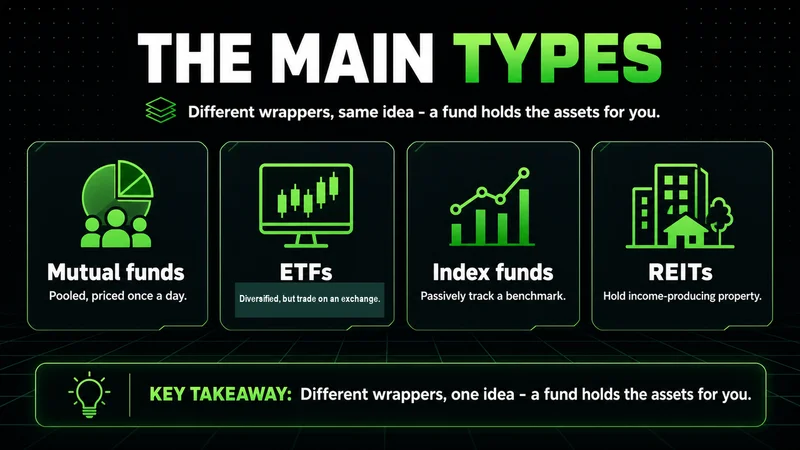
The main types of indirect investment
Most indirect investment types fall into a handful of structures:
Mutual funds. Pooled vehicles priced once a day, actively or passively managed, suited to long-term holding.
Exchange-traded funds (ETFs). Similar diversification, but they trade on an exchange through the session, so pricing and liquidity behave more like a stock.
Real estate investment trusts (REITs). Listed companies that own income-producing property, giving real estate exposure without holding the building.
Index and bond funds. Broad, low-cost baskets that track an equity index or a slice of the fixed-income market.
Hedge funds and private equity. Less liquid, higher-minimum vehicles where manager discretion and lockups dominate.
The structure you choose decides your liquidity, your cost, and how much the manager's judgment affects the outcome.
A simple indirect investment example
Here is a plain indirect investment example. You want exposure to commercial real estate, but you do not have the capital to buy a building, and you do not want to manage tenants. Instead, you buy shares of a REIT that owns offices and warehouses. You now have real estate exposure, rental income passes through as distributions, and you can sell your shares without listing a property.
The same logic applies across markets:
Want the S&P 500 without buying 500 stocks? Buy one index ETF.
Want bond exposure without picking individual issues? Buy a bond fund.
Want property income without a landlord's workload? Buy a listed REIT.
In each case the fund handles the holdings, and you hold the fund.
Indirect investment vs direct investment
The core of indirect investment vs direct investment is who holds the asset and who makes the decisions. Direct investment means you own the stock, the bond, or the property outright, with full control and full responsibility. Indirect investment hands the holding and most of the day-to-day decisions to a vehicle.
The split comes down to a few trade-offs:
Control. Direct gives you full say over holdings and timing; indirect hands most decisions to the manager.
Cost. Direct has no fund fees; indirect carries an expense ratio and sometimes more.
Effort and capital. Direct demands more of both; indirect lets you start small and stay passive.
Neither is better in the abstract. The right choice depends on how much time, capital, and conviction you bring.
The benefits of indirect investment
The indirect investment benefits are practical, not glamorous:
Diversification by default. One purchase spreads risk across many holdings.
Low minimums. You can start with a small amount and still own a broad portfolio.
Professional management. Someone else handles selection, rebalancing, and execution.
Liquidity in listed vehicles. ETFs and listed REITs can be sold during market hours.
For most beginners building a first portfolio, these benefits are the entire reason indirect investing exists. It removes the need to be an expert before you start.
The risks most beginners underestimate
The main risks of indirect investment are easy to overlook when markets are calm. Fees compound against you over decades. Manager underperformance is common, and you carry it whether or not you agreed with the decisions. You also inherit the wrapper's rules, including how and when you can exit.
That last point is where the framework breaks down. Indirect investing feels liquid until everyone wants out at once. In a sharp drawdown, correlations across holdings converge, the diversification you paid for thins out, and some funds gate redemptions or suspend them entirely. The structure that protected you on the way up can strand you on the way down, precisely when you most want your capital back. That is not a reason to avoid indirect investment. It is a reason to know which vehicles can lock and to size around it.
How to use indirect investment in a portfolio
For beginners asking how to use indirect investment in a portfolio, a short checklist keeps the decision disciplined:
Define the exposure you actually want before picking a product.
Read the expense ratio and total cost, not just the headline return.
Confirm the liquidity terms and whether the vehicle can gate redemptions.
Check what the fund truly holds, not what its name implies.
Size each position so a bad year in one wrapper does not damage the whole plan.
Common indirect investment mistakes beginners make usually trace back to skipping these steps. Chasing last year's top fund, ignoring fees, and assuming daily liquidity in an illiquid vehicle are the recurring three.
Most portfolios do not fail because the wrapper was wrong. They fail because the investor never read what the wrapper actually does. — MRPNL
FAQs
What is indirect investment in simple terms? It is investing through a vehicle that owns the asset for you, such as a mutual fund, ETF, or REIT. You hold a share of the fund, and the fund holds the underlying stocks, bonds, or property.
What is the difference between direct and indirect investment? Direct investment means you own the asset outright with full control and responsibility. Indirect investment means a fund owns the asset and makes most decisions, giving you diversification and management in exchange for fees and less control.
What are the main risks of indirect investment? The recurring risks are fees that compound over time, manager underperformance you cannot opt out of, and liquidity that can disappear when a fund gates or suspends redemptions during a sharp market drawdown.
Worth the read?