Joint Stock Company — What It Is and Why It Matters
A joint stock company is a business owned by its shareholders through tradable shares. Here is what that means and why it matters for investors.

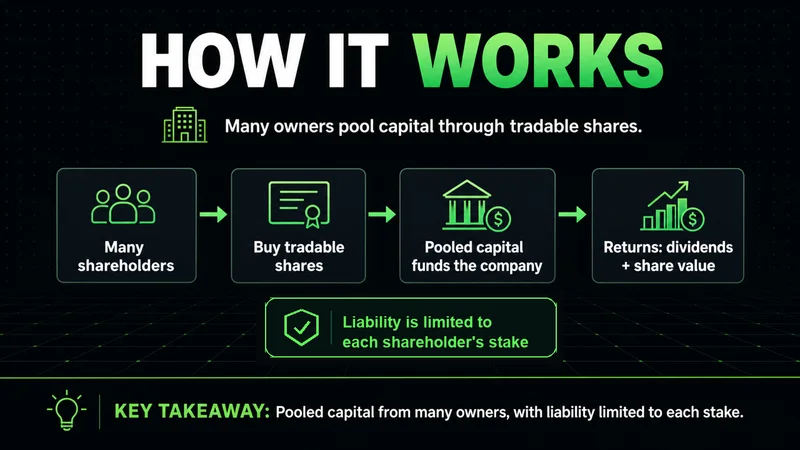
A joint stock company is a business owned by the people who hold its shares, where ownership is split into transferable units and each shareholder's loss is capped at what they paid in. That single arrangement — pooled capital, divided ownership, limited downside — is the structure behind almost every public company whose ticker you can pull up today. Understand it once and a lot of what happens on an exchange stops looking like noise.
The term feels academic, but it describes something concrete. When you buy a share, you are buying a slice of a joint stock company. The price moving on your screen is the market repricing that slice in real time. Knowing what you actually own changes how you read it.
What a joint stock company actually is
The joint stock company meaning comes apart into three parts. First, the capital is joint: many people contribute money rather than one owner funding everything. Second, that capital is divided into stock — standardized shares that can be bought, sold, or transferred without dissolving the business. Third, the company is usually a separate legal entity, so it can own assets, sign contracts, and be sued in its own name, independent of any shareholder.
Limited liability is the piece that made the structure dominant. A shareholder's exposure stops at the amount invested. If the company fails, creditors cannot reach a shareholder's house or savings. That cap is why strangers are willing to fund a business they will never manage — the worst case is defined before they commit a dollar.
How a joint stock company works
Ownership and control are deliberately separated. Shareholders own the company in proportion to their shares, but they do not run it. They elect a board of directors, the board appoints management, and management handles operations. A shareholder's direct power is mostly a vote and a claim on profits distributed as dividends.
The shares themselves are the moving part. Because they transfer freely, ownership can change hands constantly while the business carries on undisturbed. A founder can sell out, a fund can take a position, and the company's contracts, employees, and obligations stay intact. That continuity is structural, not accidental. It is also why a stock can trade millions of times without the underlying company noticing.
Where joint stock companies came from
The joint stock company history runs back further than the modern exchange. Early versions appeared in medieval Europe, but the form matured in the seventeenth century with chartered trading ventures. The English East India Company, chartered in 1600, and the Dutch East India Company, founded in 1602, let large numbers of investors fund expeditions too expensive and too risky for any single merchant to bankroll alone.
The logic was risk distribution. A voyage could sink, and with it the entire investment. Spreading that risk across many shareholders meant no single loss was fatal to any one of them. The Dutch East India Company went further and traded its shares on what became the first true stock exchange. The mechanics you watch today were drafted four centuries ago to solve a capital problem, not a trading one.
Joint stock company vs public company
The joint stock company vs public company question trips people up because the categories overlap. A joint stock company describes the ownership structure: capital divided into shares. Public versus private describes where those shares trade. A public company lists its shares on an exchange so anyone can buy them; a private one keeps ownership among a closed group. Every listed public company is a joint stock company, but not every joint stock company is public.
Aspect | Joint stock company | Public company |
|---|---|---|
What it describes | Ownership split into shares | Where shares are traded |
Who can own shares | A defined group or the public | Anyone, via an exchange |
Liability | Limited to the amount invested | Limited to the amount invested |
Disclosure | Varies by jurisdiction | Heavy regulatory disclosure |
For a trader, the practical line is liquidity and disclosure. A public listing means shares you can sell on demand and financials you are entitled to read. A private joint stock company offers neither reliably, even though the ownership mechanics are the same.
What a joint stock company looks like from an investor's seat
For investors, the structure decides what a share is worth holding. Two things matter most: the float and the gap between economic ownership and control. The float is the portion of shares actually available to trade. A small float can move violently on ordinary volume, because a normal order is large relative to what is changing hands. The role a joint stock company plays in markets is to convert a business into something divisible and tradable, and the float sets how smoothly that trading happens.
The second point is subtler. Owning shares gives you economic exposure, not operational control. Why a joint stock company matters for investors comes down to this: your upside is real, but your influence is usually negligible unless you hold a meaningful block. You are along for the ride that management and the board steer. That is the trade you accept in exchange for limited liability and easy entry and exit.
This matters at the screen, too. How a joint stock company affects trading shows up in liquidity and in how price reacts to ownership events — secondary offerings, insider sales, large holders unwinding. A thin float trades like a different instrument than a deep one, even when the headline business looks identical.
The risks you inherit as a part-owner
Limited liability caps your loss, but it does not remove risk — it relocates it. As a shareholder you sit last in line. If the company is liquidated, creditors and bondholders are paid before equity sees anything, and equity is often wiped out entirely. Your downside is capped at your investment, and your investment can still go to zero. The main risks to weigh are these:
Last-in-line claim. In a liquidation, equity is paid only after creditors and bondholders, so a share can go to zero.
Dilution. A joint stock company can issue new shares to raise capital, and each new share shrinks the percentage you own.
Agency conflict. Management runs the company, but its incentives do not always match yours, and boards do not always police that gap.
The business can grow while your slice of it shrinks, which is why dilution catches passive holders off guard. The agency problem is the one that compounds quietly — small misalignments between management and shareholders rarely show up in a single quarter.
There is a belief worth stating plainly here. Most account damage is not one dramatic loss; it builds quietly first. Owning a slice of a well-run joint stock company feels passive, which is exactly why position size and the price you pay deserve more attention than the story does — the structure protects you from unlimited loss, not from a bad entry.
This framework holds while the business is a going concern with a functioning market for its shares. It breaks down at the edges. In a forced liquidation, share transferability stops mattering because there is no buyer; in a fraud, the disclosures you relied on were never real. The structure assumes an orderly market and honest reporting. Strip either away and the protections you were counting on thin out fast.
FAQs
What is a joint stock company in simple terms? It is a business owned by its shareholders, where ownership is divided into tradable shares and each owner's loss is limited to what they invested. Buying a share makes you a partial owner with a claim on profits but no direct role in running the company.
How does a joint stock company work? Shareholders supply capital by buying shares and elect a board of directors, which appoints management to run operations. Shares can be bought and sold freely, so ownership changes hands without disrupting the business itself.
What is an example of a joint stock company? Any company whose shares trade on a stock exchange is one. Historically, the English and Dutch East India Companies were early examples that pooled investor capital to fund expensive trading voyages.
What is the difference between a joint stock company and a public company? Joint stock describes the ownership structure — capital split into shares. Public describes where those shares trade — on an open exchange. Every public company is a joint stock company, but a joint stock company can also be private.
Why does a joint stock company matter for investors? It is the structure that lets you own a fraction of a business with limited liability and easy entry and exit. It also defines your limits: economic exposure without operational control, and a last-in-line claim if the company fails.
What are the main risks of owning shares in a joint stock company? Your investment can fall to zero even though your loss is capped at what you paid. Beyond that, new share issuance can dilute your stake, and management's incentives may not align with yours.
Worth the read?