Investment — What It Is and How It Actually Works
Investment is capital you commit to an asset today expecting it to be worth more later. Here is what investment really means, how it works, and its risks.
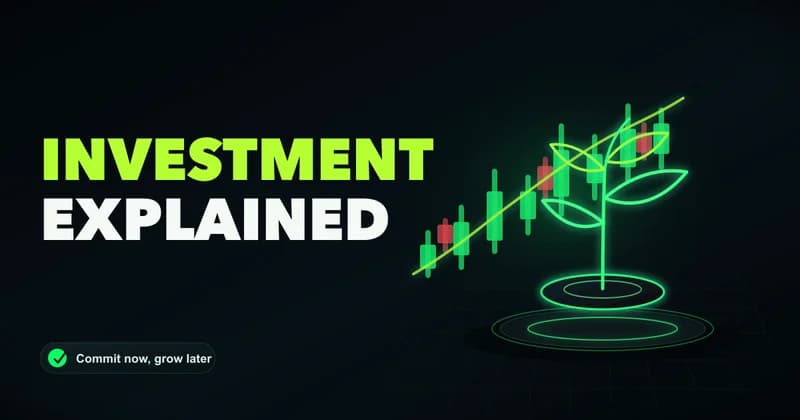
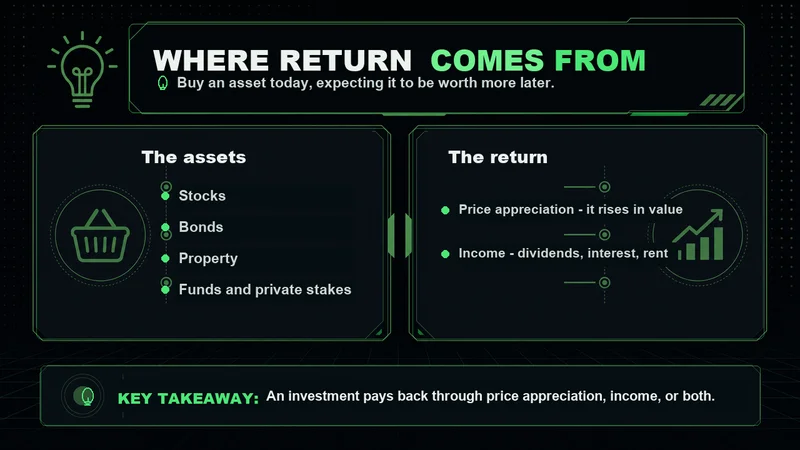
An investment is capital you commit to an asset today because you expect it to be worth more later, through price appreciation, income, or both. That is the whole idea in one sentence. Everything else is detail about which assets, over what time horizon, and at what risk. Most explanations of investment bury that simplicity under jargon, so we will keep the definition front and center and build outward from it.
The part that gets lost is the cost. Every investment is a decision to give up the certainty of cash now for an uncertain larger sum later. You are paid for accepting that uncertainty, not for being clever. Understanding investment well means understanding what you are actually being paid to tolerate, and when that payment stops being worth it.
What is investment, in plain terms
An investment is the purchase of an asset with the expectation of a future return. The asset can be a share of a company, a bond, a property, a fund that holds hundreds of those things, or a stake in a private business. The return can arrive as the asset rising in value, as a stream of income while you hold it, or as a mix of the two.
The investment meaning that matters in practice is the trade you are making with time. You hand over money you could spend or keep today. In exchange, you hold an asset whose value you do not control and cannot predict. The expectation of a return is reasonable, grounded in how the asset has behaved and what it produces. It is never a promise.
That distinction is the foundation. An investment expects a return; it does not promise one. The moment someone describes an investment as a sure thing, they are describing something else, and usually selling it.
How does investment work
Investment works through two engines: appreciation and income.
Appreciation is the asset becoming worth more than you paid. You buy a share at one price and, over years, the underlying business grows, earns more, and the share trades higher. Income is what the asset pays you while you hold it: dividends from stocks, interest from bonds, rent from property. Some assets lean on one engine, some on both.
Compounding is what turns those engines into something meaningful. When returns are reinvested rather than withdrawn, each year's gain produces its own gain the following year. Over a long horizon, the curve bends upward in a way that short holding periods never reveal. This is why time in the market tends to matter more than the precise entry price for a long-term investor. The effect is slow, then it is not.
None of this happens in a straight line. Asset prices move against you for stretches that feel much longer than they are. The investor who understands how investment works expects the drawdowns and stays positioned through them. The one who does not treats every decline as a signal to act, and usually acts at the worst time.
What are the main types of investment
The investment universe is large, but most of it sorts into a handful of categories. Each carries a different blend of expected return, risk, and liquidity. Here is how the common investment types compare.
Investment type | What it is | Primary return | Typical risk |
|---|---|---|---|
Stocks | Ownership in a company | Appreciation and dividends | High |
Bonds | A loan to a government or company | Interest income | Low to moderate |
Mutual funds and ETFs | A pooled basket of many assets | Mixed, diversified | Moderate |
Real estate | Property held for income or gain | Rent and appreciation | Moderate to high |
Cash equivalents | Savings, money market, short CDs | Interest | Very low |
A few notes on the table. Stocks carry the widest range of outcomes, which is exactly why they tend to reward patient holders over long periods. Bonds sit lower on both return and risk because you are a lender, not an owner, and lenders get paid before owners but rarely participate in the upside. Funds exist so a single purchase buys you a slice of hundreds of underlying holdings, which is the cheapest diversification most people will ever find.
Real estate behaves differently from the rest because it is illiquid and lumpy. You cannot sell a third of a building on a Tuesday afternoon. Cash equivalents are barely investments at all in the return sense; they are where capital waits, preserving value while it looks for a better use.
A simple investment example
Concrete numbers make the mechanics clear. Say you buy one share of a company at 100. Over the next year, the business performs well and the share trades at 110. It also pays a dividend of two during that year. Your total return is the 10 of appreciation plus the two of income, which is 12 on a 100 cost, or 12 percent.
Now hold that same position for several years and reinvest each dividend into more shares. The dividends buy shares, those new shares pay their own dividends, and the position grows from two directions at once. The headline price did most of the work in year one. Compounding does an increasing share of it every year after.
This investment example for investors is deliberately small. The logic does not change with size. A diversified fund works the same way, only the single share is replaced by a basket, which smooths the path without altering the engine underneath.
What are the benefits of investing
The case for investing rests on a single uncomfortable fact: cash loses value over time. Inflation erodes purchasing power quietly, year after year, so money left idle does not stay still. It shrinks in real terms. The first benefit of investment is simply keeping pace with, and ideally outrunning, that erosion.
The deeper benefit is compounding over a long horizon. Returns that reinvest grow on a curve, and the earlier the capital is put to work, the more time that curve has to bend. A modest sum invested early can outweigh a larger sum invested late, because time, not amount, is the dominant variable in the equation.
Investing also builds ownership. When you hold equities, you own a piece of productive businesses that earn, grow, and adapt. That ownership is the mechanism by which long-term wealth has historically been built. The benefits of investment are real, but they are earned slowly and only by capital that stays committed through the rough stretches.
What are the risks of investment
Every benefit above has a cost on the other side of the ledger, and naming the risks honestly is more useful than listing the upside again.
The main risks of investment fall into a few categories:
Market risk — the asset's price falls because the whole market falls, regardless of how the underlying business performs.
Inflation risk — the return fails to outpace rising prices, so you gain in nominal terms but lose in real ones.
Liquidity risk — you need to sell, but the asset cannot be sold quickly at a fair price, which is acute in real estate and private holdings.
Concentration risk — too much capital sits in one position, so a single bad outcome damages the whole portfolio.
Behavioral risk — the investor sells in fear near the bottom and buys in confidence near the top, converting temporary declines into permanent losses.
That last one quietly does the most damage. The asset recovers; the investor who sold the decline does not participate in the recovery. Risk in investment is not only what the market does to you. It is also what you do to yourself when the market moves against your position and patience runs out.
This is where the whole framework breaks down: it assumes you can hold. The expected return on a diversified portfolio is a long-horizon number, and it only belongs to the investor who stays positioned across the full horizon. Add leverage, concentrate the capital, or be forced to sell into a drawdown because the money was needed sooner than planned, and the math inverts. The same volatility that compounds in your favor over decades can end the position in months. The strategy is sound only while the holding period is genuinely yours to control.
Investment vs trading, and why the difference matters
Investment and trading both involve buying assets, but they are different activities with different time horizons, different edges, and different failure modes. Conflating them is a common and expensive mistake.
Investing is a long-horizon commitment to an asset's underlying growth. The investor accepts short-term volatility as the price of long-term appreciation and income. The holding period is measured in years. The edge comes from time, diversification, and the patience to do very little.
Trading is short-horizon and reactive. The trader is positioning around price behavior, liquidity, and momentum over hours, days, or weeks, not the multiyear growth of a business. The edge comes from execution quality and risk management on a far tighter loop, where a single position is risk-defined and exited the moment the idea is invalidated.
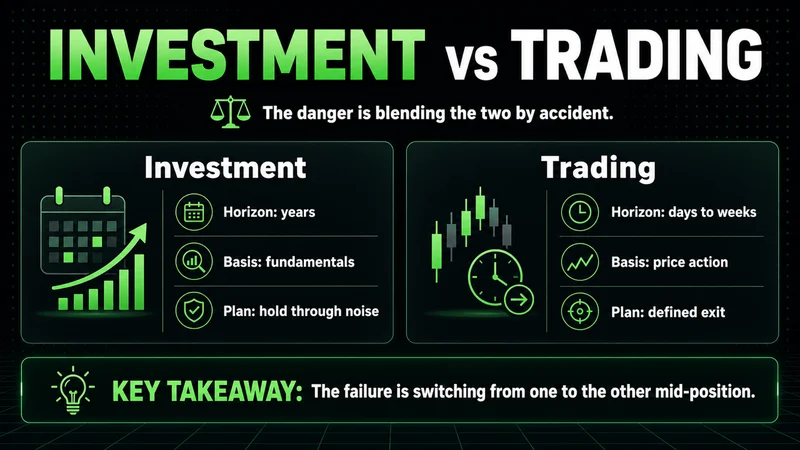
The investment vs trading explained distinction is not about which is better. It is about not blending the two by accident. The most common failure is buying something as a long-term investment, watching it fall, and then managing it like a trade, or buying a trade and holding it for years because it went against you. Pick the horizon before you buy, and let the horizon govern how you manage the position.
Investment for beginners: where to actually start
The first step in investing is not choosing an asset. It is making sure your financial base can survive being left alone. Capital that might be needed next month has no business in a multiyear investment, because the one thing that breaks the math is being forced to sell at the wrong time.
A workable sequence for a beginner looks like this:
Build a cash reserve that covers several months of expenses, so a surprise does not force you to liquidate.
Clear high-interest debt, since paying down a high rate is a certain return that most investments cannot match.
Define the horizon and the goal before buying anything, because the goal decides the asset, not the other way around.
Start broad and diversified, usually through a low-cost fund, rather than concentrating in a single name you happen to like.
Automate contributions and then do less, since most damage comes from acting, not from waiting.
Here the market rewards patience far more than activity. Newer investors usually believe they need to do more: more trades, more research, more adjustments. In practice, most need to do less and hold longer. The temptation to act on every headline is the single most reliable way to underperform the very assets you own.
What factors should you weigh before investing
Before any capital moves, a short checklist forces the decisions that actually matter. This is the investment checklist for investors that keeps the horizon honest:
Time horizon — when will you realistically need this money back?
Risk tolerance — how large a temporary decline can you hold without selling?
Diversification — is the capital spread across assets, or concentrated in one?
Cost — what are the fees, and how much do they compound against you over decades?
Liquidity — can you access the money if you need it, or is it locked up?
Run a position against those five before you buy it, not after it falls. The checklist is boring on purpose. Boring is what survives the years it takes for an investment to actually work.
FAQs
What is investment in simple terms? It is committing money to an asset today because you expect it to be worth more later, through price appreciation, income, or both. You give up certain cash now for an uncertain larger sum later, and the expected return is your payment for accepting that uncertainty.
What is the difference between investment and trading? Investment is a long-horizon commitment to an asset's underlying growth, held for years, with an edge built on patience and diversification. Trading is short-horizon and reactive, positioning around price behavior over hours to weeks, with an edge built on execution and tight risk management. The mistake is blending the two by accident.
How does investment work for beginners? It works through appreciation and income, amplified by compounding when returns are reinvested over time. For a beginner, the practical mechanics matter less than the discipline of building a cash reserve first, diversifying broadly, and then leaving the position alone long enough for compounding to do its work.
What are the main risks of investment? Market risk, inflation risk, liquidity risk, concentration risk, and behavioral risk. The last is the most damaging, because selling into a decline turns a temporary loss into a permanent one. Most of an investor's risk comes from their own reaction to volatility, not from the asset itself.
Why does investment matter for beginners? Because cash loses value to inflation while it sits idle, and compounding rewards capital that starts early far more than capital that starts large. Time is the dominant variable, so the earlier a beginner begins, the more the curve has to work in their favor.
Related reading to go deeper
Investment is the foundation, and the practical edges live in the topics next to it. From here, the natural next steps are understanding how risk management governs position size, how diversification actually reduces the chance of a permanent loss, and how a clear time horizon changes which assets belong in a portfolio. Each one builds on the same idea you started with: an investment is a paid bet on time, and the payment only arrives for the capital disciplined enough to wait for it.
Worth the read?