Margin Requirement — What It Is and Why It Matters
A margin requirement is the minimum capital you must post to hold a leveraged position. Here is what it means, how it works, and where it goes wrong.

A margin requirement is the minimum amount of your own capital you must put up to open and hold a leveraged position. It is the floor your broker sets, not the ceiling your ambition wants. Most traders treat the margin requirement as a green light. It is closer to a speed limit: the number tells you how little you are allowed to commit, which is a very different thing from how much you should.
What a margin requirement actually is
A margin requirement is the percentage of a position's full value that you must cover with your own cash or equity. The rest is borrowed buying power extended by the broker. If the requirement is 50%, a $20,000 position needs $10,000 of your capital, and the other $10,000 is leverage.
There are two layers to it. The first is regulatory: in U.S. equities, the Federal Reserve's Regulation T sets the standard initial requirement at 50%, and FINRA's rules set a maintenance floor near 25%. The second layer is the broker's own house requirement, which can sit well above the regulatory minimum on volatile or thinly traded names. The requirement you actually trade against is whichever is higher.
Initial margin versus maintenance margin
The two numbers govern different moments in a trade's life. Initial margin is what you need to open. Maintenance margin is what you need to keep the position alive.
| Requirement | When it applies | Typical equity level | What happens if you miss it |
|---|---|---|---|
| Initial | Opening the position | About 50% under Reg T | The order is rejected before it fills |
| Maintenance | Holding the position | About 25% house minimum | A margin call, then forced liquidation |
The gap between the two is where most accounts get hurt. You can open a trade comfortably at the initial level and still drift into a maintenance breach as the position moves against you. The requirement did not change. Your equity did.
A margin requirement example, worked through
Here is a margin requirement example a beginner trader can follow end to end. You want 200 shares of a stock priced at $100, a $20,000 position.
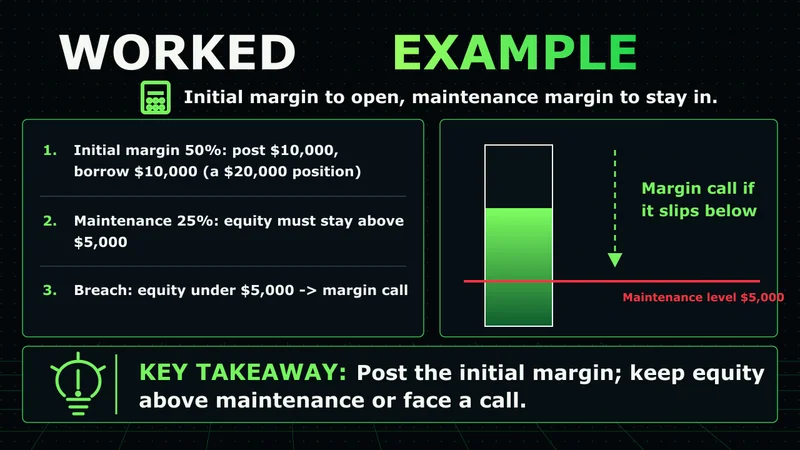
The calculation runs in three steps:
- Initial margin: at 50%, you post $10,000 of your own capital and borrow $10,000.
- Maintenance check: at a 25% requirement, your equity must stay above $5,000 as the price moves.
- The breach point: if your equity slips under that line, you face a margin call.
The breach point is the part that surprises people. Because you control $20,000 of stock with $10,000 of equity, a drop of roughly 33% in the share price, not 50%, is enough to pull you under a 25% maintenance line. Leverage moves the failure point closer than the headline requirement suggests.
Margin requirement versus leverage
Margin requirement versus leverage is the distinction most explainers blur. They are two views of one relationship. The requirement is the slice of capital you must commit; leverage is the multiple that slice buys. A 50% requirement permits 2:1 leverage, a 25% requirement permits 4:1, a 10% requirement permits 10:1.
The requirement is the input you can see. The leverage is the risk you actually carry. Traders fixate on the first and ignore the second, which is how a position that satisfies every requirement still ends up oversized. The requirement tells you the trade is permitted, not whether it is survivable.
Why the requirement moves against you in volatility
Margin requirements are not static. When volatility expands, brokers raise house requirements on the affected instruments, often without much warning. A name you held at 25% maintenance can jump to 40% or higher during a stress event.
That shift matters most to the traders who sized to the minimum. If your equity was already sitting just above the maintenance line, a mid-session requirement hike can trigger a margin call on a position that was fine an hour earlier. The market did not have to move against you. The rule moved.
Most blown accounts do not start with a bad analysis. They start with a position sized to the requirement instead of to the risk.
This is the condition where treating the requirement as your guide breaks down. In calm markets, sizing close to the minimum looks efficient. In a volatility expansion, the same approach hands the broker the timing of your exit. The requirement protects the broker first; it was never built to protect your process.
Where beginners get the margin requirement wrong
The most common margin requirement mistakes beginners make share one root: treating the minimum as a target. A few patterns show up again and again.
- Sizing to the initial requirement, which leaves no buffer for the maintenance line.
- Forgetting that the broker can raise house requirements above the regulatory floor at any time.
- Confusing the requirement with the actual risk, when leverage is the number that decides survival.
- Ignoring the account rules that govern how maintenance is calculated across multiple open positions.
The fix is not complicated. Size the position to the loss you are willing to take, then check that the margin requirement allows it, rather than letting the requirement set the size for you. The requirement is a constraint to respect, not a plan to follow.
FAQs
What is margin requirement in trading? It is the minimum percentage of a position's value you must fund with your own capital to open and hold it on margin. The broker extends the rest, and the requirement defines how much of the risk stays on your side.
How does margin requirement work in trading? Two layers apply at once. A regulatory initial requirement, near 50% in U.S. equities, governs opening the position, and a maintenance requirement, near 25%, governs holding it. Your equity must stay above the maintenance line or you face a margin call.
What is the difference between margin requirement and leverage? The requirement is the share of capital you must commit; leverage is the multiple that share buys. A 50% requirement permits 2:1 leverage, a 25% requirement permits 4:1. The leverage, not the requirement, is the risk you actually carry.
Is margin requirement important for beginners? Yes. It sets the boundary of how much you can lose relative to what you put in. Beginners who size to the minimum instead of to a defined risk are the first ones forced out when volatility expands and brokers raise the bar.
Worth the read?