Asset Classes Explained — What Traders Need to Know First
Asset classes are the structural foundation of every trading decision. Learn what they are, how they differ, and why understanding them matters for traders.

Asset classes are not just categories textbooks use to organize investments. They are the structural foundation that determines how capital behaves under different conditions. In trading, understanding asset classes means understanding what you are actually exposed to when you put on a position.
Every market participant, from passive investors to active futures traders, interacts with asset classes daily. The difference is that experienced traders think in terms of risk characteristics and correlation, not just labels.
What Are Asset Classes in Trading
An asset class is a group of financial instruments that share similar characteristics, behave similarly under market pressure, and are subject to the same regulatory and economic forces. Each class carries a distinct risk-and-return profile, and each responds to different catalysts.
The five most widely recognized asset classes are:
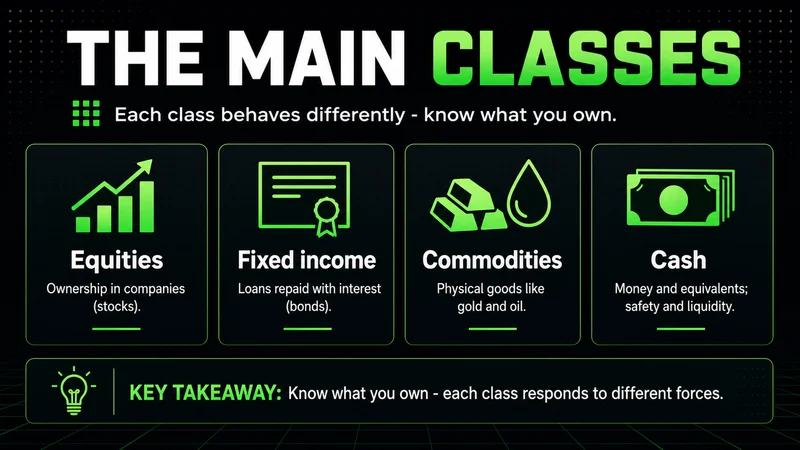
- Equities — ownership stakes in publicly traded companies, tied to earnings growth, sentiment, and economic cycles.
- Fixed income — government and corporate bonds that provide predictable cash flows through interest payments, with returns driven by interest rate expectations and credit quality.
- Commodities — physical goods like gold, crude oil, natural gas, and agricultural products that trade based on supply-and-demand dynamics.
- Currencies — pairs traded on the foreign exchange market, reflecting the relative strength of economies and central bank policy.
- Derivatives — options, futures, and swaps that derive value from an underlying asset and are used for speculation, hedging, and risk transfer.
Each class behaves differently under stress. Equities tend to sell off during economic downturns. Bonds often rally when growth slows. Commodities respond to inflation expectations and supply disruptions. Understanding these dynamics is the first step in building a framework that goes beyond picking individual trades.
Why Understanding Asset Classes Matters for Your Portfolio
Most traders who underperform are not failing because of bad analysis. They are failing because they do not understand what they own and how those positions interact. Asset class knowledge is the foundation of portfolio construction.
When equities sell off, bonds often rally. When inflation rises, commodities tend to benefit. These relationships do not always hold, but they are consistent enough to shape how professional capital is allocated.
Consider what happened during periods of rapid interest rate hikes. Equity valuations compressed, bond prices fell sharply, and commodities surged. A portfolio concentrated in a single asset class would have experienced extreme drawdowns, while a diversified approach would have cushioned the impact.
The market rewards patience far more than activity. Traders who understand asset classes can wait for conditions that favor their approach instead of forcing trades in environments where their edge does not apply.
Asset Classes vs Financial Markets Explained
A common point of confusion for newer traders is the difference between asset classes and financial markets. They are related but not the same thing.
An asset class describes what you are trading. A financial market describes where you are trading it. Equities are an asset class. The New York Stock Exchange is a financial market. Bonds are an asset class. The over-the-counter bond market is where they trade.
This distinction matters because the same asset class can behave differently depending on the market structure. A stock trading on a major exchange during regular hours has tight spreads and deep liquidity. The same stock in pre-market or after-hours sessions may have wider spreads and thinner order books. The asset class is identical, but the market conditions change execution quality and risk.
How Diversification Across Asset Classes Works
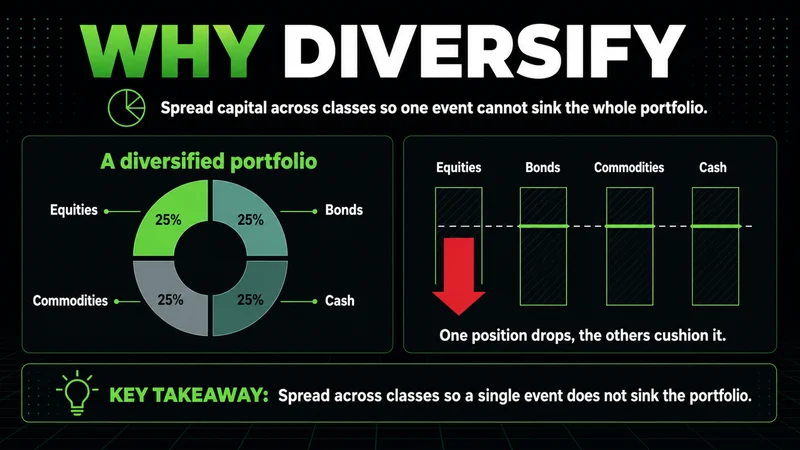
Diversification is the practice of spreading capital across different asset classes to reduce the impact of any single position or market event on overall portfolio performance. The principle is straightforward: different asset classes respond to different catalysts, so losses in one area may be offset by stability or gains in another.
A simple example: during an equity sell-off driven by recession fears, government bonds often appreciate as investors seek safety. Gold, a traditional store of value, may also rally during periods of uncertainty. Holding positions across these three classes reduces the probability that a single event wipes out the portfolio.
But diversification has limits. During acute liquidity crises, correlations across asset classes tend to spike. In March 2020, equities, bonds, and commodities all sold off simultaneously as institutions liquidated everything to meet margin calls. The standard playbook of asset-class diversification offered little protection in those first weeks.
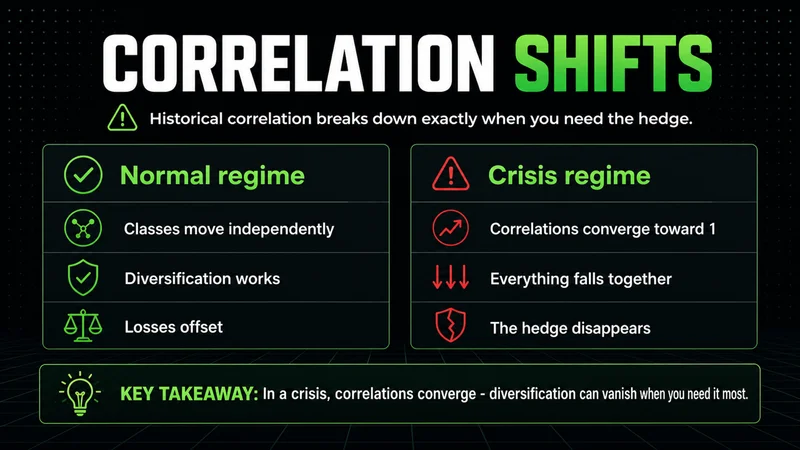
This is where most diversification advice breaks down. Correlation is not static. It shifts with market conditions, liquidity, and sentiment. Traders who rely on historical correlation without accounting for regime changes are exposed to exactly the risk they thought they had hedged.
The practical approach is to understand why asset classes move together or apart, not just that they have historically done so. Liquidity conditions, central bank policy, and risk sentiment are the real drivers of cross-asset correlation.
How to Choose Asset Classes for a Trading Plan
Choosing which asset classes to trade is not about picking the most exciting market. It is about aligning your capital with conditions that match your strategy, risk tolerance, and available screen time.
When evaluating asset classes for your plan, consider these factors:
- Risk tolerance — some classes, like derivatives and currencies, carry higher volatility and require tighter risk controls. Others, like fixed income, offer more predictable behavior.
- Time horizon — equities and commodities suit active traders who can monitor intraday structure. Bonds and real estate tend to attract longer-term capital.
- Liquidity needs — futures on major indices provide deep order books and extended hours. Small-cap equities or niche commodities may have wider spreads and thinner volume.
- Knowledge base — trading crude oil requires understanding inventory reports and OPEC dynamics. Equities demand familiarity with earnings cycles and sector rotation.
Equities offer broad opportunity across sectors and market caps. They respond to earnings, macroeconomic data, and sentiment. For traders who follow market structure and institutional price action, equities provide deep liquidity and clear technical patterns during regular trading hours.
Fixed income is driven primarily by interest rate expectations and credit conditions. Bond trading requires understanding central bank policy and yield curve dynamics. It tends to attract traders with a longer time horizon and a focus on macroeconomic themes.
Commodities reward traders who understand supply chains, seasonal patterns, and geopolitical risk. Crude oil, for example, responds to OPEC decisions, inventory reports, and global demand shifts. Gold trades inversely to real interest rates and serves as a hedge during uncertainty.
Currencies reflect the relative strength of economies. Forex trading demands an understanding of central bank policy differentials, trade balances, and capital flows. The market operates 24 hours a day during the trading week, which creates both opportunity and fatigue risk.
Derivatives allow traders to express directional views, hedge existing positions, and manage exposure. Futures on indices like the Nasdaq or S&P 500 are popular among active traders because of their liquidity and extended trading hours. Options provide risk-defined exposure but require understanding of pricing models and time decay.
The right asset class is the one where your edge is most consistent and your risk management is most disciplined. Forcing trades in unfamiliar asset classes usually ends the same way: with avoidable losses.
Asset Classes in Summary
Asset classes are the building blocks of every trading decision. Equities, fixed income, commodities, currencies, and derivatives each carry distinct risk-and-return characteristics that respond to different market forces.
Understanding these distinctions is not academic. It directly affects how you size positions, manage risk, and allocate capital across different market conditions. Traders who treat asset classes as interchangeable categories miss the structural differences that drive performance.
The key points to carry forward:
- Asset classes group instruments by shared risk-and-return characteristics, not by ticker or sector.
- Diversification across classes reduces single-event exposure, but correlation spikes during liquidity crises.
- Choosing the right class means matching your strategy, risk tolerance, and screen time to the market's structure.
The most effective approach is to start with one or two asset classes, develop deep familiarity with how they behave under different conditions, and expand only when consistency is established. Spreading attention across too many markets too early usually dilutes execution quality without improving returns.
Markets reward discipline. Asset class knowledge is one of the clearest ways to apply it.
Worth the read?