Options in Trading — What They Are and How They Work
Options are contracts giving the right, not the obligation, to buy or sell at a set price. Here is how options work, their risks, and what beginners need.
Options are contracts that give you the right, but not the obligation, to buy or sell an asset at a fixed price before a set date. That single distinction — a right instead of a promise — is what separates options from owning the underlying stock or future outright, and it is where most of the confusion for new traders begins. An option is a position on price, time, and volatility at once, not just on direction.
Most beginner explainers stop at calls and puts and move on. The harder truth is that an option can be directionally correct and still lose money, because time and volatility are working against you the whole time you hold it. Understanding that is more useful than memorizing another payoff diagram.
What options actually are, in plain terms
The options meaning that matters in practice is simple. You are buying or selling a contract tied to an underlying asset — a stock, an index, or a future. The contract specifies a price, called the strike, and an expiration date. One equity options contract typically controls 100 shares of the underlying, so a small premium can represent a large amount of exposure.
This is leverage, and it cuts both ways. A modest move in the underlying can produce an outsized gain or a total loss of the premium you paid. The options market exists because different participants want different things from the same price move: some want defined-risk exposure, some want to hedge a position they already hold, and some want to collect premium by selling that exposure to others.
The core terms are worth getting right before anything else:
- Strike price — the level at which the contract can be exercised.
- Premium — what the buyer pays and the seller receives for the contract.
- Expiration — the date the contract stops existing.
- Underlying — the asset the contract is written on.
- In, at, or out of the money — where the strike sits relative to the current price.
Calls and puts: the two contracts you actually trade
Every option is either a call or a put. A call gives the buyer the right to buy the underlying at the strike. A put gives the buyer the right to sell it at the strike. For each contract there is a buyer and a seller, and their risk profiles are not symmetrical.
- A call buyer profits if price rises well above the strike, and risks only the premium paid.
- A put buyer profits if price falls well below the strike, and again risks only the premium.
- A call or put seller collects the premium up front but takes on the obligation to deliver, which can mean substantial or, for a naked call, theoretically unlimited risk.
Buying defines your risk to the premium. Selling does not, unless it is structured against another position. For someone learning, that distinction should shape every early decision about which side to be on.
How options work in financial markets
The price of an option is not just a function of where the underlying trades. It reflects three things at once: how far the strike is from the current price, how much time remains until expiration, and how much movement the market expects, which shows up as implied volatility.
Time is the part beginners underestimate. An option is a decaying asset. Every day that passes with the underlying sitting still, the contract loses a little value — this is time decay, and it accelerates as expiration approaches. You can be right about direction, enter too early, and watch the position bleed out before the move arrives.
Volatility is the other moving part. When the market expects large moves, premiums rise; when it expects calm, they fall. Buy an option when implied volatility is high and the underlying can move in your favor while the option still loses value, because the volatility premium drained faster than direction helped. This is the most common way a directionally correct trade still ends red.
The first move after major news is often not the cleanest opportunity. In options, that is doubly true, because volatility is usually priced at its richest exactly when the headline hits.
Options examples for beginner traders
A concrete example makes the mechanics land. Say a stock trades at 100 and you buy a call with a strike of 105 expiring in a month, paying a premium of 2 per share, or 200 for the contract.
- If the stock rises to 115 by expiration, the call is worth 10 — a gain of 8 per share, or 800 on the contract, against your 200 risk.
- If the stock sits at 100 or drifts to 104, the call expires worthless and you lose the full 200.
- If the stock rises to 106, the call is worth 1 at expiration — you were directionally right and still lost money, because the move did not clear your strike plus the premium.
That third outcome is the one new traders skip past, and it is the most instructive. Being right on direction is necessary but not sufficient. The move has to be large enough, and fast enough, to overcome both the strike distance and the premium you paid. Options examples for beginner traders should always include the case where the call was correct and still unprofitable, because that is the realistic case.
Options vs futures: choosing the right tool
Options and futures both let you take a leveraged position on an underlying, but they are not interchangeable, and the choice matters more than most beginners realize. A futures contract is an obligation — you are committed to the position and your loss is not capped at a premium. An option you buy is a right, with loss capped at the premium paid.
| Feature | Long option (bought) | Futures contract |
|---|---|---|
| Commitment | Right, not obligation | Firm obligation to settle |
| Maximum loss (buyer) | Limited to premium paid | Not capped; can exceed margin |
| Time decay | Works against the buyer | None on the contract itself |
| Volatility exposure | Direct and significant | Indirect, through price only |
| Typical use | Defined-risk directional bets, hedging | Direct directional exposure, hedging |
Futures give you clean, linear exposure with no time decay, which is why disciplined directional traders often prefer them. Options give you defined risk and the ability to express a view on volatility itself, at the cost of paying for time. Neither is better in the abstract. The right tool depends on whether you want capped risk and volatility exposure, or linear exposure with no decay.
The main risks of options trading
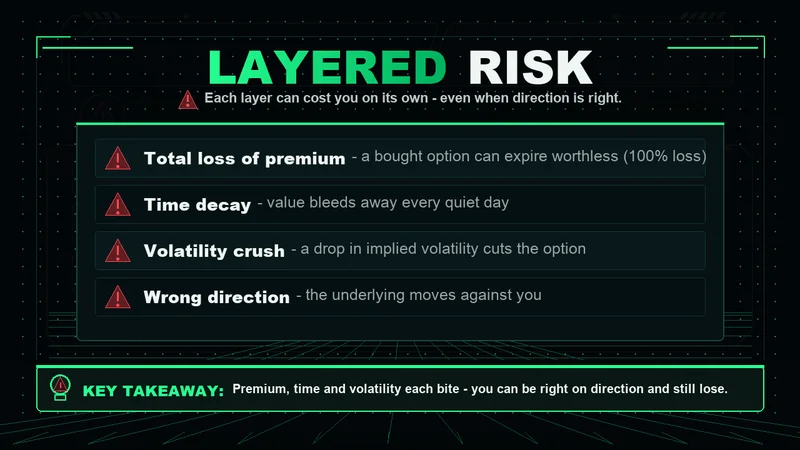
Options risk is not only the risk of the underlying moving against you. It is layered, and each layer can cost you independently.
- Total loss of premium — a bought option can expire worthless, a 100% loss on that position.
- Time decay — holding through a quiet period erodes value even when nothing goes wrong directionally.
- Volatility collapse — a drop in implied volatility lowers the premium regardless of price.
- Assignment — a seller can be obligated to deliver or take on shares at the worst time.
- Leverage — the same exposure that magnifies gains magnifies losses, and position sizing is easy to get wrong when one contract controls 100 shares.
The leverage point deserves the most attention. Because a small premium represents a large notional position, it is simple to take on far more exposure than the account can absorb. If a single losing contract changes how you make your next decision, the position was too large. That is a sizing problem, not an options problem, and it ends more beginner accounts than bad direction does.
Are options good for beginner traders?
This is where the honest answer separates from the marketing. Options can be a defined-risk way to learn, but only under specific conditions. Buy simple long calls or puts, in small size, on liquid underlyings, with enough time to expiration that decay is not the dominant force, and you have a controlled environment to learn the mechanics.
That framework breaks down fast outside those conditions. Sell options without understanding assignment, trade illiquid contracts with wide spreads, or reach for short-dated expirations chasing cheap premium, and the same instrument that taught discipline starts punishing it. Zero-day and naked-selling strategies in particular are not beginner territory, no matter how they are presented online. The tool is fine; the way most beginners are encouraged to use it is not.
Most traders do not have a strategy problem. They have a discipline problem, and options amplify that problem because the leverage and the decay leave no room for sloppy sizing or impatient entries.
What you need before you trade options
Options trading basics include the operational reality of getting access. You cannot simply place an options trade in a standard brokerage account. There are options account requirements that every broker enforces, set by regulation and the broker's own risk rules.
A realistic checklist before your first trade:
- Get options approval — brokers assign an approval level based on your experience, income, and stated objectives. Lower levels permit buying calls and puts; higher levels permit spreads and naked selling.
- Fund the account appropriately — some strategies require margin, and selling options can demand significant capital to cover assignment risk.
- Understand the contract specs — multiplier, expiration cycle, and settlement style for whatever you trade.
- Define risk before entry — know the maximum loss on the position before you place it, every time.
- Start with the simplest structure — a single long call or put on a liquid name, in a size you can lose without it affecting your judgment.
The approval level is not a formality. It exists because the risk profiles of buying and selling options are genuinely different, and the broker is gating you out of the obligations you are not yet equipped to manage.
Where to take options next
Options reward traders who treat them as a position on price, time, and volatility together — not as a cheaper way to bet on direction. Start by paper-trading simple long calls and puts until the interaction of strike distance, time decay, and implied volatility is something you can feel rather than calculate. From there, the natural next steps are option pricing and the Greeks, defined-risk spreads, and the specific liquidity and volatility conditions under which each structure works. Build the mechanics first; the strategies are only as good as the discipline underneath them.
Worth the read?