Market Order Explained — Speed at the Cost of Price
A market order guarantees execution, not price. Here is how market order execution works, when to use one, and where slippage quietly costs you.
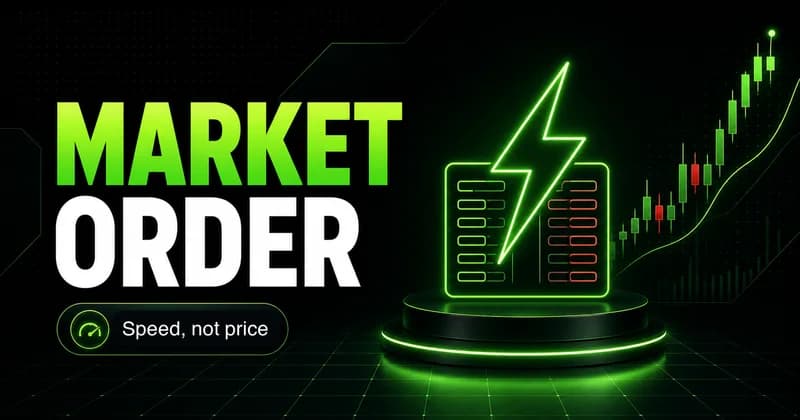
A market order is an instruction to buy or sell immediately at the best price currently available, which means it guarantees execution but never guarantees the price you get. That single trade-off is the whole story. You are telling the market you care more about being filled now than about the exact number. For liquid instruments in normal conditions, the gap between what you expect and what you get is small. In thin or fast markets, that gap is where capital quietly leaks.
Most beginners reach for the market order because it feels simple, and most of the time it works. The problem is that "most of the time" hides the conditions where it does not. The market order meaning is less about the definition than about knowing when speed is worth what you give up.
What is a market order in trading
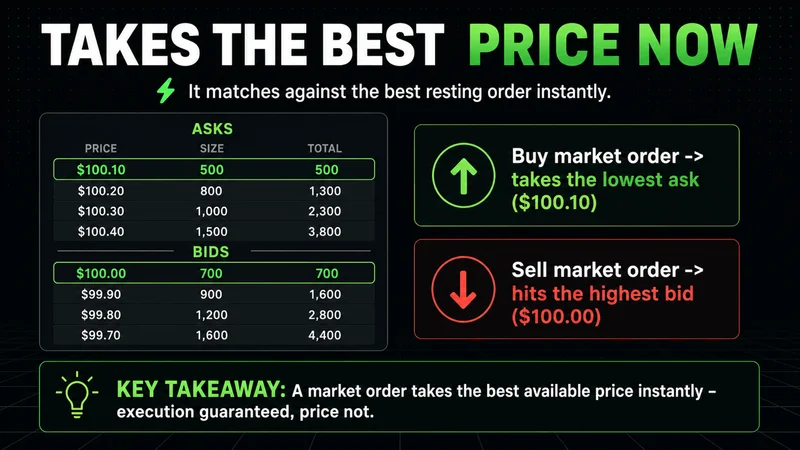
A market order routes to the exchange and matches against the best resting order on the other side of the book. If you are buying, you take the lowest ask. If you are selling, you hit the highest bid. The fill happens in a fraction of a second on a large-cap stock or an active futures contract during regular hours.
The key detail is what the order does not promise. It does not lock a price. The last traded print on the screen is a record of the past, not a quote for your fill. By the time your order reaches the book, the available price may have moved, and you accept whatever is there.
This is the difference between certainty of execution and certainty of price. A market order gives you the first and removes the second. Every other order type is some attempt to claw back control over price, usually at the cost of certainty that you get filled at all.
How market order execution actually works
When you submit a market order, your broker passes it to the venue where the instrument trades, and the matching engine pairs it with the best available counter-orders until your full size is filled.
For a small order in a deep market, that means one price, or close to it. For a larger order, or a shallow book, the order eats through multiple price levels until it is complete, and the market order fill price you end up with is the blended average of every level you consumed.
This is why size and liquidity matter more than the order type itself. The same market order behaves differently on a heavily traded name than on something with a wide spread and little depth. The order is not the risk. The conditions you fire it into are.
Market order vs limit order
The cleanest way to understand a market order is against its opposite. A limit order sets the worst price you will accept and waits. It controls price and surrenders certainty of execution; a market order controls execution and surrenders price. A limit order may never fill if price never reaches you.
The practical read: use a market order when being filled is the point, and a limit order when the price is the point. Confusing the two is one of the most common market order mistakes, because it shows up as a worse fill than expected on a position that did not need the speed.
When should traders use a market order
There is a narrow set of conditions where the market order is clearly the right tool. A few market order use cases hold up under pressure:
- You need to exit a losing position immediately and the priority is being flat, not the exact price.
- The instrument is liquid, the spread is one or two ticks, and the depth easily covers your size.
- You are trading a defined-risk setup where a one- or two-tick difference does not change the math.
In those situations the cost of crossing the spread is small and the value of certainty is high. The slippage you pay is a rounding error against the risk of not getting filled at all.
Where the market order breaks down
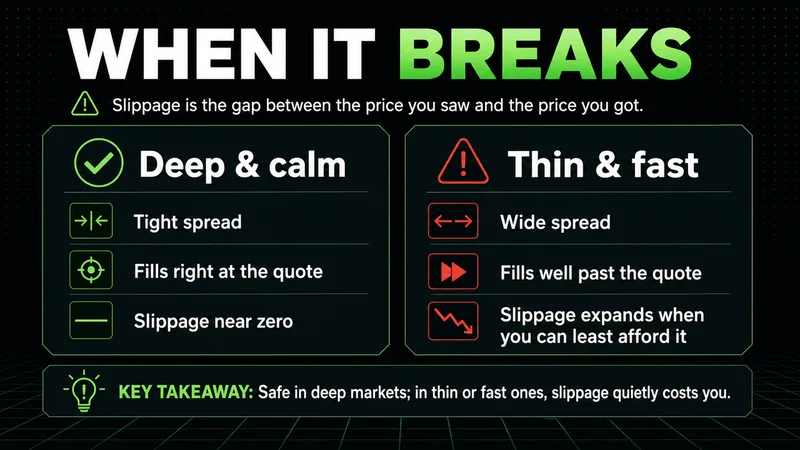
Market order slippage risk is not theoretical. It is the difference between the price you saw and the price you got, and it expands exactly when you can least afford it.
A market order is safe in deep, calm conditions. It stops being safe the moment liquidity thins out. Around a major economic release, in the first seconds after the cash open, or overnight on a thin contract, the book is shallow and moving fast. A market order in that window can fill several ticks away from where you aimed, because the resting orders you expected to hit are gone before you arrive.
The instruments I trade make this obvious. On NQ, firing a market order into a news spike often fills well off the level on screen, because the depth evaporates the instant volatility expands. The same order that costs nothing at 11 a.m. on a quiet day can cost real money in the first minute after a number prints. The order did not change; the liquidity behind it did.
This is also where many traders are quietly overleveraged without realizing it. If a few ticks of slippage on a market order meaningfully hurts the account, the position was too large, and the order type is taking the blame for a sizing problem.
A market order example for beginner traders
Say a stock shows a best bid of 50.00 and a best ask of 50.05. You send a market order to buy 100 shares. In a deep book, you fill at 50.05, paying the spread. Done.
Now run the same order during a volatile open. The ask at 50.05 is taken by faster orders, and your shares fill at 50.05, 50.07, and 50.12 as the order walks the book. The average fill is higher than the price that prompted the trade. Nothing went wrong; the order did exactly what you asked, and the cost was simply higher.
A checklist before you send one
Use this as a filter when deciding whether a market order fits the moment:
- Is the spread tight and the depth clearly larger than my size?
- Is being filled right now more important than the exact price?
- Are conditions normal, or am I near a release, the open, or thin overnight hours?
- Would a few ticks of slippage change my risk math? If yes, the position may be too big.
If the answers line up, the market order is the right tool. If they do not, a limit order usually protects the position better.
FAQs
What is a market order in simple terms? It is an instruction to buy or sell immediately at the best price currently available. It guarantees that the trade executes but does not guarantee the exact price you pay or receive.
Does a market order guarantee the price? No. It only guarantees execution. The fill happens at whatever prices are resting in the order book when your order arrives, which can differ from the last price you saw, especially in fast or thin markets.
When should a beginner avoid a market order? Avoid it on instruments with wide spreads or shallow depth, and around volatile windows such as the open, major news releases, or thin overnight hours. In those conditions slippage can push your fill several ticks away from where you aimed.
The takeaway
A market order trades price certainty for execution certainty, and that exchange is fair only when liquidity is deep and the spread is tight. The order is not dangerous; the conditions you use it in are. Match it to liquid markets and moments where being filled matters more than the exact number, watch your size, and reach for a limit order whenever price itself is the point.
Worth the read?