Trading Fees Explained — What Actually Eats Your Edge
Trading fees are the costs to execute and hold a trade, and for active traders they quietly eat the edge on every round trip. Here is what to watch.
Trading fees are the costs a broker charges to execute and hold your trades, and for an active trader they matter far more than the headline "zero commission" suggests. The real number is the round-trip cost of getting in and out, paid on every position whether the trade works or not. Most beginners size their risk carefully and then ignore the one expense that compounds against them on every single click.
That is the part the industry would rather you skim past. A small per-trade fee feels harmless in isolation. Multiply it across a week of execution and it quietly becomes one of the largest line items in the account.
What fees actually mean in trading
The simple fees meaning is this: a fee is anything that moves money from your account to the broker, the exchange, or the clearing chain, separate from the trade's own profit or loss. It is the price of access. Some of it is visible on the confirmation, and some of it is buried in the price you get filled at.
It helps to separate fees into two groups. Trading fees are charged because you placed a trade. Non-trading fees are charged for everything around the trade.
- Commission — a flat charge per trade or a per-share or per-contract rate, paid on entry and again on exit.
- Spread — the gap between the bid and the ask, paid silently the moment you take the offer or hit the bid.
- Exchange and clearing fees — small regulatory and venue charges, common in futures and often itemized separately.
- Financing or overnight cost — interest charged when you hold a leveraged or margined position past the session.
Non-trading fees sit outside execution: deposit and withdrawal charges, currency conversion, data subscriptions, and inactivity fees on dormant accounts. They do not scale with your trade count, but they still draw the account down if you ignore them.
Fees vs spread — the cost you can see and the one you can't
The fees vs spread distinction trips up most new traders, because only one of them appears on the statement. Commission is explicit. You are quoted a number, you agree to it, and it lands on the confirmation. The spread is implicit. You pay it through the fill price itself, and it never shows up as a separate charge.
Here is a concrete fees example. Say a contract shows a bid of 100.00 and an ask of 100.25. If you buy at the ask and immediately sell at the bid, you are down 0.25 before any commission, before the market has moved at all. That quarter-point is the spread, and on a round trip you pay it twice in effect — once on the way in, once on the way out.
| Cost type | How it shows up | When you pay it |
|---|---|---|
| Commission | Stated charge on the confirmation | Entry and exit |
| Spread | Built into the fill price | The instant you cross the book |
| Financing | Daily interest line | Holding past the session |
| Exchange/clearing | Itemized regulatory charge | Per contract or share |
Commission-free does not mean cost-free. When a broker drops commissions, the cost usually moves into the spread or into how your order gets routed for execution. The money still leaves your account. It just stops announcing itself.
How fees hit execution and your fill price
Fees and execution are the same conversation. Every cost above is realized at the moment of the fill, which is why fees execution quality cannot be separated from the strategy itself. A clean entry at a poor fill, on a wide spread, in thin conditions, can cost more than the commission ever did.
This is where the spread and slippage overlap. Spread is the standing cost of crossing the book. Slippage is the extra distance price travels between your intended level and your actual fill when liquidity is thin or moving fast. Together they form a fees slippage risk that widens exactly when you can least afford it — fast tape, news, the open, the close.
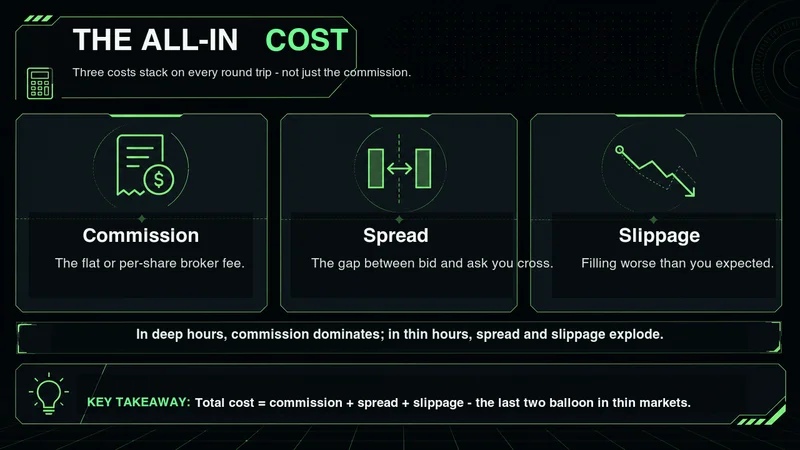
Where this framework breaks down is liquidity. In deep, liquid hours the spread is tight and slippage is negligible, so the commission is the cost that matters. Move the same trade into overnight or low-volume conditions and the spread can triple while slippage stacks on top, and the commission becomes the smallest of your problems. The cost structure inverts with the conditions, which is why a fee that looks trivial at midday can quietly dominate the same trade at 3 a.m.
Why fees matter more for active traders than for investors
This is the gap most beginner guides miss. They frame fees as an annual drag on a buy-and-hold account, which is fair for an investor. For an active trader, the math is different, because the cost scales with frequency, not with time.
Consider the difference in behavior. An investor pays the round-trip cost a handful of times a year. An active trader pays it on every position, sometimes dozens in a session. The same per-trade fee that is a rounding error for the investor becomes a structural headwind for the trader.
- Frequency multiplies cost. More trades means more round trips, and each one pays the full spread plus commission.
- Size amplifies it. Larger positions pay more spread in absolute terms, even at the same per-unit rate.
- Edge has to clear the cost. A setup that wins by a few ticks on paper can be a net loser once fees and the spread are taken out.
Most traders do not have a strategy problem. They have a cost-and-discipline problem. The edge was real; it just never survived the round-trip math once frequency went up.
The market rewards patience more than activity, and fees are the clearest place that shows up on the statement. Fewer, higher-quality trades pay the cost fewer times. Forcing trades during low-quality conditions pays it the most, at the worst fills, for the weakest setups.
Common fees mistakes new traders make
Most of the damage here is avoidable. The fees mistakes that hurt beginners are rarely exotic; they are the same handful of oversights repeated until they compound.
- Treating commission-free as free. The spread and routing still cost you. Read the all-in number, not the headline.
- Ignoring the round trip. Costs are quoted per side but paid both ways. Double every per-trade figure when you estimate it.
- Trading size that magnifies the spread. A position large enough to walk the book pays far more than the quoted spread.
- Overtrading. Each forced trade in unclear conditions pays full cost for a low-probability outcome.
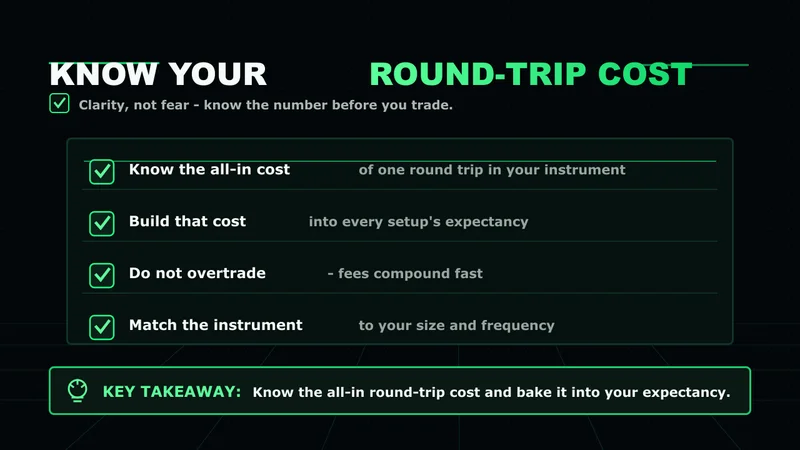
Is fees important for beginners? It is, but not as a reason for fear. It is a reason for clarity. Know the all-in cost of one round trip in the instrument you trade, build it into the expectancy of every setup, and the number stops being a surprise. Capital preservation starts with knowing exactly what each trade costs before it has a chance to work.
FAQs
What is fees in trading, in simple terms? Fees are the costs your broker, the exchange, and the clearing chain charge to execute and hold a trade, separate from the trade's own profit or loss. They include commission, the spread, financing on held positions, and small exchange charges. The total cost of getting in and out is the round-trip fee.
What is the difference between fees and the spread? Commission is an explicit charge stated on your confirmation, while the spread is an implicit cost built into the fill price between the bid and the ask. You agree to commission directly; you pay the spread silently the moment you cross the book. Commission-free trading usually just shifts the cost into the spread.
How do fees affect trading risk? Fees raise the bar every setup has to clear, because the spread and slippage widen in fast or thin conditions exactly when execution is hardest. A position that looks profitable on paper can turn into a net loss once the round-trip cost is removed, so the all-in fee belongs in your risk math before entry, not after.
Worth the read?