Protective Order in Trading — How It Actually Works
A protective order is the exit that caps your loss, not the entry. How it works, where the fill comes from, and where it quietly fails.
A protective order is an instruction you place to close a position automatically once price reaches a level you decided in advance. It is the exit that caps your loss, not the trade that opens your risk. Most beginners obsess over the entry and treat the protective order as an afterthought. That order is the part of the trade that actually keeps you in business.
This guide explains what a protective order is, how it works, where the fill price comes from, and where it quietly fails. The examples use round numbers so the mechanics stay clear, and every level is illustrative rather than a recommendation.
What a protective order means in trading
A protective order is a resting instruction attached to an open position. It defines the price at which you accept being wrong and exit. In practice it is usually a stop order: a sell stop below a long position, or a buy stop above a short position. The protective order sits on the exchange or with your broker until price touches the trigger, then it converts into a working order to close you out.
The purpose is narrow and it matters. A protective order converts an open-ended loss into a defined one. You decide the maximum you are willing to lose before the trade can argue with you, and you commit to it while you are still calm.
Three things define every protective order:
- The trigger price, which is the level that activates it.
- The direction, which is always opposite to your position.
- The order type it becomes once triggered, usually a market order or a stop-limit.
How a protective order works
Say you buy a stock at 50 and decide you will not accept a loss larger than two dollars per share. You place a protective sell stop at 48. While price stays above 48, the order rests and does nothing. The moment price trades at or through 48, the stop triggers and your broker sends a market order to sell. You are out, and the loss is contained near your planned level.
The sequence is mechanical:
- You open a position and define your invalidation level.
- You place the protective order at that level.
- Price either moves in your favor, leaving the order untouched, or moves against you and triggers it.
- The triggered order closes the position at the next available price.
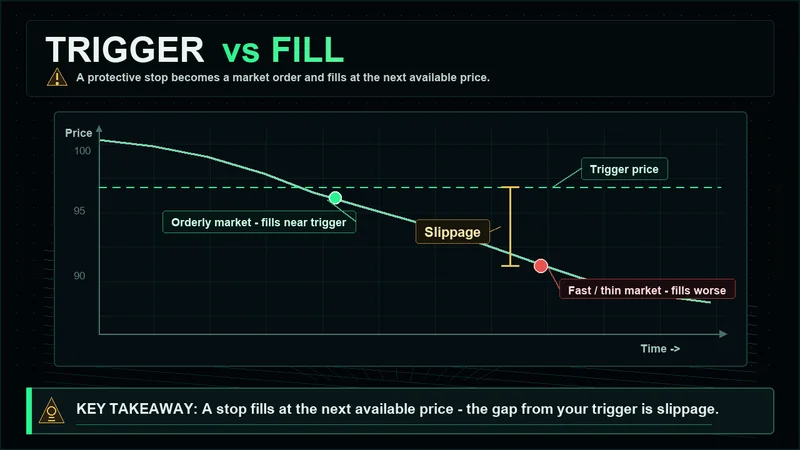
This is the part most explanations skip. The trigger and the fill are not the same number. The trigger is where the order wakes up. The fill is where it actually transacts, and that depends on what liquidity exists at that instant.
Protective order fill price and slippage risk
A protective stop that becomes a market order fills at the best price available when it triggers. In a liquid, orderly market, that price sits close to your trigger. In a fast or thin market, it can be meaningfully worse. That gap between your trigger and your fill is slippage.
Slippage is not a malfunction. It is the cost of demanding an immediate exit when few buyers are standing where you need them. How wide it gets depends on a few conditions:
- The liquidity at your level when the order triggers.
- The speed of the move pushing through it.
- Whether a gap, overnight session, or news release is involved.
The protective order did its job; it closed the position. It simply could not promise the exact price, because no market order can.
You can trade away some of that uncertainty with a stop-limit, which triggers at one price and refuses to fill below a limit you set. The trade-off is real and worth stating plainly:
| Order type | What it guarantees | What it risks |
|---|---|---|
| Stop market | The position closes | The fill price can slip in fast conditions |
| Stop limit | The fill price respects your limit | The position may not close if price jumps past the limit |
A stop-limit protects your price and exposes your position. A stop-market protects your exit and exposes your price. Beginners often reach for the stop-limit to avoid slippage and discover the worse outcome: price gaps through the limit, the order never fills, and a small defined loss becomes an open-ended one.
Protective order vs entry order
An entry order opens risk. A protective order closes it. They are opposite halves of the same trade, and confusing them is one of the more expensive beginner errors.
The entry order is where you choose to participate. It is optional and discretionary; you can always wait for a better location. The protective order is not optional once you are in. The moment your entry fills, you have exposure, and exposure without a defined exit is a position the market controls instead of you.
- An entry order is about opportunity. You place it where you want to be involved.
- A protective order is about survival. You place it where the idea is proven wrong.
- An entry can be skipped. A protective order, once you hold a position, cannot be.
When this framing breaks down is worth naming. A protective order assumes the market will trade through your level in a continuous way. Overnight, in thin liquidity, or into a scheduled news release, price can gap straight past your stop without trading a single contract at it. The order still fills, but well beyond where you planned. The protection holds in normal conditions and weakens exactly when volatility expands, which is the moment you needed it most.
The entry decides whether you are in the game. The protective order decides whether you are still in the game tomorrow.
When should traders use a protective order
The honest answer is on every position that can move against you, which is all of them. The harder question is where to place it.
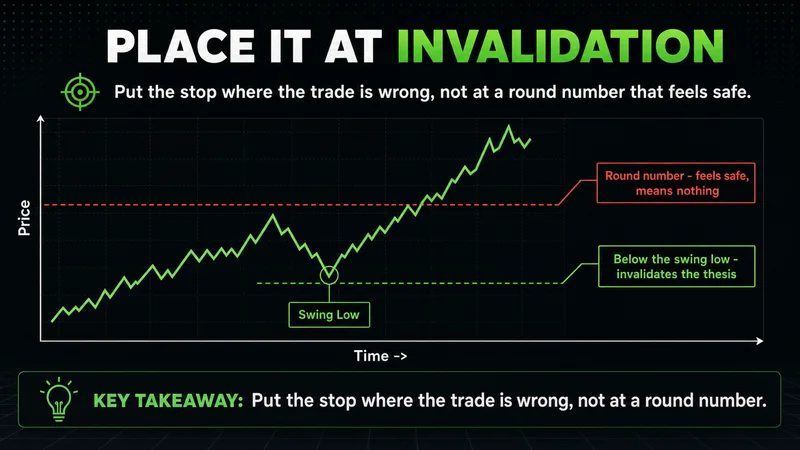
A protective order belongs at a level that structurally invalidates your reason for the trade, not at a round number that feels safe. Useful reference points include the following:
- Below a swing low you are trading above, for a long position.
- Above a swing high you are trading below, for a short position.
- Beyond a level price already defended, so routine noise does not eject you.
If you are long because price reclaimed a prior high, the protective order sits below that high. If price returns there, the reason you entered is gone, and so should you be. Placing the stop at an arbitrary dollar amount instead ties your risk to your account balance rather than to the market, and the market does not care what you can afford to lose.
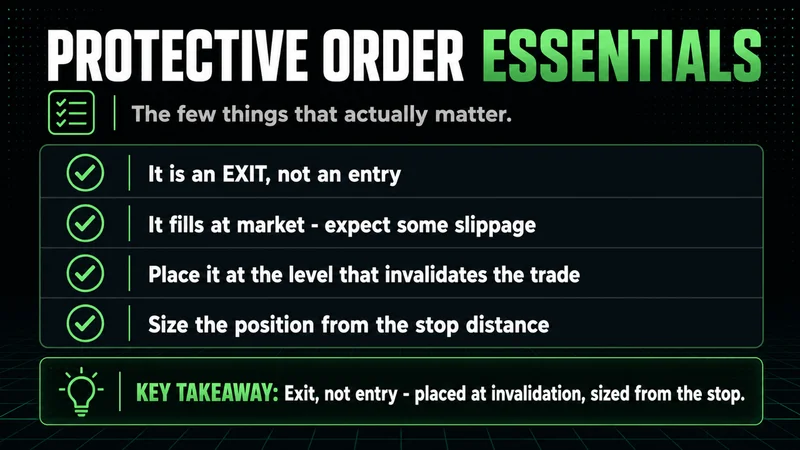
This is also where position sizing enters. Once the protective order defines your distance to invalidation, your size is whatever keeps the loss at that distance inside your risk limit. The order comes first; the size follows from it.
Common protective order mistakes beginners make
The errors repeat across nearly every new account.
- Moving the stop wider once price approaches it, which converts a defined loss into hope.
- Placing it at an even number rather than beyond a structural level, so routine noise takes you out.
- Using a stop-limit in fast markets and assuming it behaves like a stop-market.
- Sizing the position first and bolting the protective order on afterward, which inverts the correct order of operations.
- Removing the order entirely during a drawdown to avoid realizing the loss.
That last one ends more accounts than bad analysis ever does. Most blown accounts do not come from a single catastrophic trade. They come from a trader quietly canceling protection during an emotional session and letting one position run unchecked.
FAQs
What is a protective order in trading in simple terms? It is a pre-set instruction to close your position once price hits a level you chose in advance. It caps your loss without requiring you to watch the screen, and it commits you to an exit while you are still thinking clearly.
How does a protective order affect trading risk? It converts an open-ended loss into a defined one. Before the order is placed, your downside is whatever the market decides; after it is placed, your planned downside is the distance from your entry to the trigger, subject to slippage.
What is the difference between a protective order and an entry order? The entry order opens your position and your risk. The protective order closes the position and ends the risk. The entry is optional and discretionary; once you hold a position, the protective order is not.
Why does my protective order sometimes fill at a worse price? Because a triggered stop becomes a market order, and it fills at the best price available at that moment. In fast or thin conditions there may be no liquidity at your exact trigger, so the fill slips past it. This is normal and is the cost of guaranteeing an exit.
Is a protective order important for beginners? Yes, arguably more so than any entry technique. New traders survive long enough to improve only by capping losses, and a protective order enforces that cap automatically when discipline is hardest to hold.
Worth the read?