Systemic Risk — What It Is and How Traders Read It
Systemic risk is the risk the whole financial system fails at once. Here is what it means, how it hits the stock market, and how traders read it.
Systemic risk is the risk that the whole financial system seizes up at once, not the risk of one company failing on its own. It spreads when banks, funds, and clearinghouses are linked tightly enough that one default pulls the next one down. When systemic risk rises, correlations go to one, and the diversification you thought you had stops protecting the account.
That last part is what most explanations skip. They define the term, list the 2008 names, and move on. The part that matters for anyone managing live positions is simpler and harder: systemic risk is the condition where being right about a single stock no longer saves you, because everything sells together.
What systemic risk actually means
Start with the systemic risk meaning, then strip the textbook tone off it. Systemic risk is the danger that a failure in one part of the system cascades through the connections to the rest of it. The mechanism is interconnectedness. Large institutions hold each other's debt, trade with each other, and post collateral to the same clearinghouses. One large failure becomes a chain because the obligations were never isolated.
Think of it as plumbing, not weather. A storm hits everyone equally and passes. Systemic risk is a burst pipe behind the wall that floods rooms you did not know were connected. The 2008 crisis was not one bad mortgage book. It was the discovery that the same exposure sat, repackaged, inside firms that were supposed to be unrelated.
Systemic risk vs market risk — why the distinction changes how you size
The systemic risk vs market risk question is not academic. Market risk is the ordinary up-and-down of prices that you accept every time you hold a position. You can hedge it, size around it, and define your invalidation against it. It is priced in and it is survivable by design.
Systemic risk is different in kind. It is the risk that the pricing mechanism itself stops working, that liquidity disappears, and that the hedge you bought fails to settle because the counterparty is gone. You cannot diversify your way out of it, because in a systemic event the correlations that diversification relies on collapse. Market risk asks how much a position can move. Systemic risk asks whether the market clears at all.
That distinction should change how you size. Position sizing assumes you can exit near your stop. In a systemic episode that assumption breaks. The honest response is not a cleverer hedge; it is less leverage going into conditions where exits get thin.
How systemic risk moves through the stock market
The systemic risk market impact shows up first as correlation, then as liquidity. In normal conditions, sectors rotate and individual names trade on their own stories. The systemic risk stock market effect is that those stories stop mattering. Quality and junk sell together because participants are raising cash, not expressing views.
Liquidity is the second stage, and it tends to fail in a recognizable order:
- Spreads widen and depth thins, so the size you moved yesterday drags price against you today.
- Forced sellers — funds meeting redemptions, accounts meeting margin calls — supply into a market with no natural bid.
- The selling feeds itself: prices fall, the fall triggers more selling, and the selling produces lower prices.
That feedback loop is the real damage, and it has nothing to do with whether any single company deserved to drop.
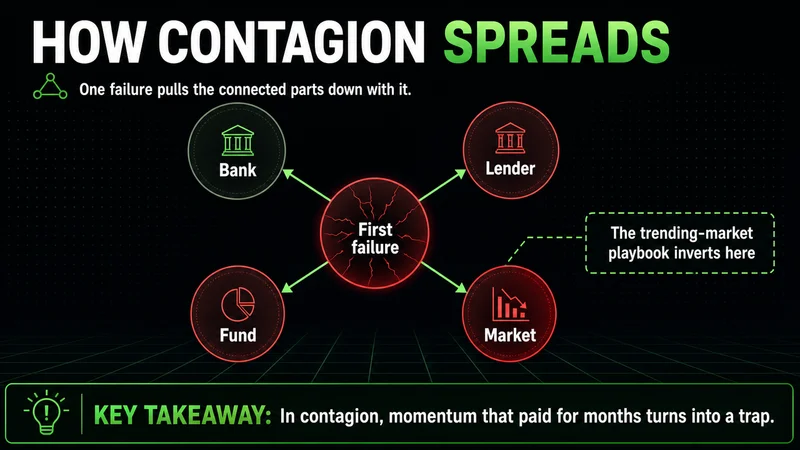
For traders, the systemic risk for investors and active participants alike is the same: the playbook that worked in trending, liquid conditions inverts. Momentum entries that paid for months turn into traps within a single session.
A 2008 example most explanations get half right
The standard systemic risk example is Lehman Brothers, and it is correct as far as it goes. A large, interconnected firm failed, counterparties faced losses, and confidence broke. But the half that gets dropped is the speed of the correlation shift. In the worst weeks, the spread between safe and risky assets stopped behaving the way the models assumed. Things that were supposed to be uncorrelated moved together because the same forced sellers held all of them.
The lesson for a practitioner is not the name on the headline. It is that the relationships you depend on for risk control can break precisely when you need them most. In 2008 it was the disappearance of liquidity, not any single forecast, that did the damage.
What rising systemic risk looks like before it's obvious
How does systemic risk affect stock prices before the crisis is named on the news? It shows up in behavior, not headlines. The early conditions are quiet ones:
- Correlations tighten across unrelated sectors.
- Funding spreads widen while equities still look calm.
- Safe assets get bid even on days with no obvious catalyst.
- Volatility stops mean-reverting and starts clustering.
None of these is a prediction. They are conditions. The point of watching them is not to call the top; it is to recognize when the environment has shifted from one where defined-risk setups work to one where they do not. Conviction does not change that shift, and the exposure is there whether you read it or not.
A short checklist for reading systemic stress
This systemic risk checklist for market analysis is built for reading conditions in real time, not for forecasting:
- Are unrelated sectors suddenly moving together? Rising cross-asset correlation is the earliest tell.
- Are safe assets getting bid with no clear catalyst? A flight to quality often precedes the obvious break.
- Is liquidity thinning — wider spreads, less depth, more slippage on normal size?
- Is volatility clustering instead of fading after each spike?
- Are funding and credit spreads widening while equities still look calm?
None of these confirms a crisis. Together, they tell you to cut size, widen your definition of risk, and stop treating individual setups as if context were neutral.
Where the systemic-risk framework breaks down
The systemic risk limitations are real, and ignoring them is its own mistake. The framework is good at describing stress after the fact and poor at timing it. Every one of the signals above can flash for weeks inside a market that keeps grinding higher. Correlations tighten and then loosen again. Spreads widen on a scare and normalize.
This is the part that does not work cleanly: the same checklist that protects you in a genuine systemic event will pull you out of dozens of ordinary pullbacks that resolve higher. Read literally, it makes you chronically defensive. The framework earns its keep only as a sizing input, not a trade trigger — it tells you when to carry less, not when to be short. Most traders do not have a strategy problem here; they have a discipline problem, treating a slow-burn condition as an immediate signal.
FAQs
What is systemic risk in simple terms? It is the risk that the entire financial system fails together rather than one company failing alone. It spreads through the connections between institutions, so one large default can pull down others that looked unrelated.
What is the difference between systemic risk and market risk? Market risk is the normal price movement you accept and can hedge or size around. Systemic risk is the risk that the market stops functioning — liquidity vanishes and correlations collapse — which no amount of diversification protects against.
How does systemic risk affect the stock market? It first turns up as correlation, with quality and junk selling together as participants raise cash. Then liquidity thins, spreads widen, and forced selling feeds on itself, pushing prices lower in a self-reinforcing loop.
Can investors diversify away systemic risk? No. Diversification reduces company-specific risk, but in a systemic event the correlations it depends on go to one. The practical defense is less leverage and smaller size going into fragile conditions, not a cleverer hedge.
What was the clearest systemic risk example? The 2008 crisis, when the failure of interconnected firms like Lehman Brothers froze funding and forced unrelated assets to sell together. The lesson was that risk-control relationships can break exactly when they are needed most.
Worth the read?