Profit After Tax — What It Tells You About a Company
Profit after tax is the bottom-line profit left after every cost and tax. Here is how to read it, calculate it, and catch the red flags it can hide.
Profit after tax is the money a company keeps once every expense and every tax has been paid. It sits at the very bottom of the income statement, and it is the number that actually belongs to shareholders. If revenue is what the business collected and operating profit is what the core operation earned, profit after tax is what survived contact with interest payments, one-off charges, and the tax authority. That last filter matters more than most beginners expect.
The figure is clean to read and easy to misread. A rising profit after tax looks like a healthy business, and often it is. But the same number can be inflated by a tax credit, a sold building, or an accounting choice that has nothing to do with selling more product. Knowing where the number comes from is the difference between reading a financial statement and trusting a headline.
What profit after tax means in plain terms
Profit after tax, often shortened to PAT, is the net amount left after a company subtracts all operating costs, interest, depreciation, and income tax from its revenue. It is the final line of the income statement. Some companies label it net profit, some label it net income, and the meaning is the same: this is what the business earned for its owners over the period.
Think of it as a sequence of subtractions. Revenue comes in at the top. Cost of goods sold leaves first, giving gross profit. Operating expenses leave next, giving operating profit. Interest on debt comes out after that. Then tax is applied to what remains. Whatever is left is profit after tax.
The reason it gets attention is simple. It is the only profit figure that reflects the full cost of running the business, including the cost of how the business is financed and the cost imposed by the government. Earlier profit lines ignore one or both of those.
The figure does a few specific jobs that earlier profit lines cannot:
It measures what shareholders actually earned, not just what the operation produced.
It sets the pool from which dividends and buybacks can be paid.
It feeds the per-share earnings and return ratios that investors compare across companies.
The profit after tax formula and its components
The profit after tax formula is straightforward:
Profit After Tax = Profit Before Tax − Tax Expense
Profit before tax is everything the company earned after operating costs and interest but before the tax authority takes its share. Subtract the tax expense and you have the bottom line.
There is a second form you will see when analysts model a business at the operating level:
Net Operating Profit After Tax = Operating Profit × (1 − Tax Rate)
This version strips out interest and looks only at what the core operation would keep after tax if it carried no debt. It is useful for comparing two companies whose financing structures differ, because it removes the effect of how each chose to fund itself.
The profit after tax components break down like this:
Revenue: total sales for the period.
Cost of goods sold: the direct cost of producing what was sold.
Operating expenses: salaries, rent, marketing, and the rest of running the business.
Depreciation and amortization: the spread-out cost of long-lived assets.
Interest expense: the cost of carrying debt.
Tax expense: income tax owed on the remaining profit.
Each line is a place where a number can be managed, deferred, or front-loaded. That is why the components matter as much as the total.
A profit after tax example you can follow
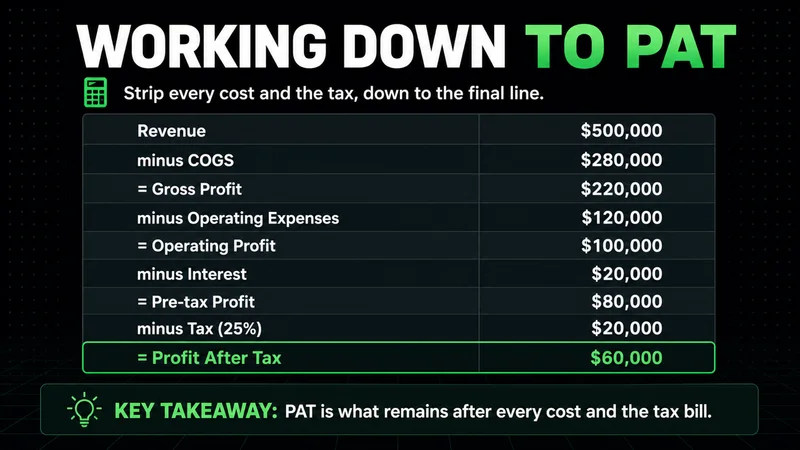
A worked example makes the formula concrete. Take a company with the following figures for the year:
Revenue: 500,000
Cost of goods sold: 280,000
Operating expenses: 120,000
Interest expense: 20,000
Tax rate: 25%
Work down the statement. Gross profit is 500,000 minus 280,000, or 220,000. Operating profit is 220,000 minus 120,000, or 100,000. Profit before tax is 100,000 minus 20,000 of interest, or 80,000. Tax at 25% on 80,000 is 20,000. Profit after tax is 80,000 minus 20,000, which is 60,000.
So the company kept 60,000 from 500,000 in sales. Its profit after tax margin is 60,000 divided by 500,000, or 12%. That margin is the figure worth tracking over time. A single year tells you very little. The same margin across three or four years, compared against companies in the same industry, tells you whether the business is durable or just had a good twelve months.
Profit after tax versus net income
Profit after tax versus net income is a question that trips up beginners, and the honest answer is that they usually mean the same thing. Net income, net profit, profit after tax, and the bottom line are different labels for the same final figure on most income statements.
The small print is where care is needed. Some statements report net income attributable to the parent company separately from net income that includes minority interests. Some report a figure before certain extraordinary items and another after them. When two sources quote different numbers for the same company, the difference almost always lives in these adjustments, not in a disagreement about what profit after tax means.
The practical rule is to read the label and the footnote together. If the statement says net income and the notes describe the same set of subtractions covered above, you are looking at profit after tax under another name.
When two figures disagree, the difference usually lives in one of these adjustments:
Minority, or non-controlling, interests carved out of the consolidated total.
Extraordinary or discontinued items reported separately from continuing operations.
Tax adjustments tied to a prior period rather than the current year.
How to read profit after tax like an analyst
Reading the number well means refusing to take it at face value. A figure that looks strong can be assembled from pieces that will not repeat. This is where most surface-level explainers stop, and it is exactly where the work begins.
Start by separating recurring earnings from one-off items. A company that sold a warehouse this year books that gain inside profit after tax, and it inflates the figure for one period only. A tax benefit from a prior-year settlement does the same. Pull the annual report and read the notes. The income statement gives you the total; the notes tell you how much of it the business can repeat.
The number at the bottom of the statement is only as honest as the lines that built it. A clean total can hide a messy quarter, and a messy total can hide a strong core. Read both.
Next, look at the tax line itself. An unusually low effective tax rate in one year often signals a credit or a deferred item rather than a structurally efficient business. When the rate normalizes the following year, profit after tax can fall even though sales rose. That is not deterioration in the business; it is the tax line returning to normal. Mistaking one for the other leads to bad conclusions about a stock.
This discipline carries a cost. It takes time, and it works far better on a stable, mature company than on a young one. For an early-stage business burning cash to grow, profit after tax is often negative by design, and reading it as a verdict on quality would be a mistake. The framework of separating recurring from non-recurring earnings only works once a company has a core operation steady enough to have a normal year. Apply it to a pre-profit growth company and the number tells you almost nothing useful.
Common profit after tax red flags
A healthy bottom line can sit on an unhealthy foundation. These are the profit after tax red flags worth checking before trusting the figure:
Profit after tax rises while operating profit falls. The gap is usually filled by something below the operating line, such as an asset sale or a tax benefit, and it will not repeat.
The effective tax rate drops sharply with no clear reason in the notes. Sustainable profit comes from the business, not from a temporary tax position.
Profit after tax grows but operating cash flow does not. Profit is an accounting figure; cash is harder to dress up. A persistent gap between the two deserves scrutiny.
One-time gains appear in the headline number without being flagged as one-time. Read the notes to find what the press release left out.
The margin expands far faster than peers in the same industry. Outperformance is possible, but a sudden lead over comparable businesses is worth explaining before it is celebrated.
None of these is automatically fatal. Each is a reason to read further before drawing a conclusion. The point is not to distrust every strong number; it is to know which questions the number cannot answer on its own.
Why profit after tax matters for stock analysis
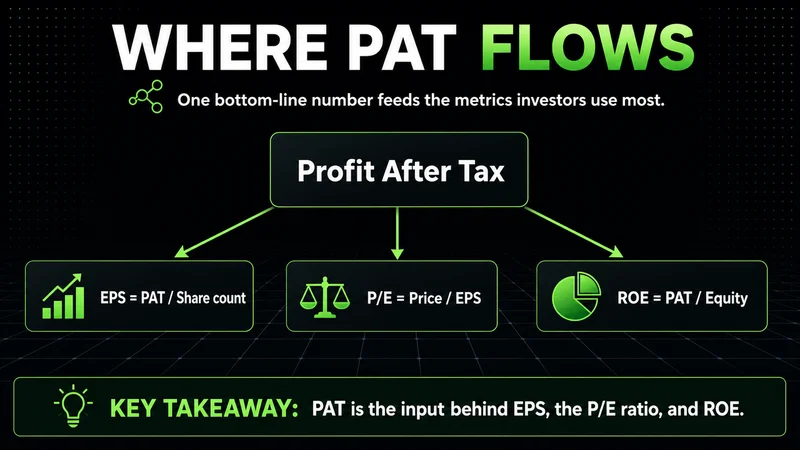
Profit after tax feeds directly into the figures investors use most. Earnings per share is profit after tax divided by the share count. The price-to-earnings ratio compares the share price to that per-share profit. Return on equity measures profit after tax against the capital shareholders put in. Each of these starts from the same bottom line, which is why getting the bottom line right matters before any ratio is calculated.
It also sets the ceiling on what a company can return to owners. Dividends and buybacks are paid from profit after tax or from accumulated past profits. A business that cannot generate consistent profit after tax cannot fund consistent returns, regardless of how its revenue grows.
For someone analyzing a stock, the figure is a starting point, not a verdict. A single strong year proves little. A consistent figure across several years, backed by operating cash flow and free of one-off boosts, is what separates a durable business from a lucky one. The number is reactive evidence about what already happened, not a prediction of what comes next, and treating it as the latter is how investors talk themselves into stories the financials do not support.
FAQs
What is profit after tax in simple terms? It is the money a company has left after paying every operating cost, all interest on its debt, and its income tax. It is the final line of the income statement and the profit that belongs to shareholders.
What is the profit after tax formula? Profit After Tax equals Profit Before Tax minus Tax Expense. At the operating level, analysts also use Net Operating Profit After Tax, which is operating profit multiplied by one minus the tax rate.
Is profit after tax the same as net income? In most cases, yes. Net income, net profit, the bottom line, and profit after tax usually refer to the same final figure. Differences between sources typically come from adjustments like minority interests or extraordinary items, not from a different definition.
Can profit after tax be negative? Yes. When total costs and taxes exceed revenue, the company reports a net loss. This is common for early-stage businesses investing heavily in growth, where a negative figure is expected rather than a sign of failure.
What is a good profit after tax margin? There is no universal number. A good margin is judged against the company's own history and against peers in the same industry. A consistent, slowly improving margin usually signals more durability than a single high year that cannot be repeated.
Why does profit fall after tax is applied? Tax is the last subtraction on the income statement. Whatever profit remains before tax is reduced by the income tax the company owes, so the after-tax figure is always lower than the before-tax figure by the amount of that tax expense.
How does profit after tax help in stock analysis? It is the input for earnings per share, the price-to-earnings ratio, and return on equity. It also caps what a company can pay in dividends and buybacks, so consistent profit after tax underpins consistent shareholder returns.
What is the difference between profit after tax and operating profit? Operating profit measures what the core business earns before interest and tax. Profit after tax takes operating profit, subtracts interest and tax, and reflects the full cost of financing and running the company. A widening gap between the two is worth investigating.
Worth the read?