What Are Stocks? A Beginner's Guide to Trading
Stocks are units of ownership in a company. A beginner's guide to how stocks trade, what moves price, and how to manage the risk.
What Are Stocks? A Beginner's Guide to Trading Them
Stocks are units of ownership in a company. When you buy one share, you own a fractional piece of that business, along with a claim on its future earnings and a price that moves with how the market values the company. That is the entire definition, and most beginners get it on the first read. The harder part is what comes after: how stocks actually trade, what moves their price during a session, and how a trader manages the risk that ownership carries.
This guide explains stocks from a trader's seat rather than a long-term investor's. The mechanics are the same, but the questions are different. An investor asks what a company will be worth in 10 years. A trader asks what the price is likely to do in the next hours or days, and what level proves the idea wrong. Both views are valid. This one is built for someone learning to read price and manage exposure.
Stocks meaning, in plain terms
A stock represents partial ownership in a publicly traded company. The terms "stock" and "share" are often used interchangeably, though "stock" usually refers to the asset class and "share" to a single unit of it. If a company has issued one million shares and you hold one thousand, you own one-tenth of one percent of that business.
Ownership comes with two possible sources of return. The first is price appreciation: you buy at one price and the market later values the share higher. The second is dividends, which are periodic cash payments some companies distribute from profits. Not every company pays a dividend, and many traders focus only on price movement, so for short-term trading the first source is what matters most.
Companies issue stock to raise capital. A private business that wants public funding lists its shares on an exchange through an initial public offering, or IPO. After the IPO, those shares trade freely between buyers and sellers, and the company itself is no longer the counterparty. The price you see quoted is simply the most recent agreement between a buyer and a seller.
How the stocks market actually works
The stocks market is not one place. It is a network of exchanges, such as the New York Stock Exchange and the Nasdaq, where buyers and sellers meet through brokers. When you place an order, your broker routes it to where the share can be matched against an opposing order. The price updates every time a trade clears.
Price is set by supply and demand in real time. More resting buy interest than sell interest pushes price up until sellers step in. The reverse pushes it down. This is the core of order flow, and it is why price can move without any news at all. Positioning and liquidity often matter more than the headline that supposedly caused a move.
A few terms describe the structure you will see on a price ladder or chart:
- Bid: the highest price a buyer is currently willing to pay.
- Ask: the lowest price a seller is currently willing to accept.
- Spread: the gap between bid and ask, which is a real cost on every entry and exit.
- Volume: how many shares changed hands, which shows whether a move has participation behind it.
- Liquidity: how easily you can enter or exit without moving the price against yourself.
Liquidity is the quiet variable beginners overlook. A large, heavily traded stock absorbs your order without much slippage. A thin, lightly traded one can move several percent on a single order, which turns a clean idea into a poor fill.
Stocks trading basics, step by step
Trading a stock is a sequence, not a single click. The order below is the process a disciplined trader follows before, during, and after a position.
- Open and fund a brokerage account. Choose a regulated broker, complete identity verification, and deposit capital you can afford to put at risk.
- Define the idea before the entry. Decide what condition would make you a buyer, and what level would prove you wrong.
- Size the position to the risk, not the conviction. Calculate how many shares keep your loss small if the stop is hit.
- Place the order with a defined stop. Use a stop order so the exit is decided in advance, not in the moment.
- Manage the trade against your plan. Let the position work, move the stop only with structure, and avoid adding emotionally.
- Review the result without judging the outcome. A good trade can lose and a bad trade can win. The process is what you grade.
Most failed trades begin long before the entry. Poor positioning, an undefined stop, and impatience usually decide the outcome before price does anything. The mechanics above are simple. Following them under pressure is the actual skill.
Stocks examples a beginner trader can picture
Concrete cases make the abstract definition stick. Consider a single share priced at 50. You buy 100 shares, committing 5,000 of capital. If price rises to 55, your position is worth 5,500, a gain of 500 before costs. If price falls to 47 and your stop is there, you exit for a loss of 300. The math is linear, which is one reason stocks are a clear first market.
Now picture the same trade sized carelessly. You buy 1,000 shares instead of 100 because the setup looked strong, committing 50,000. The same drop to 47 is now a 3,000 loss, large enough to affect your next decision. The setup did not change. The sizing did. That single difference is what separates a survivable loss from a damaging one.
These examples use round numbers on purpose. In live conditions, spreads, commissions, and slippage shave the edges, and price rarely moves in a straight line. The principle holds anyway: the position size, not the entry, decides how much a wrong idea costs you.
What influences stock prices during a session
A stock's price reacts to several forces, and they often pull in different directions at once. The main drivers a trader watches:
- Earnings and company news, which reset expectations for future profit.
- Sector and market context, since a single stock rarely fights the broader tape for long.
- Economic data and interest-rate expectations, which change how the market values future earnings.
- Liquidity and positioning, where large participants entering or exiting move price independent of news.
The first move after major news is often not the cleanest opportunity. Volatility spikes, spreads widen, and price can run both directions before it settles. Many beginners lose money reacting to the headline instead of waiting for structure to form. Reacting to what price does after the news tends to beat predicting what the news means.
Stocks risk, and why it is the first thing to respect
Every share you hold carries the risk that its price falls. A single company can disappoint earnings, lose a lawsuit, or simply fall out of favor, and the share can drop sharply with little warning. Concentrating capital in one or two names amplifies this, which is why position sizing exists.
Risk management matters more than entries. A mediocre entry with proper risk control survives a string of losses. A perfect entry with oversized risk eventually damages the account, because no edge wins every time. If one losing trade emotionally affects your next decision, the position was too large to begin with. That is the most common form of being overleveraged, and most beginners do it without noticing.
Risk-defined trading means you know your maximum loss before you enter. You place a stop at the level that invalidates the idea, you size so that hitting the stop costs a small, predefined fraction of your capital, and you accept that exit without negotiation. Protecting capital is the first objective. Growth is what survival makes possible later.
This framework holds in normal conditions. It breaks down when liquidity vanishes. During a gap on bad overnight news, or a halt that reopens far from your stop, the price can leap past your exit and fill well below it. The stop limits the decision, not always the outcome. Trading liquid names and respecting earnings dates is how you keep that gap small, but it never goes to zero.
Stocks vs forex, explained for choosing a first market
Beginners often ask whether to start with stocks or forex. They are different instruments with different mechanics, and the right answer depends on the schedule and structure you want. The comparison below frames the choice for a new trader rather than declaring a winner.
| Factor | Stocks | Forex |
|---|---|---|
| What you trade | Ownership in a company | One currency against another |
| Market hours | Set exchange sessions | Nearly 24 hours, five days a week |
| Typical leverage | Lower, often modest | Higher, which magnifies risk |
| Main price drivers | Earnings, sector, company news | Rates, macro data, central banks |
| Number of choices | Thousands of individual names | A handful of major pairs |
Stocks give you a defined session and a clear story behind each name, which can make the cause of a move easier to study. Forex runs nearly around the clock with higher leverage, which suits some schedules but punishes loose risk control faster. Neither is easier. They reward the same discipline. For a beginner who wants linear math and a market that closes so the screen can be turned off, stocks are a reasonable first choice.
Are stocks good for beginner traders, and what an account requires
Stocks are a sensible starting market for most beginners, with two honest caveats. The math is straightforward, the instruments are well regulated, and the daily session has a defined start and end, which protects you from trading around the clock before you are ready. The caveats are that single stocks can move violently on news, and that low-priced or thinly traded names carry outsized risk despite looking cheap.
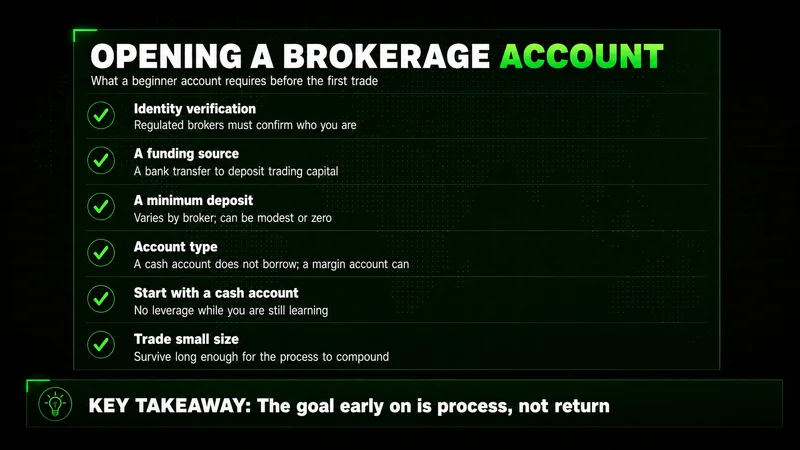
To start, a brokerage account has a few requirements:
- Identity verification, since regulated brokers must confirm who you are.
- A funding source, such as a bank transfer, to deposit trading capital.
- A minimum deposit, which varies by broker and can be modest or zero for cash accounts.
- An understanding of account type, since a margin account allows borrowing and a cash account does not.
Begin with a cash account and small size. The goal early on is not return. It is learning to follow a process and survive long enough for that process to compound. The market rewards patience far more than activity, and most beginners need fewer trades and tighter risk, not more setups.
A stocks checklist for new traders
Before you place a trade, run a short check. It keeps the decision structural instead of emotional.
- Have I defined the level that proves this idea wrong?
- Is my position sized so the stop costs a small, predefined fraction of capital?
- Is the stock liquid enough to enter and exit without large slippage?
- Am I trading around an earnings date or major news that could gap price?
- Is this entry aligned with the broader market and sector, or fighting them?
- Will I accept the exit if the stop is hit, without renegotiating in the moment?
If any answer is no, the trade is not ready. Trading without that context is gambling with better vocabulary.
FAQs
What are stocks in trading? Stocks are units of ownership in a publicly traded company. Buying a share gives you a fractional claim on the business and its earnings, and the share's price moves as buyers and sellers reprice that claim throughout the trading session.
How do stocks work in financial markets? Stocks trade on exchanges where brokers match buyers and sellers. Price is set by supply and demand in real time, so it updates with every completed trade and reflects the most recent agreement between a buyer and a seller.
Are stocks good for beginner traders? For many beginners, yes. The math is linear, the instruments are regulated, and the session has a defined open and close. The main risks are sudden news-driven moves and the temptation to oversize a position, both of which proper risk management addresses.
What are the main risks of stocks trading? The core risk is that a share's price falls, sometimes sharply on company news. Concentrating capital in one name and trading with oversized positions magnify that risk, which is why a defined stop and disciplined position sizing come before any entry.
The takeaway on trading stocks
Stocks are ownership in a company, traded on exchanges where price moves with supply and demand. The definition is simple, and the mechanics, from the bid and ask to placing an order with a stop, are learnable in a few sessions. What separates a beginner who survives from one who does not is rarely the entry. It is sizing the position to the risk, defining the level that proves the idea wrong, and accepting that loss without negotiation. Start with a cash account and small size, treat each trade as a process to grade rather than an outcome to chase, and let consistency do the compounding.
Worth the read?