Revenge Trading Turns Losses Into Spirals
Revenge trading turns one normal loss into a larger drawdown. Learn how cool-down rules, loss limits, and tracking protect execution.
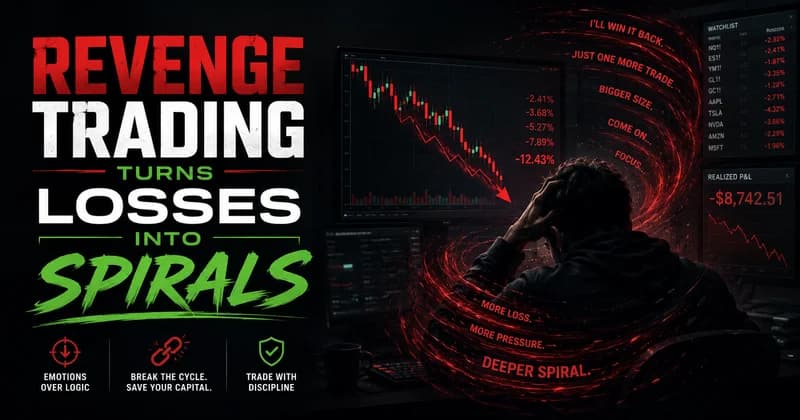
Revenge trading begins after a loss, but the real problem is not the loss. The problem is the demand to repair it immediately. Once a trader starts trying to erase emotional discomfort, execution quality usually breaks before the next setup is even evaluated.
The Loss Is Normal. The Reaction Is The Risk
Every trading system produces losses. A clean planned loss is not a failure. It is part of operating a strategy under uncertainty.
Revenge trading starts when the trader treats that normal loss as something that must be fixed right now. The next trade is no longer selected because it has the best structure. It is selected because the account is red, the trader feels wrong, and the screen offers a way to act.
Common revenge patterns include:
Entering within minutes of a loss without fresh analysis
Increasing size to recover faster
Taking lower-quality setups because waiting feels unacceptable
Moving into options, leveraged products, or unfamiliar instruments to accelerate recovery
Becoming attached to ending the day at break-even
The market does not know the trader is trying to recover. It does not care where the day started. That is why revenge trading is so expensive. The trader is negotiating with emotion while price is still operating by supply, demand, liquidity, and volatility.
Break-Even Anchoring Turns Red P&L Into Pressure
The source article ties revenge trading to prospect theory from Kahneman and Tversky in 1979. Losses are felt roughly twice as strongly as equivalent gains. A $500 loss does not feel like a routine business cost in the moment. It feels like something that needs to be removed.
Break-even anchoring makes the pressure stronger. The starting balance for the day becomes a psychological reference point. Being below it creates an open loop. The trader feels unfinished until the number is repaired.
That is why some of the worst spirals begin after modest losses. The damage is not caused by the first loss. It is caused by the emotional demand to cancel it before the session ends.
Sunk cost thinking adds another layer. The lost money feels recoverable if one more trade works. Financially, the loss is already part of the account history. Psychologically, the trader treats it as a problem still waiting to be solved.
Frustration and ego complete the pattern. A losing trade can feel personal, especially when the trader believes the analysis was sound. The next trade becomes less about edge and more about proving competence.
Revenge Trading Compounds Faster Than It Looks
The cascade is the defining feature. Revenge trading rarely stops at one bad decision because the second loss increases the emotional pressure that created it.
A typical sequence looks like this:
Trade one: planned setup, $500 loss
Trade two: larger post-loss entry, $800 loss
Trade three: more desperate recovery attempt, $1,200 loss
End of day: a normal $500 loss has become a $2,500+ drawdown
The numbers are examples, but the structure is common. Each loss makes the next decision worse. Position size increases, setup quality drops, and the trader keeps narrowing attention to the P&L instead of the market.
This is why revenge trading is one of the clearest account-damage patterns. It compresses multiple rule violations into a short window. The trader often knows the rules, but the rules were built for a calm state. After a loss, the nervous system is not calm.
The source also notes that research consistently connects emotional trading after losses with weaker outcomes. That matches practical experience. The worst sessions are often not caused by one bad read. They are caused by refusing to stop after the read failed.
Cool-Down Rules Create Distance When Judgment Is Weak
A mandatory pause after any loss is simple, but it works because it removes negotiation. The source recommends waiting at least 15-30 minutes before the next trade. That window matters because stress physiology is part of the problem.
After a loss, cortisol rises. The source describes a 20-30 minute return toward baseline. Trading while that stress response is elevated weakens impulse control and risk assessment. The trader may believe the next trade is objective, but the decision is being made from a worse state.
A useful post-loss protocol should be written before the market opens:
Close or step away from the execution screen
Record what happened and whether the loss followed the plan
Take a 15-minute break at minimum
Confirm that the loss stayed within predefined risk
Return only if the next setup is clean and emotional intensity has reset
This is not about avoiding losses. It is about refusing to let one loss decide the next trade. A losing day does not require immediate recovery. Many traders compound losses because they believe every red day has to end green.
Daily Limits Stop One Error From Becoming A Session
Daily loss limits are the hard boundary. The source gives common thresholds of 1-3% of account value, while noting that the exact number matters less than enforcing it. Once the limit is hit, trading stops.
This rule protects the account from the state where the trader is least qualified to keep making decisions. It also removes the false option of recovering by force. If the limit is reached, the decision has already been made.
Physical interruption helps too. After a loss, leave the desk. Get water, walk outside, or do anything that breaks the loop between frustration and order entry. Five minutes away from the screen can lower emotional intensity enough to prevent the next impulsive click.
The protocol should also include position-size review. If size increases after losses, revenge trading is not just a feeling. It is showing up in risk exposure. That is a high-priority correction.
Timing Data Makes The Pattern Hard To Deny
Revenge trading can be tracked with time-based data. Compare trades taken within 15 minutes of the prior trade against trades taken after 30 or more minutes. Then repeat the same check for trades taken soon after a loss.
Key metrics include:
Win rate by time since last trade
Performance after the most recent loss
Trades per day on losing sessions
Position size after losses versus normal size
Frequency of post-loss tags
A post-loss tag is especially useful. Apply it to any trade taken inside the cool-down window. At month-end, review its P&L, average R, and rule compliance. If those trades are consistently weaker, the data is giving a direct instruction: stop trading while the system is impaired.
The source references one psychology tracking example where trades that followed the plan had a 100% win rate, while broken-rule trades had a 20% loss rate. The specific result belongs to that example, but the principle is broader. A journal can show whether the trader's worst damage comes from strategy failure or post-loss behavior.
FAQs
What does revenge trading mean? It means taking a new position mainly to repair a recent loss, not because the setup meets the strategy. It often includes bigger size, lower-quality trades, and urgency around getting back to even.
Why is revenge trading dangerous? It creates a cascade. A planned loss leads to an emotional trade, the emotional trade creates a deeper loss, and the deeper loss increases the urge to keep going. That is how a manageable drawdown becomes a damaging session.
How do I stop revenge trading? Use mandatory cool-down periods after losses, enforce a daily loss limit, step away from the screen, and tag trades taken too soon after a loss. The goal is to prevent the next decision from being made while stress is still driving behavior.
How can I tell if I am revenge trading? Look for trades taken minutes after a loss, increased size after being wrong, weaker setups, obsession with daily P&L, and language like “I need to make it back.” Those are signs that recovery pressure has replaced execution discipline.
Revenge trading is rarely about the money alone. It is usually ego trying to regain control after being wrong. The professional response is not to fight the market harder. It is to stop, record the loss, and protect the next decision from the last one.
Worth the read?