Return on Capital Employed — What It Really Tells You
Return on capital employed shows how much operating profit a company earns per dollar of capital it uses. Here is the formula, the benchmark, and where it lies.
Return on capital employed measures how much operating profit a business produces for every dollar of capital it puts to work. Divide operating profit by capital employed and you get a single percentage that answers one question: is this company turning the money it controls into profit, or just sitting on it. That percentage is the cleanest read on capital efficiency most financial statements will give you.
The number itself is easy. Reading it correctly is where most people stop short. A high return on capital employed is treated as a verdict, when it is really the start of a question about why the capital is working that hard and whether it will keep doing so.
What return on capital employed actually measures
Return on capital employed, usually shortened to ROCE, is a profitability ratio. It compares the operating profit a company earns against the total long-term capital it uses to earn it. The meaning is straightforward: it tells you how efficiently a business converts the capital on its balance sheet into operating returns, before the financing structure and tax rate distort the picture.
That last part is what gives the ratio its value. Because it uses operating profit and the full capital base rather than net income and equity alone, it strips out how a company chose to fund itself. Two businesses with identical operations but different debt loads can look very different on net margin. On ROCE, they read closer to the truth.
The return on capital employed formula and calculation
The formula is short:
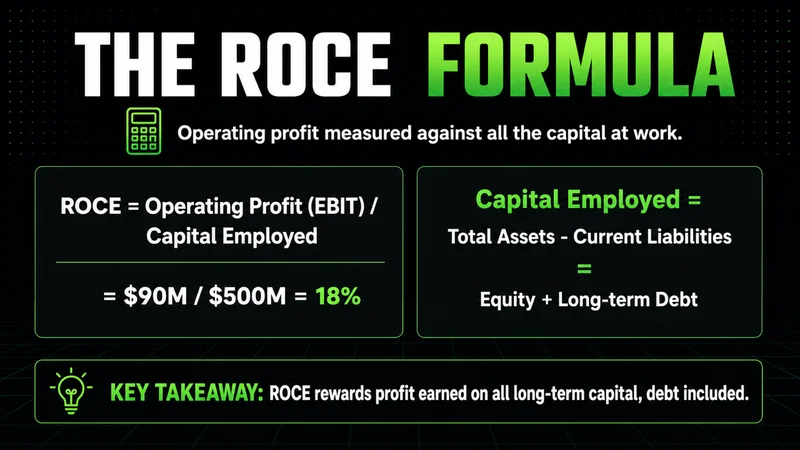
ROCE = Operating Profit (EBIT) / Capital Employed
Capital employed is total assets minus current liabilities, which is the same as equity plus long-term debt. EBIT is earnings before interest and taxes, the operating profit line.
The calculation works in three steps. Pull EBIT from the income statement. Pull total assets and current liabilities from the balance sheet, and subtract to get capital employed. Divide the first by the second.
An example makes the formula concrete. A company reports EBIT of 80 million dollars. Its total assets are 600 million dollars and its current liabilities are 200 million dollars, so capital employed is 400 million dollars. ROCE is 80 divided by 400, or 20%. For every dollar of long-term capital the business controls, it generates 20 cents of operating profit before financing and tax.
Some analysts average capital employed across the opening and closing balance sheet rather than using the year-end figure. On a company whose asset base moved sharply during the year, that adjustment matters; on a stable one, it barely changes the result.
How to interpret return on capital employed and what counts as good
Interpretation starts with a benchmark, and the common rule of thumb is a ROCE of at least 15%. Below that, the business is working capital hard without much to show for it. Well above it, the company is either operating something genuinely efficient or running an asset-light model that needs little capital in the first place.
The number only means something in context. A few things shape what counts as a good return on capital employed:
- The industry. Manufacturing and heavy industrials carry large asset bases, so a ROCE in the high teens is strong. Software and other capital-light businesses can post far higher figures because they employ little capital to begin with.
- The trend. One year tells you almost nothing. A ROCE that holds above its cost of capital for years is the signal; a single high reading is noise.
- The cost of capital. A 12% ROCE is creating value if capital costs 8% and destroying it if capital costs 15%. The threshold is relative, not fixed.
The same discipline applies here that applies to a chart. A number without context is not information. Reading return on capital employed in isolation, with no sense of the industry or the cycle, is interpretation by reflex rather than by analysis.
Return on capital employed vs return on equity
Return on capital employed and return on equity answer different questions, and confusing them is the most common mistake beginners make. ROE measures profit against shareholders' equity alone. ROCE measures operating profit against equity plus long-term debt.
The gap between them is leverage. A company can lift its return on equity simply by borrowing more, because debt shrinks the equity base the profit is measured against. ROCE does not flatter that move; the borrowed capital sits in the denominator, so a debt-fueled business has to actually earn on the money before the ratio improves. When ROE runs well ahead of ROCE, leverage is doing the work, and that is worth knowing before you treat a high ROE as a sign of quality.
The limitations of return on capital employed
ROCE is a balance-sheet ratio, and that is exactly where it can mislead. Capital employed is recorded at book value, so a company with old, heavily depreciated assets shows a small denominator and an inflated ROCE that has more to do with accounting age than operating skill. A competitor that recently invested in new plant looks worse on the same metric while being the stronger business.
This is the part worth saying plainly: ROCE breaks down where the capital base is distorted or the cycle is turning. In a cyclical business near a profit peak, EBIT is temporarily high and the ratio flatters a company that is about to mean-revert. In a capital-light business, the denominator is so small that the percentage swings on rounding and tells you little about durability. The cleaner the asset base and the more stable the cycle, the more the number is worth. Outside those conditions, treat it as one input, not a conclusion.
How investors use return on capital employed in stock analysis
For someone analyzing a stock rather than auditing a company, ROCE works best as a filter, not a target. It separates businesses that compound capital efficiently from those that consume it. A short checklist keeps the read honest:
- Look at five years of ROCE, not one. Consistency above the cost of capital matters more than any single high print.
- Compare against direct competitors in the same industry, never across sectors.
- Check whether ROE is running far ahead of ROCE, which flags leverage doing the heavy lifting.
- Watch for an aging asset base inflating the ratio, and for cyclical peaks that will not hold.
The broader belief underneath this is simple. Most analysis online treats a metric like return on capital employed as a number to screen on and move past, when the real edge is in understanding the conditions under which it holds and the conditions under which it lies. The ratio is reactive evidence about how a business has used capital, not a prediction about what the stock will do next.
FAQs
What is return on capital employed in simple terms? It is the operating profit a company earns for every dollar of long-term capital it uses. A 20% ROCE means the business generates 20 cents of operating profit per dollar of capital employed, before interest and tax.
How do you calculate return on capital employed? Divide operating profit, or EBIT, by capital employed, where capital employed is total assets minus current liabilities. EBIT comes from the income statement and the capital figure comes from the balance sheet.
What is a good return on capital employed? A common benchmark is 15% or higher, but the answer depends on the industry and the company's cost of capital. The ratio only signals value when it stays above the cost of capital over several years, not in a single strong period.
What is the difference between return on capital employed and return on equity? ROCE measures operating profit against equity plus long-term debt, while ROE measures profit against equity alone. When ROE runs well ahead of ROCE, leverage rather than operating quality is driving the difference.
Worth the read?