Market Share — What It Tells Investors
Market share is the slice of industry sales a company controls. Learn to calculate it and read the trend as a fundamental-analysis signal.

Market share is the slice of an industry's total sales a single company controls, expressed as a percentage. You calculate it by dividing the company's revenue or units sold by the total for the whole market over the same period. For an investor reading fundamentals, the number itself matters less than its direction: a share that climbs while rivals shrink is one of the cleaner signals that a business is winning on something durable rather than on price.
Most explainers stop at the formula. That is the easy part, and it is also the least interesting. The harder and more useful question is what a given market-share reading tells you about the company behind it, what the trend in that reading implies about competitive strength, and the specific conditions under which the same number quietly stops meaning anything at all.
What market share actually measures
Market share answers one question: of every dollar customers spend in this industry, how many land with this company. If the total market is 50 billion dollars in annual sales and a company books 5 billion of it, the company holds a 10 percent share. The denominator is the entire addressable market; the numerator is the firm's piece of it.
That framing already exposes the metric's first weakness. The number depends entirely on how you draw the boundary of the market. Define the market narrowly and a company looks dominant. Define it broadly and the same company looks marginal. A streaming service holds a large share of paid subscription video and a tiny share of "all the ways people spend an evening." Both are defensible denominators. Neither is wrong. This is why two analysts can quote different market-share figures for the same firm and both be telling the truth.
So the metric is relative, not absolute. It compares a company to its competitors inside a defined arena. A 10 percent share means little until you know whether the next-largest player holds 9 percent or 40 percent.
How to calculate market share
The core formula is direct:
Revenue-based market share: company revenue divided by total market revenue, times 100.
Unit-based market share: company units sold divided by total industry units, times 100.
Revenue share and unit share can diverge sharply, and the gap is informative. A company with a small unit share but a large revenue share is selling fewer, higher-priced items, which usually points to a premium position and stronger margins. A company with a large unit share but a thin revenue share is moving volume cheaply. Same industry, very different businesses.
To work through it step by step:
Define the market precisely, including geography, product category, and time window. Write the definition down before you pull any numbers.
Find the company's sales for that exact scope, usually from its income statement or segment reporting.
Estimate total market size for the same scope, from industry reports, regulator filings, or the combined revenue of the major players.
Divide and convert to a percentage.
The third step is where most calculations break. Total market size is rarely published cleanly; it is estimated. The quality of your market-share number is capped by the quality of that denominator, and a confident percentage built on a soft total is false precision dressed up as analysis.

A market share example for investors
Consider two companies in the same industry. Company A holds 30 percent of a market that is growing 4 percent a year. Company B holds 8 percent of that same market but is taking share at roughly two points a year while A slowly loses ground.
The surface read favors A: larger, more dominant, more established. The structural read is more interesting. B is the one demonstrating that customers prefer its product enough to switch, and it is compounding that advantage in a market that is itself expanding. A's size may reflect a position built years ago that is now eroding. Neither picture is complete without margins, but the share trend alone reframes which business has momentum.
That is the example that matters for stock analysis. The static number tells you where a company stands today. The trend tells you where the competitive balance is heading, and markets price the direction long before they price the level.
Why market share matters in fundamental analysis
Rising market share is one of the few metrics that is genuinely hard to fake over time. A company can manage earnings for a quarter, time its buybacks, and frame its guidance favorably. Taking share from capable competitors, quarter after quarter, is harder to engineer. It usually requires a real advantage: a better product, a cost structure rivals cannot match, a distribution edge, or switching costs that lock customers in.
Sustained share gains often point to a competitive moat, and a moat is what lets a business defend its profitability rather than compete it away. A company that holds dominant share tends to have more pricing power, steadier cash flows, and more room to absorb a downturn than a small player fighting for every account. For a long-term investor, the share trend is a proxy for the durability of the earnings stream, which is the thing a valuation ultimately rests on.
Liquidity drives markets more than opinions do, and the same logic applies to a company's customers: where the spending actually goes tells you more than any management narrative about where it should go.
This is also where market share connects to the broader idea of company health. Combined with margins, return on invested capital, and the trajectory of the industry itself, share trend helps separate a business that is genuinely strengthening from one that is buying growth it cannot keep.
Market share vs revenue growth: reading them together
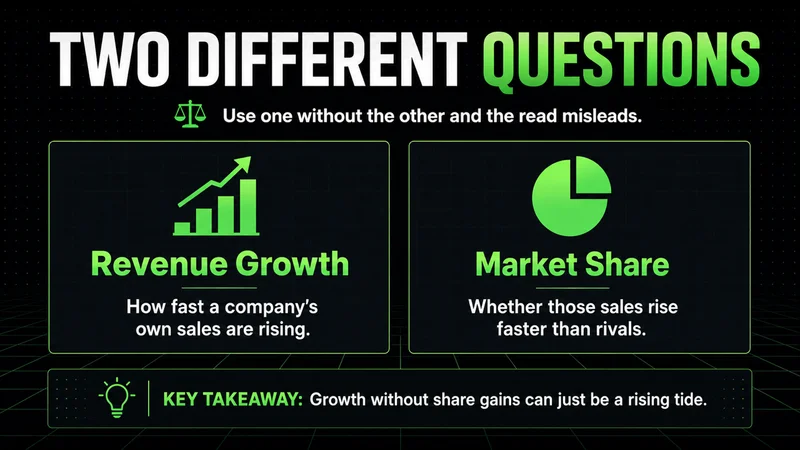
Revenue growth and market share answer different questions, and using one without the other is where beginners get misled.
Revenue growth tells you how fast a company's sales are rising. Market share tells you whether those sales are rising faster than the market around them. A company can grow revenue 10 percent in a year and still be losing share if its market grew 15 percent. From the income statement alone, that looks like success. Against the industry, it is quiet decline.
The combinations worth separating:
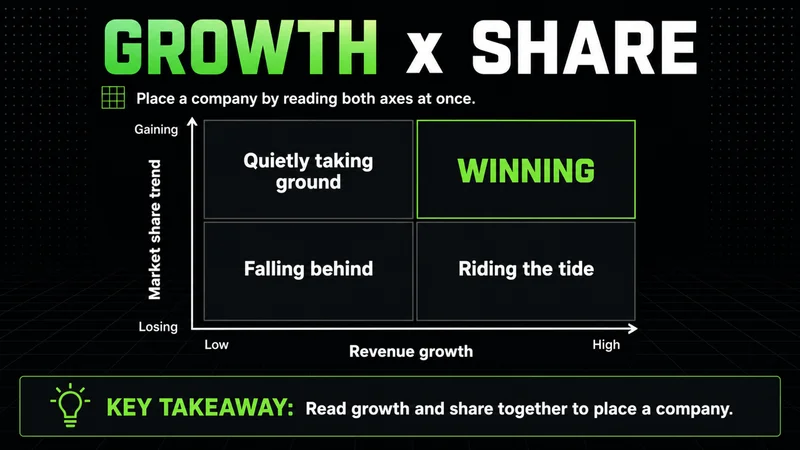
Revenue up, share up: the company is outgrowing its market and winning competitively. The strongest signal.
Revenue up, share flat: the company is riding industry tailwinds without gaining ground. Growth that depends entirely on the tide coming in.
Revenue up, share down: the warning case. Sales rise, but rivals rise faster, and the company is losing the relative race even as the absolute number flatters management.
Revenue flat, share up: often overlooked. In a shrinking industry, holding revenue while taking share can signal a survivor consolidating a fading market.
Reading the two together is the difference between knowing a company grew and knowing whether it actually got stronger.
Common market share mistakes beginners make
A few errors show up repeatedly, and most of them come from treating the metric as more solid than it is.
Trusting the denominator. Total market size is an estimate. Treating a soft total as a hard fact produces a precise-looking share that is built on sand.
Ignoring how the market was defined. Change the boundary and the share changes. Always check the scope before comparing two figures.
Celebrating share bought with margin. A company can buy share by cutting prices or spending heavily on promotion. Share that costs more to hold than it earns is not strength; it is a subsidy with a deadline.
Reading a single snapshot. One quarter's share is noise. The trend across several periods is the signal.
Forgetting the industry's direction. Gaining share in a structurally declining market is a slower way to lose. The biggest share of a shrinking pie is still a shrinking business.
When market share stops being a useful signal
Market share reads cleanly in a stable, well-defined industry with mature competitors. Outside those conditions, the same number can mislead, and this is the part most guides skip.
When a market is being redefined, share figures lose their footing. If a new category is absorbing demand from an old one, a company can hold steady share of a market that is itself becoming irrelevant. The share looks defended; the relevance is draining. Likewise, in a fast-moving industry where the leaders change every few years, a dominant share is a snapshot of the last cycle, not a forecast of the next one.
There is also the margin trap. Share gained by destroying profitability inverts the signal entirely. A company taking share while its returns collapse is not building a moat; it is renting customers who leave the moment the discount stops. The healthiest reading of market share always pairs the trend with what it costs the company to hold its position. When that cost runs ahead of the value of the share, the metric is telling you the opposite of what it appears to say.
Treat market share the way a disciplined trader treats any single indicator: as one input that gains meaning only in context, never as a decision on its own.
FAQs
What is market share in simple terms? It is the percentage of an industry's total sales that one company controls. You divide the company's sales by the total market sales for the same period and multiply by 100. A 10 percent share means the company captures one in every ten dollars spent in that market.
How do you calculate market share? Divide a company's revenue or units sold by the total revenue or units for the entire market over the same time window, then multiply by 100. The main difficulty is estimating the total market size accurately, since that figure is rarely published cleanly and usually has to be approximated from industry data.
Why does market share matter for investors? Rising market share is hard to fake over time and often signals a durable competitive advantage. A company taking share from capable rivals usually has a real edge in product, cost, or distribution, which supports stronger pricing power and steadier cash flows. That durability is what a long-term valuation depends on.
What is the difference between market share and revenue growth? Revenue growth measures how fast a company's own sales are rising. Market share measures whether those sales are rising faster than the market around them. A company can grow revenue while still losing share if its industry is growing faster, which looks like success on the income statement but is competitive decline.
What is considered a good market share? There is no universal number. A good share depends on the industry's structure and how fragmented it is. In a market split among many small players, 15 percent can mean leadership. In a concentrated industry, the same figure can mean a distant follower. The trend usually matters more than the level.
Can a company have high market share and still be a poor investment? Yes. Share bought through heavy discounting or unsustainable spending can erode profitability even as the percentage rises. A high share in a structurally declining industry can also mask a shrinking business. Share is only useful when read alongside margins and the direction of the market itself.
Worth the read?