Risk Reward Ratio — What It Actually Buys You
The risk reward ratio compares defined risk against defined reward, and it only means something when both levels come from real market structure.
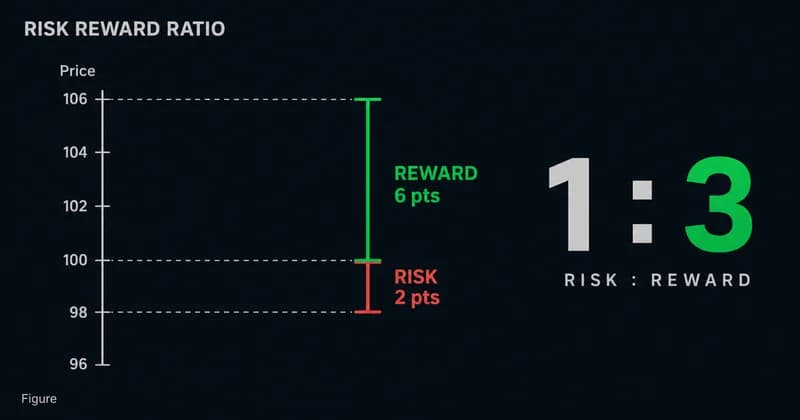
The risk reward ratio compares how much you stand to lose on a trade against how much you stand to make, measured from your entry to your stop and your target. Risk 1 to make 2, and you are working a 1:2 ratio. It is a planning number, not a prediction.
Most traders treat it as a quality score. A 1:3 looks better than a 1:1, so the 1:3 must be the better trade. That reasoning skips the part that matters. A ratio is only as honest as the stop and target you built it from, and those levels come from structure, not from the number you wanted to see.
Risk reward ratio meaning, without the dress-up
The risk reward ratio meaning is simple on the surface. Risk is the distance from your entry to your stop, reward is the distance from your entry to your target, and the ratio says what you are trying to collect for every unit you put at risk.
The number describes intent. It says nothing about whether the trade works; a 1:4 plan still loses when price hits the stop. What it gives you is a way to compare the shape of trades before you take them, so capital flows toward setups where the math is on your side. One trade tells you almost nothing; the ratio earns its keep across hundreds of trades, where the relationship between risk and reward decides whether the account survives a losing streak.
The risk reward ratio formula and how to calculate it
The risk reward ratio formula states the risk against the reward as a ratio.
Risk = entry price minus stop price. Reward = target price minus entry price. Ratio = risk : reward.
To calculate risk reward ratio on a long trade, you enter at 100, set the stop at 98 below a defended level, and target 106 where prior supply waits. Risk is 2 points, reward is 6 points, and the ratio is 1:3.
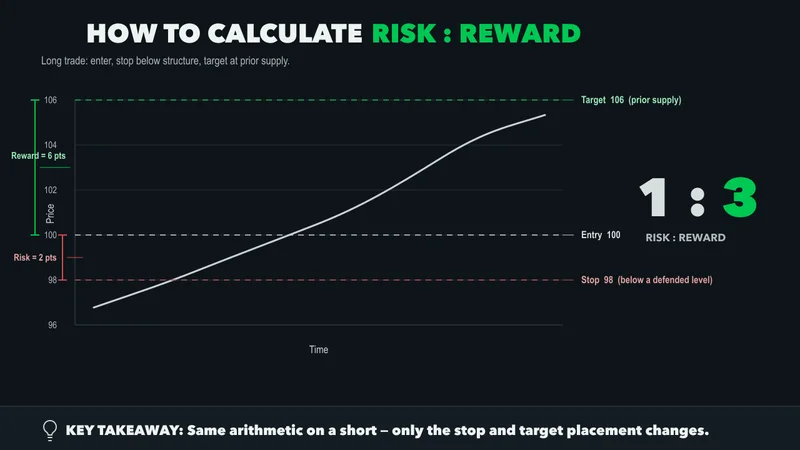
The same risk reward ratio calculation works on a short: entry at 100, stop at 102, target at 94, again 1:3. The arithmetic does not change with direction. What changes the ratio is where you place the stop and the target, and that placement is a structural decision, not math.
This is where a risk reward ratio example earns its value for beginner traders. Build the ratio from levels the market respects: a swing low for the stop, a prior high or a liquidity pool for the target. Anchored to structure, the ratio reflects something real. When it is not, it is two numbers you chose to make the trade look acceptable.
Why risk reward ratio matters in risk management
Why risk reward ratio matters in risk management comes down to how it pairs with win rate. The two are not separate dials; they are the inputs that decide whether a strategy makes money over time.
Risk reward ratio vs win rate explained in one line: a higher reward per unit of risk lets you be wrong more often and still come out ahead. At 1:3, you can lose roughly three of every four trades and break even on the wins alone. At 1:1, you need to win more than half just to stay flat after costs. Neither is better in isolation; the right one depends on how often your setup wins.
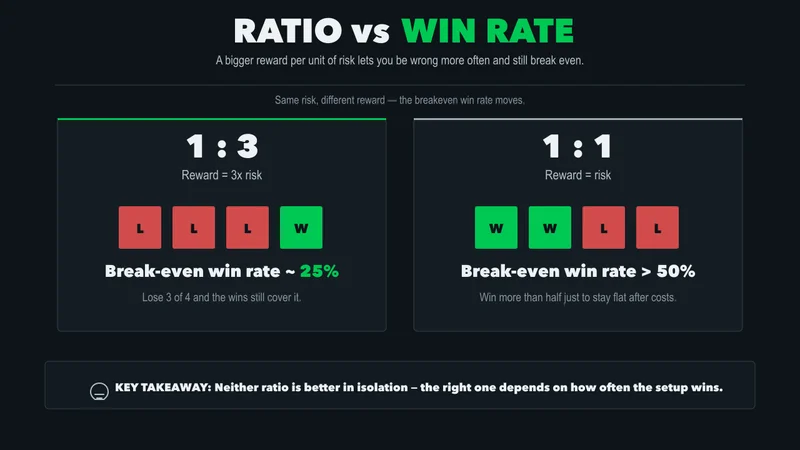
A favorable ratio does not remove losing streaks; it changes what a losing streak costs you, which is what keeps accounts alive through drawdowns. Risk management matters more than entries, and the ratio is where that belief becomes arithmetic: a mediocre entry on a defined 1:3 plan survives a rough month that a perfect entry on a 1:1 plan does not.
What is a good risk reward ratio for new traders
Most guides answer this with a single number. The honest risk reward ratio benchmark is a range tied to your win rate, not a fixed target you force onto every setup.
For new traders, 1:2 is a reasonable working floor. It gives enough cushion that a normal win rate keeps the account positive, and it forces you to skip trades where the target sits too close to justify the risk. As you learn how often your setups resolve in your favor, the useful ratio shifts: a high win rate setup can work at 1:1.5, while a selective, lower win rate approach needs 1:3 or wider. What it should never be is a number you get by moving the stop closer until it looks clean.
Common risk reward ratio mistakes beginners make
The most common risk reward ratio mistake is tightening the stop to manufacture a better ratio. A trader wants a 1:3, the natural stop only allows 1:1.5, so they pull the stop in until the math reads 1:3. The number improves; the trade gets worse. The stop now sits inside normal noise, so price taps it on a routine wiggle and the plan never plays out.
A risk reward ratio is only meaningful when the stop sits where the trade idea is actually wrong, not where the ratio looks good. Move the stop for the ratio and you are no longer measuring the trade; you are measuring a fiction.
Other common risk reward ratio mistakes beginners make follow the same pattern of bending the number instead of respecting structure:
- Setting the target at a round figure rather than where price is likely to react, which inflates the reward side on paper.
- Ignoring win rate and assuming a wide ratio fixes a setup that simply does not win often enough.
- Cutting winners early, so the realized reward never matches the planned number.
That last one matters more than it looks. The ratio you live with is the realized one, not the one you wrote down.
This is where the framework bends in live execution. The risk reward ratio assumes you hold to the stop and target you defined. The moment you manage the trade by feel, slippage and early exits pull the realized ratio away from the planned one, and only the realized one shows up in your account. The concept is not flawed; execution introduces variables the number never accounted for. Plan the ratio from structure, then hold it through the part where holding is uncomfortable.
How to improve risk reward ratio over time
How to improve risk reward ratio over time is mostly about patience on the entry, not ambition on the target. A wider ratio rarely comes from reaching for a farther target; it comes from a tighter, structure-based entry that shrinks the risk side without moving the stop into noise. Wait for price to come to a level instead of chasing it into the move. An entry close to your invalidation point keeps the risk small while the target stays anchored to structure. Fewer, better-located entries widen the ratio more reliably than any amount of activity does.
A risk reward ratio checklist for trading review makes the improvement measurable. After each trade, log the planned ratio, the realized ratio, and the reason for any gap. Over a few dozen trades the pattern is obvious: if realized ratios sit well below planned ones, the problem is execution, not analysis.
FAQs
What is risk reward ratio in trading? It is the comparison between the amount you risk on a trade and the amount you aim to make, measured from your entry to your stop and your target. A 1:3 ratio means you risk one unit to try to collect three.
How do you calculate risk reward ratio? Measure the distance from your entry to your stop for the risk, and from your entry to your target for the reward, then state it as risk to reward. An entry at 100 with a stop at 98 and a target at 106 is 2 points of risk against 6 points of reward, or 1:3.
Does a high risk reward ratio guarantee profit? No. The ratio only describes the planned shape of the trade. Profit depends on how the ratio pairs with your win rate and on whether your realized exits match the plan you defined.
Summary
The risk reward ratio is a planning tool that compares defined risk against defined reward, and it only means something when both levels come from structure. It pairs with win rate to decide whether a strategy survives, it gets faked when traders tighten stops into noise, and it drifts when the realized exit does not match the plan. Build it from real levels, hold it through the uncomfortable part, and review the gap between planned and realized ratios trade by trade. That is where the number stops being decoration and starts protecting capital.
Worth the read?