Securities — What They Are and How They Trade
Securities are tradable financial instruments that hold value. Here is what securities are, the main types, and how they actually behave when you trade them.

Securities are tradable financial instruments that carry value and can be bought or sold between parties. A stock, a bond, an exchange-traded fund, an options contract: each is a security. What matters is what it gives you, a defined claim on a company, a stream of payments, or the right to a future transaction. Once that claim can change hands in a market, it behaves like a price, not a definition.
Most explanations stop at the taxonomy. That misses the part that decides whether you keep your capital. A security is not just what it represents on paper. It is what other participants will pay for it right now, under current liquidity and positioning. That gap between the textbook claim and the live price is where most beginners get hurt.
What securities mean in plain terms
A security is a financial asset you can trade. That working definition holds up. The instrument represents something, an ownership stake, a debt obligation, or a contractual right, standardized enough that a market can price it and move it from one holder to another.
The word covers a lot of ground. Stocks, bonds, Treasury bills, mutual fund shares, ETFs, options, and futures all qualify. What unites them is transferability. A handshake loan to a friend is a financial arrangement, not a security. The same loan, packaged as a standardized note that trades on an open market, is.
A short history of how securities developed
Securities are old. Governments and merchants were issuing transferable debt centuries ago, and joint-stock companies began selling ownership shares to pool capital for voyages no single backer could fund alone. The Dutch East India Company is the usual reference point for the first widely traded equity.
The form has changed; the function has not. A security still moves capital from people who have it to enterprises that need it, and gives that provider something to sell when they want out. In the United States, the regulatory framework the SEC enforces came later, mostly in response to periods where the gap between what securities claimed and what they delivered grew dangerous.
The different types of securities and their examples
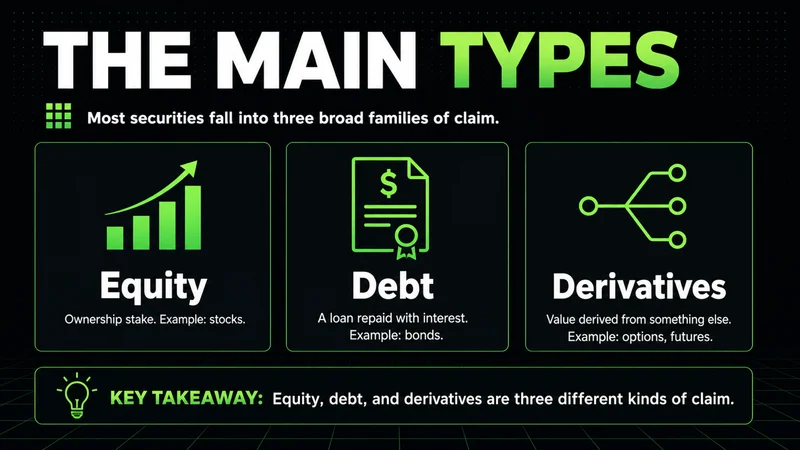
Most securities fall into a few buckets, and each behaves differently when markets move.
Equity securities. Ownership in a company. Common and preferred stock are the core examples. You hold a residual claim on the business and often a vote.
Debt securities. A loan you can trade. Bonds, Treasury notes, and commercial paper qualify. You are owed principal and interest under defined terms.
Derivative securities. Instruments whose value comes from something else, such as options, futures, and swaps. The price tracks an underlying asset, not a direct claim.
Hybrid securities. Instruments that blend the two, such as convertible bonds and preferred shares that carry both income and equity-like features.
A concrete example: a share of an index ETF is an equity security bundling hundreds of stocks, a two-year Treasury note is a debt security with a fixed payment schedule, and an index futures contract is a derivative tied to that index. Same broad family, very different risk behavior.
Securities versus assets, and why the distinction matters
Every security is an asset, but not every asset is a security. The difference comes down to two traits a security adds:
Standardization. The claim is defined in uniform terms a market can price.
Transferability. The instrument can change hands quickly at a known price.
An asset is anything that holds value, a building, a gold bar, a private business. A security is the narrower case: an asset standardized into a tradable instrument with a market price.
That distinction is practical. A rental property and a real estate ETF give exposure to the same sector, but only one prices continuously and lets you exit in seconds. The security carries liquidity the raw asset does not, and that liquidity is a feature when you need out and a trap when it tempts you to trade something you do not understand.
How securities actually behave when you trade them
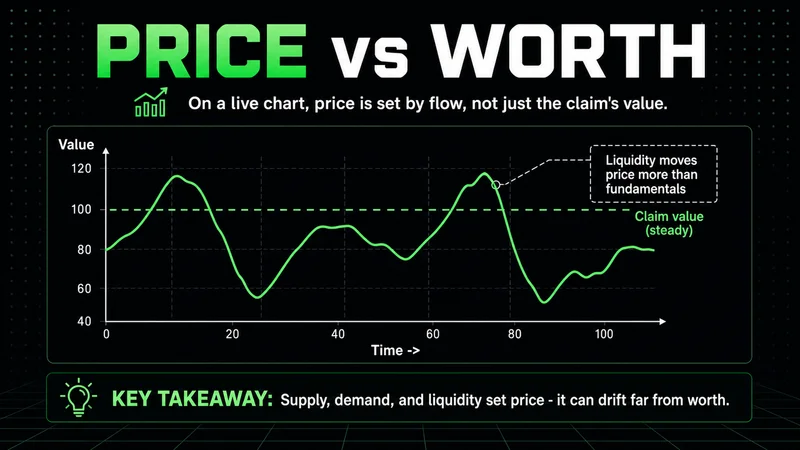
Here is the part the taxonomy guides skip. On paper, a security is a stable claim. On a live chart, it is a price set by supply, demand, and positioning, and that price can drift far from what the claim is worth.
Liquidity drives this more than opinions do. A stock can be fundamentally sound and still sell off hard because larger participants needed to exit and there were not enough buyers to absorb them. The instrument did not change. The order book did. Imbalance between resting orders moves the price in the short term, not the press release.
The market does not care about opinions, effort, or conviction. Risk exists whether you acknowledge it or not.
The textbook tells you a bond is a claim on fixed payments. The screen tells you that same bond can gap when rate expectations shift, faster than your reasoning about it can keep up.
When the clean definition stops being useful
The tidy framing, a security is a stable, tradable claim, holds in normal conditions. It breaks down in two places.
The first is thin liquidity. A small-cap stock or an off-the-run bond can look like a precise, priceable security and then trade with a spread so wide the quoted price is almost fiction. The instrument is the same; the ability to act on it is not.
The second is volatility expansion. During a macro-driven session, correlations tighten and instruments that normally move on their own merits start moving together, dragged by broad positioning. A security you bought for its specific qualities gets repriced by a flow unrelated to it. The classification on paper does not protect you from the liquidity event on the screen.
What beginners get wrong about securities first
The most common early mistake is treating the category as the strategy. Knowing that a stock is an equity security tells you what it is, not whether it is worth buying here, at this price, in this market. The label is the starting point, not the edge.
The second mistake is underestimating how differently each type behaves under stress. A few habits prevent most of the early damage.
Match the instrument to the holding period. A derivative with an expiration is not a buy-and-forget position.
Size for the volatility of the specific security, not for the dollar amount you want to deploy.
Define your exit before you enter. A tradable instrument is only an advantage if you use the exit.
Treat liquidity as a property of the security, not a guarantee. The exit you assume exists has to be there when you need it.
Protecting capital comes before optimizing returns. A beginner who treats a security as a live price under live liquidity, and sizes for it, survives long enough to learn the rest.
FAQs
What is a security in simple terms? A security is a financial instrument that holds value and can be traded between parties. Stocks, bonds, ETFs, and options are all securities. What defines one is a standardized claim, on ownership, debt, or a contract, that a market can price and transfer.
Is a stock a security? Yes. A stock is an equity security. It represents ownership in a company, usually with a claim on residual value and often voting rights, and it trades on an open market.
What is the difference between securities and assets? Every security is an asset, but not every asset is a security. An asset is anything with value, including property or equipment. A security is the narrower case: an asset standardized into a tradable instrument with a market price.
Why do securities carry risk? A security trades at a price set by supply, demand, and positioning, and that price can move away from the underlying claim. Liquidity can thin out and volatility can expand, repricing the instrument on flows unrelated to its fundamentals. The claim on paper does not remove the risk on the screen.
Worth the read?