Short Selling — How It Works and Where It Breaks
Short selling stocks means borrowing shares to sell now and buy back lower. How it works, where the real risk lives, and when the setup breaks down.

Short selling stocks means borrowing shares you do not own, selling them at the current price, and buying them back later to return them. If the price falls between the sale and the repurchase, the difference is your profit. If it rises, the difference is your loss. The mechanics are simple. The part that ends accounts is everything around the mechanics: borrow availability, position size, and the trader's willingness to be wrong slowly instead of all at once.
Most explanations stop at the definition and a clean example where the stock conveniently drops. Real short selling rarely behaves. A short is a position that loses money while you wait to be right, and the market is under no obligation to cooperate on your timeline.
What short selling actually means
Start with the short selling meaning in plain terms. When you buy a stock, you own it, and the worst case is that it goes to zero. When you short a stock, you owe it. You have a borrowed asset that you must eventually return, and your obligation grows as the price climbs.
That single difference reshapes the entire risk picture. A long position has a floor. A short position has a ceiling that does not exist, because there is no defined limit on how high a price can travel. You are not buying low to sell high. You are selling first, with the intent to buy back lower, and you are renting the shares from someone else to do it.
The rented part matters. You hold the position inside a margin account, you pay borrow interest for as long as the trade stays open, and any dividend paid during that window comes out of your account, not the lender's. None of that shows up in the textbook example. All of it shows up in your statement.
How short selling stocks works, step by step
Here is how a short selling example plays out from open to close:
You locate shares to borrow through your broker and sell them at the market price.
The proceeds sit in your account as collateral, and borrow interest begins accruing.
You wait for the price to decline toward your target, or for your invalidation to trigger.
You buy back the same number of shares, called covering, and return them to the lender.
Your result is the sale price minus the repurchase price, after borrow costs and any dividends owed.
Say a stock trades at 80, and structure has broken down with no buyers stepping in on the retest. You short 100 shares and collect 8,000. Price works lower and accepts under a prior swing low. You cover at 64 for 6,400. The gross difference is 1,600, reduced by borrow interest and fees. That is the entire loop. Notice the trade was defined by where it would be wrong, not only by where it might be right.
The locate step is the one beginners skip in their heads. Hard-to-borrow names carry higher interest, and in thin or heavily shorted stocks the lender can recall the shares, forcing you to cover at a moment you did not choose. The cleaner the borrow, the more control you keep over your own exit.
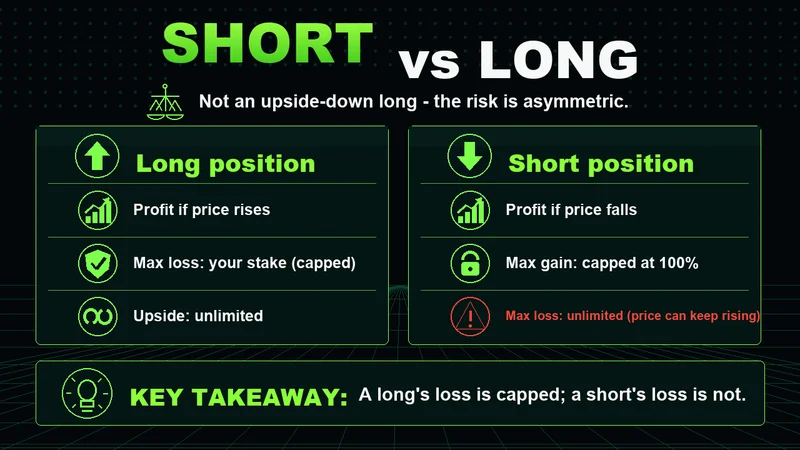
Short selling versus a long position
The short selling vs long position comparison comes down to where risk sits and how time treats you. The differences are not symmetric, and treating a short like an upside-down long is how traders get hurt.
Loss profile: a long can lose only what you put in; a short has no fixed cap on the loss.
Time: a long can be held with patience at no carrying cost beyond opportunity; a short bleeds borrow interest and dividend obligations the longer it stays open.
Drift: markets trend up over long horizons more often than down, so a short fights the broader background tendency.
Crowding: a long is rarely forced to close by others; a heavily shorted name can squeeze when shorts cover at once.
This is why a short and a long with the same dollar size are not the same risk. Sizing a short like a long is a quiet way to be overleveraged without noticing it until the position moves against you.
Where the real risk lives
The headline short selling risk is the uncapped loss, and it is real, but it is not the one that drains most accounts. The slower killers are borrow cost, time, and the short squeeze.
A short squeeze happens when a rising price forces shorts to cover, and that covering is itself buying, which pushes price higher, which forces more covering. The feedback loop can run far past anything fundamentals would justify. If your size is wrong going in, you do not get to wait it out. A margin call arrives, and the broker can close the position for you at the worst possible level.
Positioning sets the path here more than your opinion does. You can be completely correct about a company and still lose, because borrow conditions and who else is short decide the path long before the thesis resolves. Being early in a short is operationally the same as being wrong, since the account feels the loss either way.
When a short setup is structurally valid
A disciplined short selling strategy starts from structure, not from a feeling that a stock has gone up too much. Expensive is not a setup. Price can stay extended far longer than a short position can stay funded.
The condition that actually matters is a break in market structure with no recovery: a prior support level lost, a retest that fails to reclaim it, and sellers holding control on lower timeframes. That is a structural short. The invalidation is clean, which is the whole point. If price reclaims the broken level and accepts above it, the idea is wrong and you are out.
The best traders react to what price confirms. They do not predict where it should go and then short it for disagreeing with them.
Here is where this approach breaks down, and it is worth naming plainly. Structural shorting reads well in liquid names during regular cash hours, when order flow is visible and levels mean something. In thin pre-market or overnight sessions, the same broken level can be swept and reclaimed on almost no volume, and your invalidation triggers on noise rather than signal. The framework depends on liquidity being present to make the structure trustworthy. Outside that, a clean-looking short is mostly guesswork wearing a chart.
The rules that govern short selling
Short selling rules are not just personal risk rules; regulators impose real constraints, and ignoring them is how a trade becomes a violation. You do not need to memorize statute, but you do need to know the shape of it.
Locate requirement: you generally must have a reasonable basis to believe the shares can be borrowed before you short, which is why naked shorting without a locate is restricted.
Price-test protection: under the SEC's alternative uptick rule, once a stock drops far enough in a session, short selling is curbed so shorts cannot pile on freely during a sharp decline.
Margin maintenance: short positions live in margin accounts and must hold minimum equity, and the broker enforces that with margin calls.
These exist because unmanaged shorting can accelerate declines. From a trader's seat, the practical takeaway is narrower. Confirm the borrow, respect the margin math, and assume the rules can tighten precisely when volatility spikes and you most want to act.
What are the most common short selling mistakes?
The common short selling mistakes beginners make are rarely about analysis. They are about discipline under pressure, which is where most accounts are decided. The setups are not the hard part; holding to your own rules while the position moves against you is, and shorting exposes that gap faster than going long ever will.
Shorting strength with no structural break, on the belief that a stock is simply too high.
Sizing the short like a long position and quietly carrying uncapped risk.
Holding through a squeeze without a defined invalidation, hoping the move reverses.
Ignoring borrow cost and dividend obligations until they have eaten the edge.
Adding to a losing short to lower the average, which increases risk exactly when the trade is already wrong.
Every one of these is a process failure, not a knowledge gap. The fix is not a better indicator. It is a defined invalidation and a size small enough that a single loss does not distort the next decision.
A short selling checklist before you commit risk
Use a short selling checklist as a gate, not a suggestion. If a setup cannot clear every line, it is not a trade yet.
Is there a confirmed structural break, with a failed reclaim of the lost level?
Is the borrow available and at a cost that does not erode the edge?
Is the invalidation a specific price where the idea is objectively wrong?
Is the size small enough that hitting the stop is an operational cost, not an emotional event?
Is liquidity present right now, so structure can be trusted on this timeframe?
The checklist is deliberately boring. Boring is the point. The market rewards patience far more than activity, and most traders need fewer shorts with better risk control, not more chances to be clever.
FAQs
What is short selling in simple terms? It is borrowing shares, selling them at the current price, and buying them back later to return them. You profit if the price falls between the sale and the repurchase, and you lose if it rises.
How does short selling work for a beginner? You borrow shares through your broker, sell them, wait for a decline, then buy them back to cover and return them. The position sits in a margin account and accrues borrow interest the entire time it stays open.
What are the main risks of short selling? The loss is theoretically uncapped because price has no ceiling, and a short squeeze can force you to cover into a rising market. Borrow cost, dividend obligations, and margin calls add pressure that a long position never carries.
When should traders use short selling? Only when structure has broken and failed to reclaim, the borrow is clean, and the invalidation is defined. Shorting because a stock looks expensive, with no structural confirmation, is closer to guessing than to trading.
Is short selling good for beginners? It is harder than going long because the risk is uncapped and time works against the position. A beginner is better served learning structure and risk control on long setups first, then approaching shorts with strict size and defined invalidation.
Is short selling legal? Yes, it is legal and regulated. You generally must locate borrowable shares first, and price-test rules can curb shorting after a steep intraday decline.
Keep building the foundation
Short selling is one expression of a single discipline: define where you are wrong, size so a loss is survivable, and let structure rather than opinion decide the trade. If this was useful, the natural next steps are our breakdowns of market structure, risk-defined position sizing, and how liquidity shapes price behavior. The mechanics of any single tactic matter far less than the process you bring to it.
Worth the read?