Short Selling Explained — Profiting When Price Falls
Short selling is borrowing shares to sell high and buy back lower, profiting when price falls. Learn how it works, the risks, and the short squeeze.
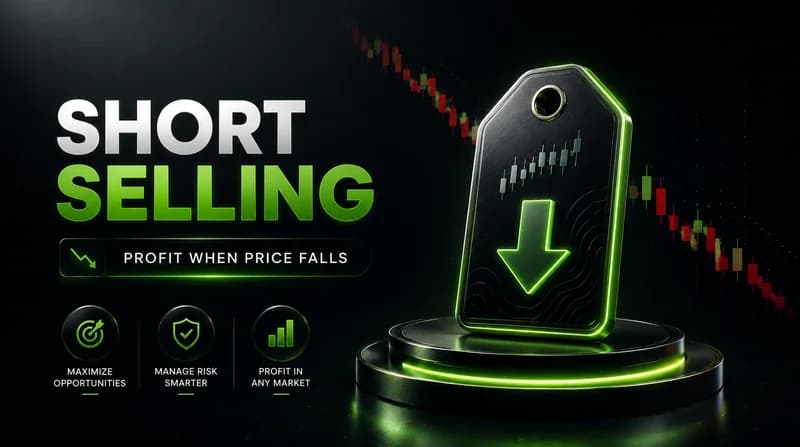
Short selling is a way to profit when a price falls instead of rises. You borrow shares you do not own, sell them at the current price, and aim to buy them back later at a lower price — returning the borrowed shares and keeping the difference. It is the same buy-low, sell-high logic run in reverse: you sell high first, then try to buy low. The mechanic is simple. The risk profile is not, and that is where most beginners get hurt.
The reason short selling deserves respect is the asymmetry. When you buy a stock, the most you can lose is what you paid — the price can only fall to zero. When you short, the loss runs the other way. Price can keep climbing, and there is no ceiling on how high it goes, which means no fixed limit on what a short can lose.
What short selling is
The short selling meaning comes down to direction. A normal position is long: you own the asset and profit when it rises. A short position is the opposite: you are positioned for a decline, and you profit when the price drops. You do not own the shares you sell — you borrow them, usually from your broker, and you are obligated to return them later.
Because you are borrowing, short selling happens inside a margin account. The borrowed shares are collateralized against the cash and assets you hold, and the broker charges interest on the borrow for as long as the position stays open. You also owe any dividends paid while you hold the short, since the lender of the shares is still entitled to them. These are real costs that quietly eat into the trade.
How short selling works
The mechanics are easiest to follow as a sequence.
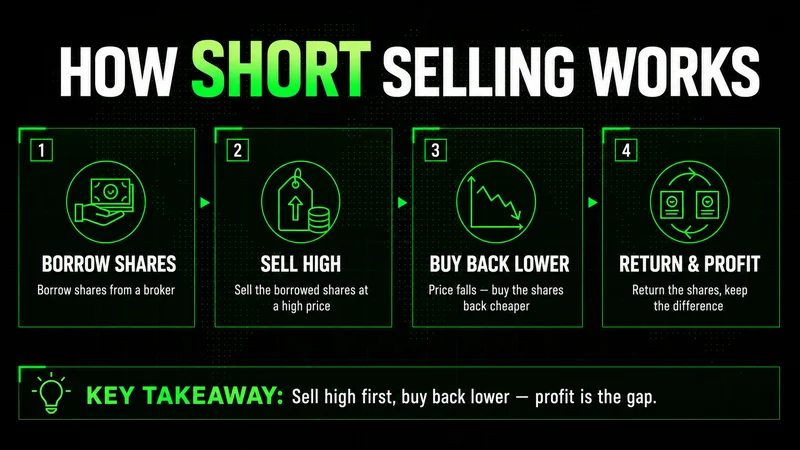
A short sale moves through the same steps every time:
Borrow the shares. Your broker locates shares to lend, often from another client's holdings.
Sell them at the current price. The proceeds sit in your margin account as collateral.
Wait for the price to fall — the entire thesis of the trade.
Buy the shares back at the lower price. This is called covering.
Return the borrowed shares to the lender and keep the difference between your sell and buy prices, minus borrow interest and any dividends owed.
A simple example: you borrow shares trading near a high level and sell them. The price declines, you buy them back at the lower price, return them, and the gap between the two prices is your profit before costs. If the price had risen instead, you would have bought them back higher and taken a loss.
Short selling vs going long
Short selling vs going long is a question of which direction pays and what you are risking to get it. The difference is not symmetric, and the chart of outcomes makes that clear.
When you go long, your downside is capped at your entry — the worst case is the asset going to zero — while your upside is open-ended. When you short, the payoff inverts in the worst possible way: your profit is capped because a price can only fall so far, but your loss is open-ended because a price can rise without limit. You are trading a limited reward for an unlimited risk, which is the opposite of the structure most traders should want.
That does not make short selling wrong. It makes it a tool that demands tighter risk control than a long position, because the math is working against you on the downside.
The risks of short selling — and the short squeeze
The central short selling risk is that unlimited downside, and it stops being theoretical during a short squeeze.
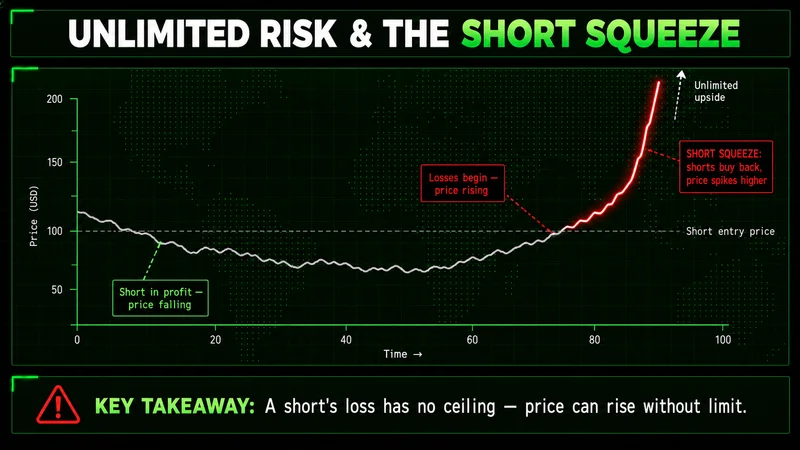
A short squeeze happens when a heavily shorted stock starts rising and the shorts are forced to buy back to limit their losses. Their buying pushes the price higher, which forces more shorts to cover, which pushes the price higher still. The move feeds on itself, and a position that looked like a small loss can become a large one in minutes.
A short can be right about the company and still get carried out of the position. Being correct on direction means nothing if the timing forces you to cover into a spike.
There are two other frictions beginners overlook. Hard-to-borrow shares carry high borrow fees that can exceed any realistic profit. And the lender can recall the shares at any time, forcing you to close the position before your thesis plays out. This is where short selling stops working as a strategy: in a strong uptrend, against a crowded short, or in a name with an expensive, unstable borrow. The setup that reads cleanly on a chart can be the one that squeezes hardest. Most blown accounts on the short side start with a position sized for the expected outcome instead of the unlimited one.
Common short selling mistakes beginners make
The damage tends to come from a short, repeatable list:
Sizing for the thesis, not the risk. Unlimited downside means the position has to be small enough to survive being wrong.
No defined stop. Without a price that closes the trade, a small loss becomes an account-level one.
Ignoring borrow cost and dividends. A pricey borrow can erase the profit before the price even moves.
Shorting strength. Fighting a strong uptrend with a short is the lowest-probability version of the trade.
Forgetting the recall risk. The lender can pull the shares and end the trade on someone else's schedule.
None of these are exotic. They are the predictable result of treating a short like a mirror image of a long, when the risk behind it is anything but symmetric.
FAQs
What is short selling in simple terms? It is borrowing shares you do not own, selling them at the current price, and buying them back later at a lower price to return them. You keep the difference, so you profit when the price falls instead of rises.
How do you short a stock step by step? Open a margin account, have your broker locate and borrow the shares, sell them at the current price, wait for the price to drop, buy them back at the lower price, and return the borrowed shares. The gap between your sell and buy prices, minus costs, is the result.
Why does short selling have unlimited risk? Because a price can rise without limit. When you buy, the most you lose is your entry, since the price can only fall to zero. When you short, there is no ceiling on how high the price can climb, so there is no fixed cap on the loss.
What is a short squeeze? It is a sharp upward move in a heavily shorted stock that forces short sellers to buy back to limit losses. That forced buying drives the price higher, pressuring more shorts to cover, which accelerates the move.
Worth the read?