Slippage in Trading — The Price You Did Not Get
Slippage in trading is the gap between your expected price and your fill. Here is what causes it, how it differs from the spread, and how to limit it.
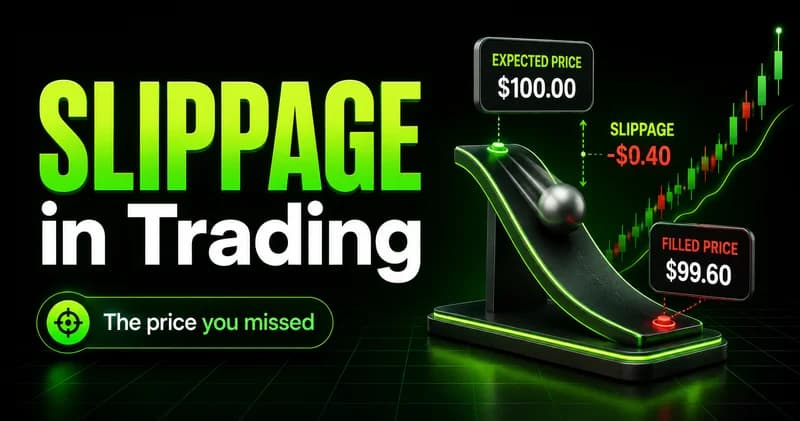
Slippage is the gap between the price you expected and the price you actually got. You click to enter at 4,500, the order fills at 4,502, and those two points are gone before the trade even starts working. Most explanations treat this as a broker problem or a technology problem. It is neither. Slippage is what liquidity looks like when there is not enough of it sitting where you wanted to trade.
That distinction matters more than it sounds. A trader who blames the platform keeps making the same entries. A trader who reads slippage as a liquidity signal starts choosing different moments to act.
What slippage actually means
The slippage meaning is simple once you separate the order from the fill. Your order is an instruction. The fill is what the market gives you when that instruction reaches available liquidity. When the two prices match, you traded into a resting order at your level. When they do not, the price you wanted was already gone, and your order kept walking up or down the book until it found size willing to take the other side.
Slippage runs in both directions. Negative slippage fills you worse than expected, which is the version traders complain about. Positive slippage fills you better, which most traders never notice because a good surprise rarely gets logged. Both come from the same source: the price moved, or the liquidity thinned, in the moment between your decision and your execution.
How slippage works at the level of the fill
A market order does not ask for a price. It asks for a fill, immediately, at whatever is available. If the best offer holds enough size, you get that price. If it does not, your order consumes the first level, then the next, then the next, until it is complete. The slippage fill price is the blended result of every level you touched.
This produces two outcomes worth separating:
- A clean fill, where the top of the book held enough size to complete your order at one price.
- A walked fill, where your order consumed several levels and returned a worse blended average.
This is why slippage and order size are linked. A single contract usually clears at the top of the book. A larger position eats deeper, and the deeper it goes, the worse the average becomes. Slippage execution is rarely about speed alone. It is about whether the resting liquidity at your level can absorb what you are sending into it.
Slippage vs spread, and why traders confuse them
The slippage vs spread question comes up constantly, and the two are not the same cost.
- The spread is the standing distance between the bid and the offer. You pay it the instant you cross the market, every time, in normal conditions.
- Slippage is the additional distance the price moves past the spread because the level you wanted could not fill you.
Think of the spread as the posted toll and slippage as the surcharge that appears when the road is congested. In calm conditions the spread is tight and slippage is near zero. In fast conditions the spread widens and slippage stacks on top of it. Both shrink your edge, but only one of them is predictable.
A slippage example beginners can read
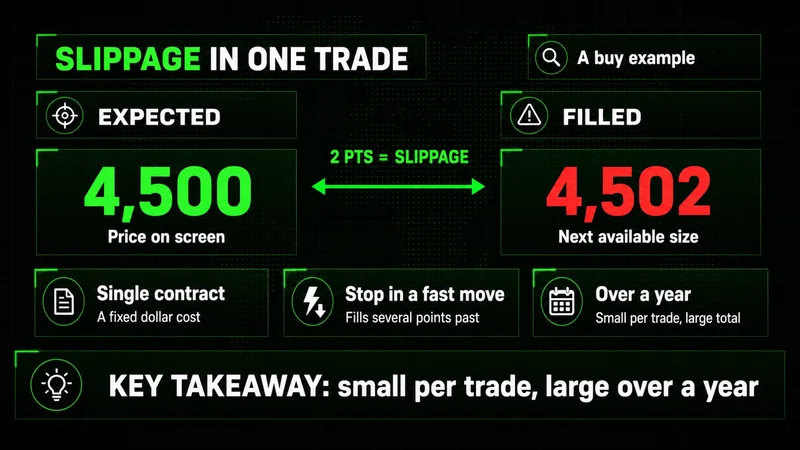
Here is a slippage example that mirrors what happens on a live chart. You want to buy ES at 4,500. The screen shows 4,500. By the time your market order reaches the book, the resting offers at 4,500 are already taken, and the next available size sits at 4,502. You fill at 4,502.
Those two points are your slippage. On a single contract, that is a fixed dollar cost. On a stop that triggers during a fast move, the same mechanics can fill you several points past your intended exit, which is the version that quietly damages accounts. The cost is small per trade and large over a year of trades.
When slippage risk climbs
Slippage is not random. It concentrates in specific conditions, and most of them are visible before you click. Slippage risk rises when:
- A scheduled news release hits and liquidity pulls away from the book.
- You trade a thin session, such as the overnight hours, when fewer participants are resting orders.
- The spread is already wide, which signals that depth behind it is shallow.
- Your position is large relative to the size available at your level.
- Price is moving fast through a level rather than holding at it.
Liquidity drives execution more than opinions do. The fill you receive is decided by what is resting at your level, not by how confident you were about the trade.
This is also where the framework has a limit. Slippage reads cleanly in liquid, regular-hours conditions on a deep market like ES. Take the same logic into a thin, low-volume product during a macro release and the book can gap so far that your expected price never existed at all. In that regime, managing slippage is not about better timing. It is about not being in the trade.
How slippage affects trading risk
Slippage changes your real risk, not just your cost. A stop set at 10 points is a 10-point stop only if it fills at the level. If it slips to 14 points in a fast move, your actual loss is 40 percent larger than the number you planned around. Repeat that across a sizing model built on the assumption of clean fills, and the model is quietly wrong.
The practical fix comes down to a few habits that respect the conditions instead of fighting them:
- Treat your stop distance as a planning figure, not a guarantee.
- Size as if some slippage is coming, especially around news.
- Use a limit order whenever the entry is not time-sensitive.
That is not pessimism. It is matching the position to the conditions the market is actually offering.
Common slippage mistakes new traders make
The slippage mistakes that hurt beginners are not exotic. They are habitual.
- Using market orders for entries that are not time-sensitive, paying for speed they did not need.
- Trading the first move after major news, when spreads are widest and the book is thinnest.
- Sizing as if every fill will be perfect, then being surprised when stops fill worse than planned.
- Blaming the broker for slippage that the conditions made unavoidable.
- Ignoring positive slippage entirely, which hides the fact that the cost is two-sided.
A short pre-trade habit removes most of this. Before you send the order, check the spread, check whether news is near, and ask whether a limit order would serve the same purpose. When the entry is not urgent, a limit order fills at your price or not at all, which removes negative slippage from that trade by design.
FAQs
What is slippage in trading in simple terms? It is the difference between the price you expected and the price your order actually filled at. The gap appears because the price moved, or the liquidity at your level ran out, in the moment between your decision and your execution.
Is slippage always negative? No. Slippage runs both ways. Negative slippage fills you worse than expected and positive slippage fills you better. Traders notice the negative version more because a worse fill is the one that registers as a cost.
How does slippage differ from the spread? The spread is the fixed distance between the bid and the offer that you cross on every trade. Slippage is the extra distance the price moves past that spread when your level cannot fill you. The spread is predictable; slippage is not.
How can beginners reduce slippage? Use limit orders when the entry is not time-sensitive, avoid trading the first move after major news, and size positions as if some slippage is coming. Most slippage concentrates in fast or thin conditions that are visible before you click.
Worth the read?