Spread in Trading — What It Really Costs You
The spread is the bid-ask gap you pay on every trade before price moves. What spread means, a clear example, and how it raises your real cost.
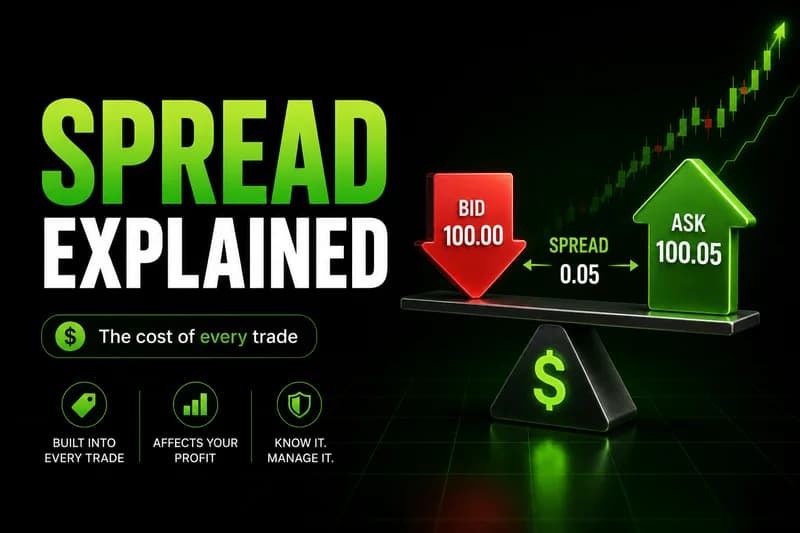
The spread is the gap between the price you can buy at and the price you can sell at right now, and it is the first cost you pay on every trade before the market moves at all. Buy at the ask, sell at the bid, and the difference is gone the instant you click. Most beginners learn the entry and ignore this number, and that order of attention is backward.
A clean way to hold the idea: the bid is the highest price someone will pay, the ask is the lowest price someone will sell at, and the spread is the distance between them. You always cross that distance to get filled. Understanding spread is not about memorizing a definition. It is about knowing what it costs you, when it gets worse, and how your order choices either pay it or avoid it.
What the spread means and why it exists
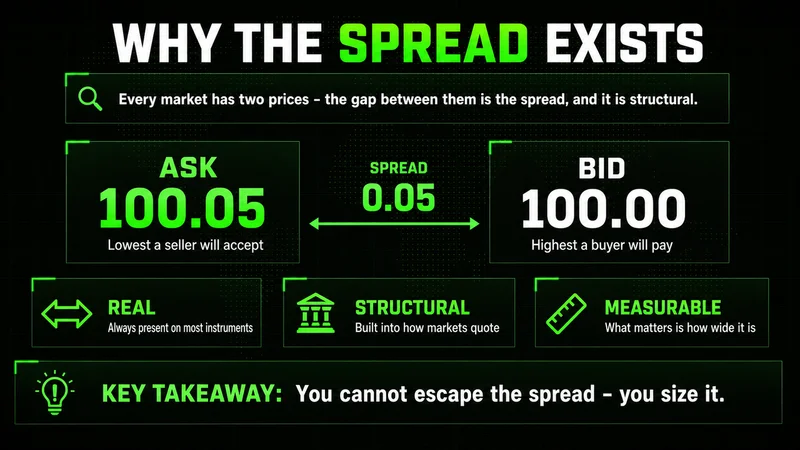
Spread meaning comes down to one fact: there are two prices, not one. The single number on a quote screen is a convenience. Underneath it sit a bid and an ask, and the spread is the working space the market keeps between them.
That space is not an accident or a fee a broker invented to annoy you. It is compensation for the people standing ready to take the other side of your order. The spread exists because:
Market makers quote both prices and carry inventory while they wait for a buyer to meet a seller.
They absorb risk during that wait, and the spread pays them for it.
Liquidity drives the size of that payment more than any opinion about where price is going.
So the spread is real, structural, and unavoidable on most instruments. The question is never how to escape it, but how large it is and whether your conditions make it larger.
A spread example you can hold in your head
Here is a spread example with plain numbers. A stock shows a bid of 100.00 and an ask of 100.05. The spread is five cents. Buy at the ask and immediately sell at the bid, and you are down five cents per share before price has done anything. On 100 shares, that is five dollars gone on a round trip.
Now widen it. A thin small-cap shows a bid of 100.00 and an ask of 100.40. The spread is forty cents. Same trade, same size, and the round-trip cost is forty dollars. The asset did not change. The liquidity did. The spread scales with how thin the market is, and it is charged whether your trade works or not.
How spread affects trading risk and your real cost
This is where spread stops being a definition and becomes a risk input. Every trade starts underwater by the size of the spread. Price has to move in your favor by at least that distance before you break even, so a setup that looked like a clean two-to-one can quietly become something worse.
Spread slippage risk compounds the problem. The quoted spread is what you see in calm conditions. The spread you actually pay is what exists when your order hits the book, and in fast markets those are not the same number.
Spread is important for beginners for exactly this reason: it is a certain, recurring cost that most new traders never measure, while they obsess over the entry that may or may not pay off.
A short checklist for new traders before any entry:
Read the current bid and ask, not just the last price.
Estimate the round-trip cost of the spread for your size.
Compare that cost to the distance to your target.
Skip the trade if the spread eats a meaningful share of the expected move.
When the spread turns against you
This is the part most explainers leave out, and it is the part that costs real money.
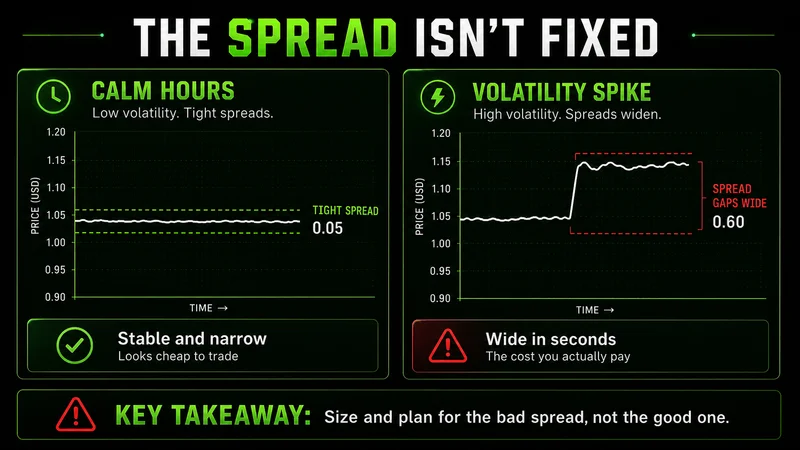
The spread is tightest exactly when you least need it and widest exactly when you most do. In liquid hours on a deep instrument, it is a rounding error. But in the first seconds after major news, around the open and close, and overnight on thin instruments, it can blow out to several times its normal size. The moment you most want to exit a position moving against you is often the moment exiting costs the most.
A market can quote a tight, stable spread for hours and then gap wide within seconds when a macro headline hits. If your plan assumes the calm-hours spread, it breaks in the conditions that matter most. A cost you measured at midday tells you almost nothing about what you will pay flattening a position into a volatility spike. Size and plan for the bad spread, not the good one.
Spread vs commission, and how execution changes what you pay
Spread vs commission confuses a lot of newer traders because both are costs that behave differently. Commission is an explicit, fixed charge your broker lists on the statement. The spread is implicit. You never see a line item for it, yet you pay it on every fill.
Treat them as one number. Your true cost per round trip is the commission plus the spread you actually crossed. A broker advertising zero commission is not free if the spreads are wide, and a tight-spread venue with a small commission can be cheaper in practice.
Spread execution is where your order type decides which cost you pay:
A market order takes the ask or hits the bid immediately. You cross the full spread in exchange for a certain fill.
A limit order rests at your chosen price. You can sit on the bid to buy and avoid crossing, but you accept the risk of not getting filled.
That tradeoff is the heart of spread fill price. Cross the spread and you pay for certainty. Post a limit and you trade for a better price at the cost of execution risk. Neither is correct in the abstract; it depends on whether the fill or the price matters more for that trade.
When the spread actually deserves your attention
Knowing when traders should care about the spread keeps you from overthinking it. On deep, liquid instruments in normal hours, it is small enough that obsessing over it is wasted energy. The spread use case that matters is narrower and specific. Watch it closely when:
You trade thin or low-volume names.
You size up and the per-share cost scales with you.
You scalp small moves where the spread is a large fraction of the target.
You enter or exit around news, the open, or the close.
In those situations the spread is no longer a rounding error. It is a line item that can decide whether the trade was worth taking.
Common spread mistakes beginners make
Most traders do not have an analysis problem here. They have a measurement problem. These are the spread mistakes that show up most often:
Reading only the last traded price and never checking the live bid and ask.
Using market orders on thin instruments and crossing a wide spread without noticing.
Ignoring spread cost when calculating a risk-reward ratio, so the real ratio is worse than the plan.
Assuming the calm-hours spread holds during news, the open, or overnight.
Treating a zero-commission broker as a zero-cost broker.
None of these require advanced skill to fix. They require the discipline to look at two prices instead of one before committing capital.
FAQs
What is spread in trading in simple terms? It is the difference between the bid, the price you can sell at, and the ask, the price you can buy at, at any given moment. You cross that gap every time you enter or exit, so it is a cost you pay on every trade regardless of whether the trade works.
Is a smaller spread always better? For your cost, yes, a tighter spread means a cheaper round trip. But a tight spread usually reflects a liquid, actively traded market, so it is less a goal to chase than a signal of the conditions you are trading in.
How does spread work in trading when the market moves fast? The quoted spread you see in calm conditions can widen sharply during news, the open and close, and overnight on thin instruments. The spread you actually pay is the one that exists when your order reaches the book, which is why fast markets can cost far more to enter or exit than a calm-hours quote suggests.
Worth the read?