Full-Time Trader — What the Job Actually Demands
A full time trader is defined by a process that pays the bills, not hours at the screen. What the transition really requires — capital, pressure, and rules.
A full-time trader is someone whose trading process — not a strong quarter — covers their living expenses, month after month, in conditions they do not choose. That is the entire definition. It says nothing about hours at the screen or monitors on a desk. It only says the process now pays for everything.
Most discussions of going full time focus on skill. In practice, the transition is decided by structure: how much capital sits behind the process, how long expenses are covered without withdrawals, and whether decision-making holds up once income depends on it. Plenty of profitable part-time traders fail full time without their trading getting any worse. The pressure changes, and the process was never built for it.
What a full-time trader actually is
The full-time trader meaning has drifted. On social media, the title describes a lifestyle — screens, watchlists, an aesthetic. Professionally, it describes an income statement. A full-time trader runs a trading operation that produces enough profit, after costs and taxes, to fund a life. The instrument matters less than the output: some trade index futures inside a defined session window, others swing trade equities around a slower schedule.
Two things follow from that definition. First, the title is earned by results across different market conditions, not declared after a good run. A trader who has only been profitable in one type of environment has a sample, not a business. Second, hours are irrelevant. Watching price for 10 hours a day is not the job. Executing a defined process when conditions allow it — and doing nothing when they do not — is the job.
Full-time trader vs part-time trader — an honest comparison
The full-time trader vs part-time trader question is usually framed as a commitment question. It is closer to a financing question. The part-time trader's salary removes the most dangerous variable in trading: the need to get paid this month.
| Part-time trader | Full-time trader | |
|---|---|---|
| Income source | Salary covers expenses; profits compound | Trading pays every bill |
| A flat month | Irrelevant | The reserve drains |
| Trade selection | Can wait indefinitely for quality | Tempted to force trades to get paid |
| Account drawdown | Painful, but life continues | Threatens the operation itself |
| Required edge | Any positive expectancy builds | Must clear living costs, taxes, and drawdowns |
This is why the part-time stage matters so much. It is the only period when a trader can build a track record under realistic conditions without income pressure distorting the data. Skipping it does not accelerate the career. It removes the evidence the decision should rest on.
The capital question most traders answer too late
The math is simple, and most traders avoid it. Annual income requirement divided by a realistic annual return gives the capital the process must run on. Realistic is the operative word — the return assumption should come from the trader's own multi-year record, not from a target. Run honestly, this calculation usually shows the required account is several multiples of what was planned.
Capital also splits into three pieces, and mixing them is a structural error:
- Trading capital — sized so the process can absorb its historical worst drawdown without forcing smaller, fear-driven positions afterward.
- A living reserve — one to two years of expenses held outside the account, so a difficult stretch never forces a withdrawal at the worst time.
- Tax money — set aside as profits are realized, not discovered as a liability in April.
Withdrawals deserve their own line. An account that funds a life stops compounding the way a part-time account does. Every month, profit leaves. The process has to outearn both expenses and the lost compounding, which is why undersized accounts fail even when the trading itself is decent.
What does a full-time trader's day actually look like?
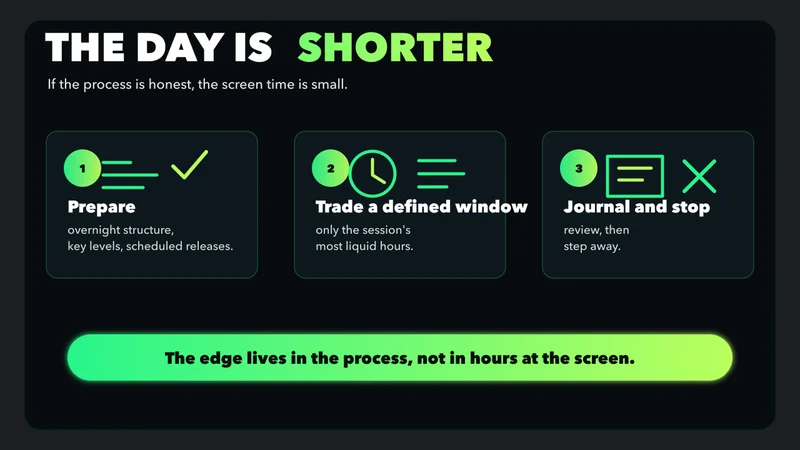
Shorter than expected, if the process is honest. A concrete example: an index futures trader might prepare before the New York open — overnight structure, key levels, scheduled economic releases — then trade a defined window around the session's most liquid hours, then journal and stop. The edge lives inside a few hours of high-quality conditions. The extra screen time most traders add on top of that window is where unforced errors come from.
The uncomfortable part is the waiting. Most of a full-time trader's week is spent not trading, and leaving low-quality conditions alone contributes more to the year than almost any entry technique.
"It was never my thinking that made the big money for me. It always was my sitting." — Jesse Livermore
A day with no trades is not a wasted day. It is the process correctly identifying that there was nothing worth taking.
A full-time trader strategy is a process, not a setup
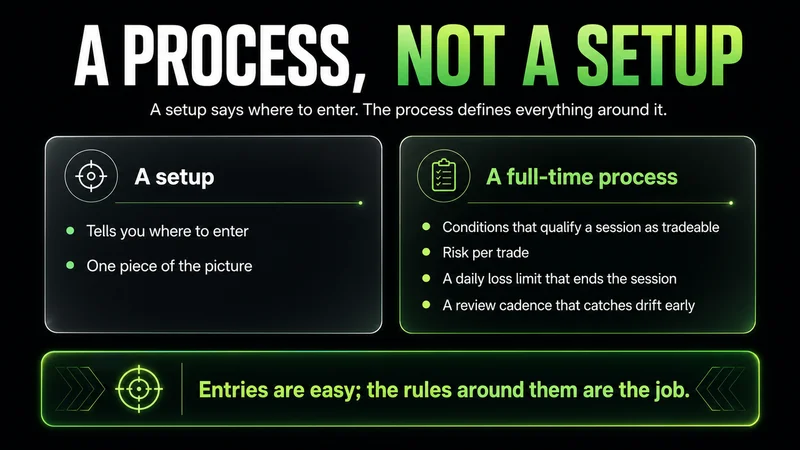
A setup tells a trader where to enter. A full-time trader strategy defines everything around it: the conditions that qualify a session as tradeable, the risk per trade, the daily loss limit that ends the session, and the review cadence that catches drift before it compounds. The full-time trader rules that matter most are the boring ones — predefined risk on every position, a hard stop to the trading day, and no size increases during drawdown.
There is also a condition every full-time process meets eventually: the environment that built it goes away. A momentum process built for expanding volatility earns very little when ranges compress for weeks — and this is exactly when full-time traders hurt themselves. The setups are not there, but the expenses are, so they trade more to replace the missing income. Trading more in conditions the process was not built for is how a profitable year gets given back. The professional response is smaller and slower: reduce activity, protect capital, and let the reserve do the job it was saved for.
The risks and mistakes that end full-time runs early
The main risks of trading full time are not market risks. They are pressure risks:
- Income pressure corrupting trade selection — needing a trade and finding a trade start to look identical.
- Sizing creep — position size rising to hit a monthly number rather than because setup quality improved.
- Drawdown and expenses compounding — the account falls while withdrawals continue, which accelerates everything.
- Isolation and fatigue — trading alone, decision quality decays quietly, and there is no one positioned to notice.
Most traders are overleveraged without realizing it, and going full time makes the test simple: if one losing trade changes how the next decision gets made, the position size was too large. The first month in which rent depends on the account is usually the month sizing discipline gets exposed.
The common full-time trader mistakes track the risks. Going full time off one strong year. Treating the living reserve as extra trading capital. Budgeting around the best month repeating. None of these are analysis failures — they are structural decisions made under optimism instead of under process.
A full-time trader checklist — and when to reverse the call
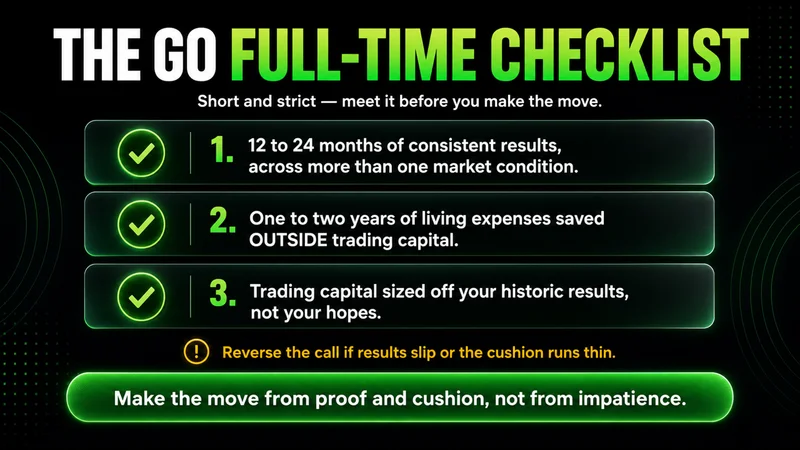
For a new trader weighing the move, the checklist is short and strict:
- 12 to 24 months of consistent results in the account that will fund the transition, across more than one market condition.
- One to two years of living expenses saved outside trading capital.
- Trading capital sized off the historical worst drawdown, not the average month.
- A written process — qualifying conditions, risk per trade, daily loss limit, and review schedule.
- A predefined reversal condition, agreed on before the transition, not negotiated during it.
The last item is the one almost nobody writes down. Going back to part-time trading is not failure — it is the same risk management applied to a career. If the living reserve drops below a set floor, or results run below plan for two consecutive quarters, income returns from elsewhere and the process gets rebuilt without pressure. Traders who define this in advance make the call calmly. Traders who do not tend to make it after the account has already paid for the delay.
The bottom line on trading full time
A full-time trader is defined by a process that pays for a life, not by hours or titles. The transition is a structural decision: capital sized to the worst stretch, expenses covered long enough that no single month matters, and rules that hold when the pressure arrives — because it arrives. Part-time profitability is the prerequisite, not the proof. Build the record across different conditions, fund the reserve, write the reversal condition, and let the results — not the calendar — decide when trading becomes the job.
Worth the read?