Trade Exit — How to Close a Position With a Plan
A trade exit is the order that closes a position to lock a gain or cap a loss — and how you plan it decides what the entry was actually worth.

A trade exit is the decision to close an open position, either to lock in a gain or to cap a loss, and it usually matters more than the entry. The entry chooses the risk. The exit decides what you actually keep. Most traders spend their attention hunting for the perfect entry, then improvise the close under pressure, which is where the result gets decided and usually lost.
That order is backward. A clean entry with a sloppy exit still bleeds. A mediocre entry with a defined exit survives. If you only fix one part of your process, fix the part that turns an open position into a realized number.
What a trade exit actually is
The trade exit meaning is simple on the surface: it is the order that closes your position and converts an unrealized result into a realized one. You sell what you bought, or you buy back what you sold short. Until that order fills, nothing on the screen is real. The green number is a possibility, not a fact.
There are only two reasons to exit. You reached a target and want to keep the gain, or the trade proved itself wrong and you want to protect capital. Everything else — boredom, a news headline, the urge to do something — is noise dressed up as a reason. A real exit answers one question: has the condition that justified this position changed?
Trade exit vs trade entry — why the close decides the result
The trade exit vs trade entry comparison is where most beginners misallocate effort. The entry is a single decision made with full information and no pressure. The exit is a sequence of decisions made while money is moving and emotion is loud. One is calm. The other is live.
Think about trade exit vs trade entry in terms of control. At entry you control everything: size, level, timing, and whether to participate at all. After entry you control almost nothing except when and where you leave. That is why the exit carries more weight. It is the only lever left once the position is on, and it is the one most traders refuse to plan in advance.
Where the exit gets decided: at entry, not mid-trade
Trade exit placement is not a mid-trade improvisation. It is decided before you click buy. The level that would prove your idea wrong defines where the loss-side exit sits. The level where the move has likely done its work defines where the profit-side exit sits. Both come from structure, not from how the position feels twenty minutes in.
When you set trade exit placement at entry, you remove the worst input from the decision: the emotion of being in a live trade. A stop placed below a clear invalidation level is a structural statement — "if price trades here, my read was wrong." A stop placed where it merely feels safe is a guess that moves every time price threatens it.
Anchor the exit to something the market can confirm or reject. A swing low, a prior high, the edge of a range, a level where acceptance would change the story. If you cannot name the level that invalidates the trade, you do not have a trade. You have a hope with a ticker attached.
The main types of trade exit
A trade exit strategy is not one tool. It is a small set of mechanisms, each suited to a different condition. The common ones:
Stop-loss exit — a resting order that closes the position at a predefined adverse level. This is the loss-side floor and the one non-negotiable exit.
Take-profit exit — a resting order that closes at a predefined favorable level, capturing the gain before a reversal can take it back.
Trailing stop exit — a stop that follows price as the trade works, locking in more of the move while leaving room for continuation.
Partial exit — closing a portion of the position at a first target and managing the rest, reducing risk while keeping exposure to a larger move.
Time-based exit — closing because the setup has not performed within the window it was supposed to, common around a session close or a scheduled event.
Most traders need fewer of these than they think. A defined stop and a defined target cover the majority of situations. The table below maps each exit to the condition it fits.
Exit type | Best used when | Main risk |
|---|---|---|
Stop-loss | Every trade, without exception | Placed too tight, stopped on noise |
Take-profit | The level where the move likely completes is clear | Capping a trade that had more to give |
Trailing stop | Momentum is strong and you want to ride it | Trailed too close, exited on a normal pullback |
Partial exit | You want to bank risk yet stay in the move | Overmanaging, cutting the runner early |
Time-based | The setup is event- or session-bound | Exiting a valid idea that simply needed more time |
How trade exit controls risk
Trade exit risk control is the entire point of the discipline. The stop is what converts an open-ended downside into a fixed, known cost. Without it, a single position can do damage that a dozen good trades cannot repair. With it, every loss is an operational cost you sized for on purpose.
The math is unforgiving here. The exit defines your loss per trade, and loss per trade defines how many wrong reads you can absorb before the account is in trouble. Trade exit risk control is really position survival expressed as a price level. Move the stop wider to avoid being wrong and you quietly increase the size of every loss you will eventually take.
This is also where most accounts actually die. Blowups rarely come from one catastrophic entry. They come from refusing the exit — widening the stop, then removing it, then averaging into a losing position because closing it would make the loss real. The exit was there the whole time. The trader chose not to use it.
Common trade exit mistakes beginners make
The trade exit mistakes that drain new accounts are predictable, and they cluster on the loss side. The pattern repeats across markets and instruments.
Moving the stop to avoid a loss. The level was set for a reason. Sliding it lower because price approached it discards the only risk control you had.
No predefined exit at all. Entering first and deciding how to leave later guarantees the decision gets made under maximum pressure.
Cutting winners on the first wiggle. A normal pullback inside a working trade is not a reversal. Exiting on every flinch caps every gain at its smallest size.
Holding losers for a recovery. A position that is wrong does not owe you a comeback. Hoping is not a trade exit strategy.
Exiting on emotion instead of structure. A headline or a red candle is not an invalidation. The level you named at entry is.
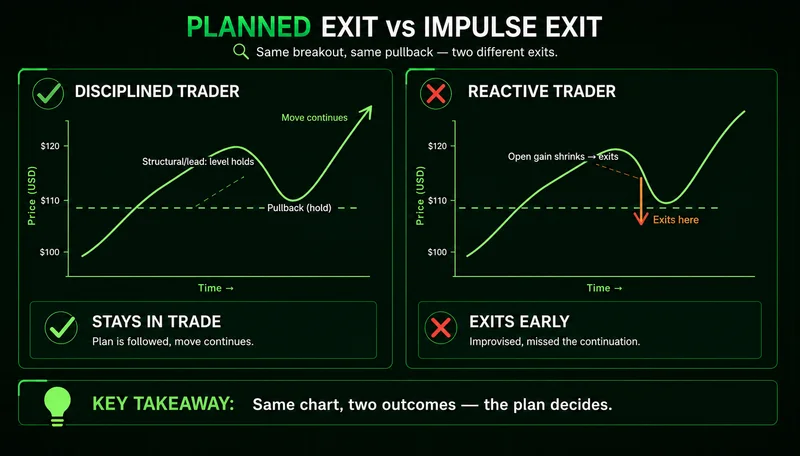
A useful trade exit example: a trader buys a breakout above a prior high, with the stop set just below that high — the level that, if reclaimed, says the breakout failed. Price pushes up, then pulls back toward the high. The structural read has not changed; the high still holds. The disciplined trader stays. The reactive trader, watching an open gain shrink, exits early and watches the move continue without them. Same chart, two outcomes, decided entirely by which trade exit was planned and which was improvised.
When holding longer beats cutting early — and when it does not
The advice to "let winners run" is repeated until it sounds like a law. It is not. Trailing a position and holding for continuation works while the structure that justified the trade stays intact and the market is trending with real participation. In that environment, cutting early is the expensive mistake.
The same approach inverts in a range. Inside a tight, choppy range with thin participation, holding for a big extension means giving back gains at the edges over and over, because the move you are waiting for is not coming. There the take-profit exit at the range boundary is the correct read, and the trailing stop is the one that bleeds you.
The market rewards patience far more than activity, but patience applied to the wrong condition is just a slower way to lose.
So the exit is not a fixed rule you carry between trades. It is a read of the current condition. Trending with momentum: give the trade room and trail. Ranging and thin: take the level and stand aside. The trader who applies one exit style to every condition will be right half the time and confused about why.
A simple trade exit checklist
Before the position goes on, the trade exit checklist should already be answered. If any line is blank, the trade is not ready.
Where is my invalidation? The level that proves the idea wrong — the loss-side exit.
Where is the move likely complete? The structural target — the profit-side exit.
What is my loss in money, not points? The size that keeps a single loss survivable.
Which exit mechanism fits the condition? Fixed target, trailing stop, partial, or time-based.
What would make me override this plan? If the honest answer is "a feeling," the plan is not real yet.
Run the trade exit checklist every time until it stops being a checklist and becomes how you think. The goal is not to follow steps. It is to never again convert an open position into a realized number by accident.
Closing read
A trade exit is not the afterthought to a good entry. It is the part of the process that decides what the entry was worth. Set the loss-side level at structure, define the profit-side level at entry, size the loss so it stays an operational cost, and match the exit mechanism to whether the market is trending or ranging. Do that consistently and the result stops depending on how you feel while the trade is live. The plan does the work, and the plan was made when you were calm.
Worth the read?