Three Black Crows — How to Read the Reversal
The three black crows pattern is three bearish candles after an uptrend that signal sellers took control. Here is how to read and confirm it.
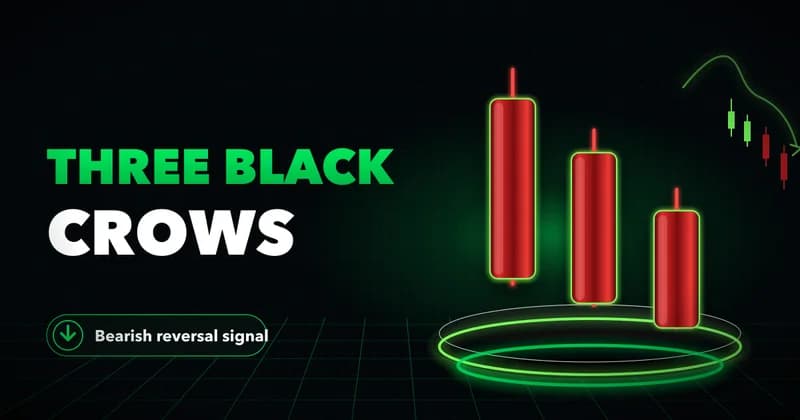
The three black crows pattern is three long bearish candles in a row, each opening inside the previous body and closing near its low, that appear after an uptrend and warn that sellers have taken control. It is a reversal signal, not a guarantee. The shape tells you momentum has flipped; it does not tell you the move will follow through. Most traders read the candles and skip the part that matters, which is the context around them.
That is the recurring mistake. Three red candles look obvious on a finished chart. In live conditions, the pattern only means something when it forms at the right place, with participation behind it, against structure that was already stretched.
What is the three black crows pattern
The three black crows meaning is simple to state and easy to misapply. It is a bearish reversal pattern built from three consecutive long-bodied bearish candles. Each candle opens within the real body of the one before it, then closes lower, ideally near its own low with little or no lower wick.
The first crow appears at or near the top of an existing uptrend. The second and third extend the move down in a controlled, stair-step fashion. The picture is one of steady distribution: buyers who were in control are now absorbing supply and stepping back.
Three things define a clean three black crows pattern:
- Three bearish candles in sequence, each with a real body long enough to dominate its range.
- Each open sits inside the prior candle's body, and each close prints lower than the last.
- Short or absent lower wicks, which show sellers held the lows rather than getting pushed back.
When all three hold, the pattern reads as a genuine shift in control. When one is missing, you are usually looking at noise dressed up as a signal.
How the three black crows pattern forms on a chart
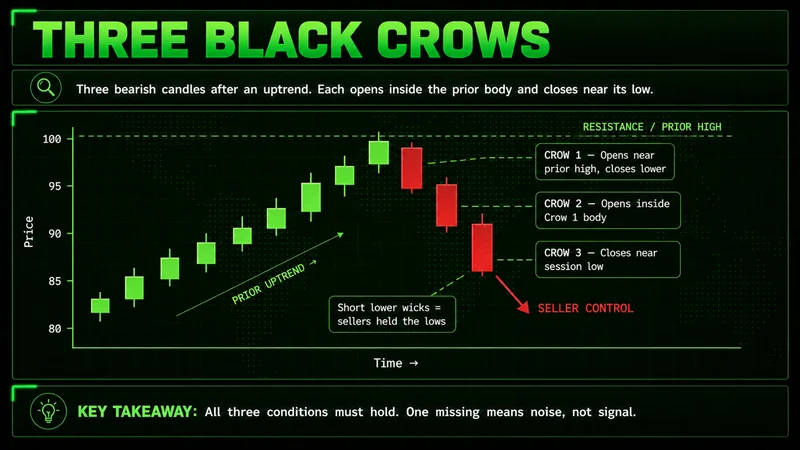
To identify three black crows on a chart, start with the trend, not the candles. The pattern carries weight only after a sustained move higher. Three red candles in the middle of a range or inside an existing downtrend are just three red candles.
Find the prior uptrend first. Then look for the first long bearish body forming near the highs. If the next two candles open inside the previous body and close progressively lower, with each body roughly comparable in size, the sequence qualifies. The chart example most beginners picture is textbook clean. Real ones rarely are. Bodies vary, wicks appear, and one candle often closes mid-range instead of near its low.
That variation is the point. The pattern is a description of behavior, not a stamp. You are reading whether sellers showed up with intent across three sessions, not matching pixels to a diagram.
What the three black crows pattern actually signals
As a reversal signal, the three black crows pattern marks a transfer of control from buyers to sellers at the top of a move. The longer the prior uptrend and the cleaner the three closes, the more meaningful the shift.
What it does not do is forecast the size of the decline. The pattern tells you the immediate balance has changed. It says nothing about how far price travels next, or whether the next session reclaims everything. Treating it as a price target is where most of the damage happens.
This is where context decides everything. The same three candles mean one thing after an extended, low-volume grind into resistance and something far weaker after a sharp two-day spike. Liquidity drives the follow-through, not the candle count. A pattern that forms into thin overnight conditions on an index future can look identical to one printed in cash hours and resolve in the opposite direction.
| The pattern tells you | The pattern does not tell you |
|---|---|
| Control shifted from buyers to sellers | How far price will fall |
| Sellers held three closes near the lows | Whether the next session reclaims the move |
| Momentum flipped at this location | The exact entry or target |
How to confirm three black crows before you trade it
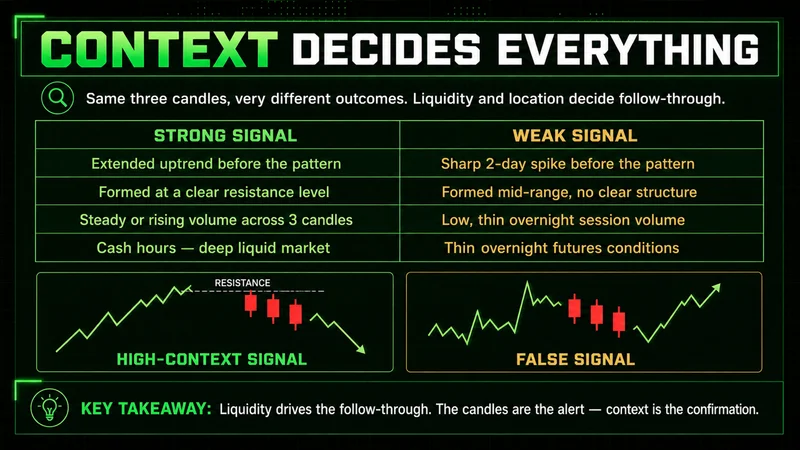
Confirmation is the difference between reading the pattern and reacting to it. The candles are the alert. The confirmation is what tells you the move has a chance of continuing.
Before you act on a three black crows signal, confirm it against conditions outside the candles themselves:
- Location: the pattern formed at or into a known resistance level or the top of a stretched trend, not mid-range.
- Participation: volume held steady or expanded across the three candles, rather than fading.
- Follow-through: the session after the third crow opens weak or fails to reclaim the third candle's body.
- Invalidation: you can define a clear level above the pattern's high where the read is wrong.
Most breakouts and breakdowns fail because traders enter on the shape alone and skip the context. Confirmation is not hesitation. It is the part of the process that keeps a wrong read cheap.
Three black crows vs three white soldiers
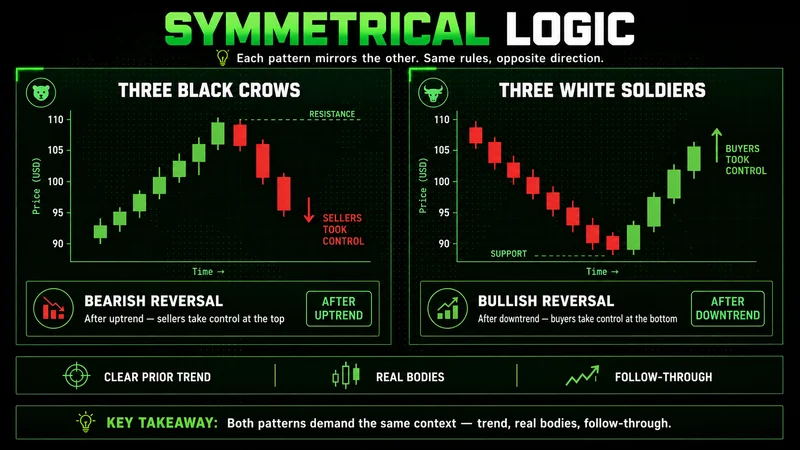
The cleanest way to understand three black crows is to set it beside its mirror image. Three white soldiers is the bullish version: three long green candles after a downtrend, each opening inside the prior body and closing higher. Same structure, opposite direction.
| Factor | Three black crows | Three white soldiers |
|---|---|---|
| Trend before | Uptrend | Downtrend |
| Candle color | Three bearish | Three bullish |
| Signal | Bearish reversal | Bullish reversal |
| Each close | Progressively lower | Progressively higher |
| Wicks | Short lower wicks | Short upper wicks |
The logic is symmetrical. Three black crows shows buyers losing control near a top; three white soldiers shows sellers losing control near a bottom. Both depend on the same conditions for reliability: a clear prior trend, real bodies, and follow-through after the third candle.
The best timeframe for reading three black crows, and when it fails
The best timeframe for three black crows analysis is the daily and the four-hour for most traders. Higher timeframes filter out the noise that produces false patterns on the one-minute or five-minute chart, where three red candles print constantly and mean almost nothing.
The pattern breaks down in specific, repeatable conditions. It fails when the third candle is an exhaustion move rather than a continuation, leaving price oversold and primed to snap back. It fails when an earnings gap or a macro headline drives the candles, because the next session can erase the structure entirely. And it fails when the prior trend was weak, since there is little control left to transfer. The same daily pattern that reads cleanly into a stretched uptrend means little when it forms inside a choppy range.
Common three black crows mistakes beginners make
The pattern is easy to name and hard to trade, which is exactly why beginners lose money on it. The errors are consistent:
- Chasing the third crow. Entering after three full bearish candles often means entering near short-term exhaustion, with the best part of the move already gone.
- Ignoring the trend. Calling any three red candles a three black crows pattern, regardless of what came before.
- Skipping volume. Treating three weak, low-participation candles the same as three decisive ones.
- Trading it without a stop. No defined level above the pattern's high means no real risk control.
These are discipline mistakes, not analysis mistakes. The read is usually fine. The execution around it is where accounts get drained, one chased entry at a time.
A three black crows checklist before entering
A short checklist keeps the pattern honest. Before you treat a three black crows signal as actionable, every line should be true:
- There was a clear, sustained uptrend before the first candle.
- All three candles have real, comparable bodies with short lower wicks.
- Each candle opened inside the prior body and closed lower.
- Volume held or expanded across the sequence.
- The pattern sits at or into a meaningful resistance level.
- You have a defined invalidation above the pattern's high.
If a line fails, the setup is lower quality. That does not always mean skip it, but it does mean size smaller and expect less. The checklist is not about finding more setups. It is about taking the ones where the read and the risk are both defined.
FAQs
What is three black crows in trading? It is a bearish reversal candlestick pattern made of three consecutive long bearish candles after an uptrend, each opening inside the prior body and closing lower. It signals that sellers have taken control near a top.
Is the three black crows pattern reliable? It is reliable only with context. The pattern is stronger after a sustained uptrend, at a resistance level, and with steady or rising volume. On its own, without confirmation, it produces frequent false signals.
What is the difference between three black crows and three white soldiers? They are mirror images. Three black crows is three bearish candles after an uptrend, signaling a bearish reversal. Three white soldiers is three bullish candles after a downtrend, signaling a bullish reversal.
What timeframe works best for three black crows? The daily and four-hour charts are the most dependable for most traders. Lower timeframes produce constant three-candle sequences that rarely carry the same meaning.
Worth the read?