Stop Order in Trading — How It Triggers and Fills
A stop order triggers at a price you set, then fills at whatever the market offers next. Here is how stop order execution and fills actually work.
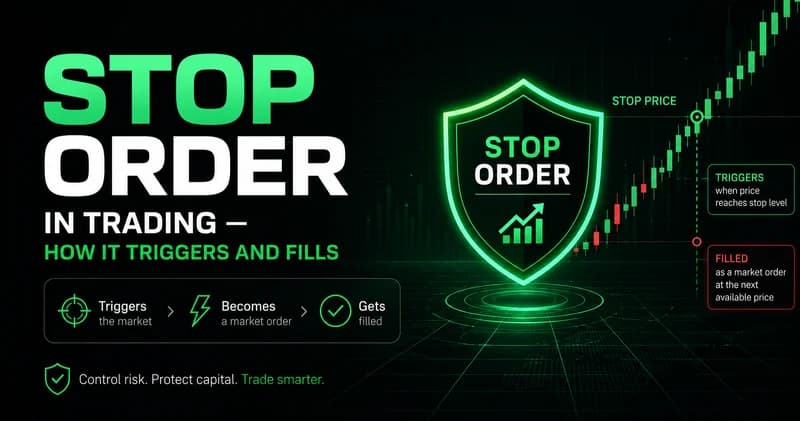
A stop order stays dormant until price trades at a level you choose, then converts into a market order and fills at the next available price. That last part is what most beginners miss. The stop price is the trigger, not the fill. Once it fires, the order takes the next price the book offers, which can sit above, at, or below your level.
What a stop order means and how it triggers
The stop order meaning is simpler than the name suggests. You define a price; when the market trades through it, the order activates and seeks an immediate fill. A sell stop sits below the current price and underlies most stop-loss exits. A buy stop sits above it, used to enter on strength or cover a short. The order is reactive, not predictive: it waits for the market to reach the level rather than guessing where price will go.
How stop order execution actually works
Stop order execution runs in two stages: the trigger, then the fill. The trigger is mechanical. Price prints at or through your stop, and the order goes live as a market order, taking whatever liquidity rests when it arrives. The stop order fill price is a range, not a fixed number: deep markets fill near the trigger, thin or fast ones do not.
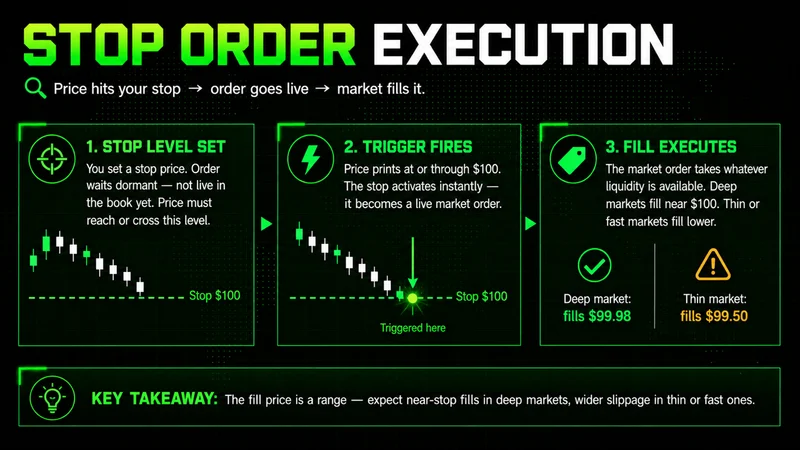
A concrete stop order example makes this obvious. A stock trades at 100, and you place a sell stop at 95. The moment a trade prints at 95 or lower, your stop becomes a market order to sell. If a headline gaps the stock to 91 first, your stop still triggers but fills near 91 — the level held as a trigger, while the fill reflected the available liquidity.
Stop order vs stop limit order
The stop order vs stop limit order decision is one trade-off: certainty of execution versus certainty of price.
- A stop order almost always fills, but the price floats with available liquidity.
- A stop limit order caps the fill price, protecting you from a bad price but risking no fill if the market runs past your limit.
For a beginner managing risk, a plain stop usually wins. Getting out at a worse price beats staying trapped because a limit blocked the exit.
Stop order slippage risk and where stops break down
The stop order slippage risk is the gap between your trigger and your fill, and it widens exactly when you need the stop most. This is where a stop order is the wrong tool. It reads cleanly in regular cash-session hours. Hold the same stop into an earnings release or an overnight session on a thin name, and the trigger means almost nothing. Price can leap past your level before a single share changes hands.
A stop does not promise an exit price. It promises you will be out. Confusing the two is how a defined risk quietly becomes an undefined one.
When traders should use a stop order, and the mistakes to avoid
The honest stop order use case is narrower than most beginners assume. A stop is strong when you cannot watch the screen, liquidity is reliable, and your invalidation is a clear price level. It is weak in thin liquidity or when a scheduled event sits inside your holding window. The common stop order mistakes follow from ignoring that:
- Placing the stop at a round number or obvious swing, where it gets swept before price reverses.
- Treating the trigger as a fixed fill and being shocked by slippage on a gap.
- Setting the stop so tight that normal noise removes you before the idea works.
The through-line is discipline. A stop protects an account only when the level is chosen for a reason and respected.
FAQs
What is a stop order in trading? An order that stays inactive until price reaches a chosen stop price, then becomes a market order and fills at the next available price. The stop price is the trigger, not a fixed fill.
How does a stop order work for beginners? When the market trades through your level, the order activates and seeks a fill. A sell stop below price exits losers; a buy stop above price enters on strength.
Why did my stop order fill at a worse price than my stop level? The trigger and the fill are separate events. Once triggered, the order takes the next price, which in a gap or thin market can sit past your level. That gap is slippage.
The short version
A stop order is a trigger that becomes a market order. It activates at a price you choose and fills at a price the market decides. Used where liquidity is reliable and the level marks real invalidation, it defines risk without watching the screen. The order type is not the edge. Choosing the level with reason and respecting it is.
Worth the read?