AMD AI Data Center Growth Catalysts Explained
AMD AI data center growth catalysts matter only if accelerator demand converts into revenue, wider operating margins, and durable earnings growth.

AMD AI data center growth catalysts matter because the company’s valuation assumes that AI revenue will eventually produce much stronger profits. Revenue growth alone is not confirmation. The useful signal is whether data-center demand, customer wins, and processor share gains lift operating margin after research and development costs.
That distinction frames the entire analysis. AMD already produces substantial revenue and positive net income, but its current earnings remain thin relative to the expectations reflected in the valuation snapshot. The business is profitable. The open question is whether it can scale profitably enough to justify the premium.
How AMD makes money across four segments
AMD generated $34.6 billion of FY2025 revenue in the supplied income-statement breakdown. Data Center was the largest engine at approximately $16.6 billion, driven by AI accelerators and EPYC server processors. Client and Gaming contributed about $14.6 billion through PC processors, Ryzen products, and consoles. Embedded added roughly $3.5 billion, including the Xilinx FPGA portfolio.
Those rounded segment figures show why the company can no longer be analyzed as a simple PC-chip business. Data Center and Client and Gaming supply most of the revenue, while Embedded provides a smaller, steadier line. Each segment also reacts to a different cycle. AI infrastructure spending can accelerate while gaming demand slows, or PC share can improve while embedded customers reduce inventory.
The practical principle is to separate revenue sources before forming a view on consolidated growth. A strong total can hide weakness in the segment carrying the highest expectations. It can also hide improving economics in a smaller business that receives less attention.
AMD AI data center growth catalysts require confirmation
The visible catalysts are specific. Demand for the Instinct MI350 and MI400 accelerator ramp can increase data-center revenue. Hyperscaler order wins can improve future revenue visibility. Higher accelerator guidance can lift expectations, while server and PC processor share gains against Intel can support growth outside AI GPUs.
None of those catalysts confirms the earnings thesis by itself. Product announcements need orders. Orders need shipments. Shipments need revenue recognition. Revenue then needs enough gross profit to cover the operating expense required to compete. A clean analytical sequence is demand, orders, revenue, gross margin, operating margin, and cash flow.
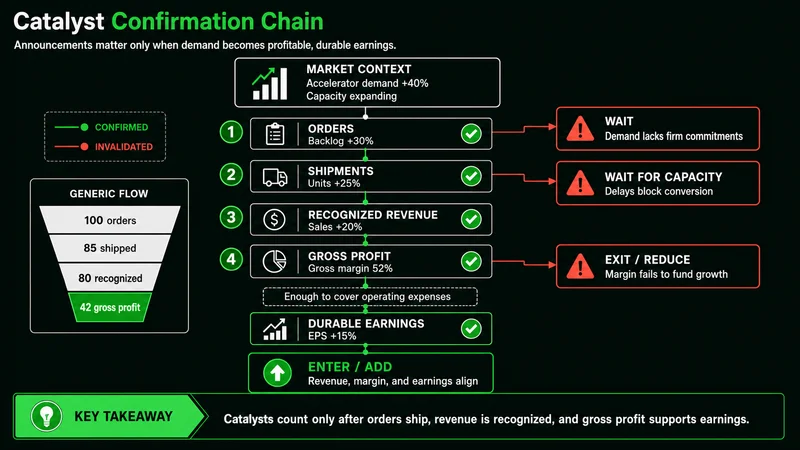 A catalyst becomes financial confirmation only after it reaches earnings and cash flow.
The common mistake is treating every AI headline as equivalent. A product launch, a customer commitment, and recognized revenue are different stages. The stock can respond to all three, but the durability of the response depends on what the event changes in the income statement. Headlines move expectations. Financial results determine whether those expectations were justified.
AMD profit margins reveal where the AI story stands
The FY2025 breakdown shows approximately $16.5 billion of cost of sales against $34.6 billion of revenue. That leaves about $17.2 billion of gross profit, or a gross margin near 50%. Research and development consumed roughly $8.1 billion, while marketing, general, and administrative expense was about $4.1 billion. Operating income finished near $3.7 billion, representing an operating margin around 11%.
Net income was approximately $4.3 billion, or 12.5% of revenue. The presentation notes that a tax benefit helped lift the net result above operating income. That makes operating margin the cleaner measure for judging whether the underlying business is scaling. Net margin can move because of taxes and other items that do not describe core execution.
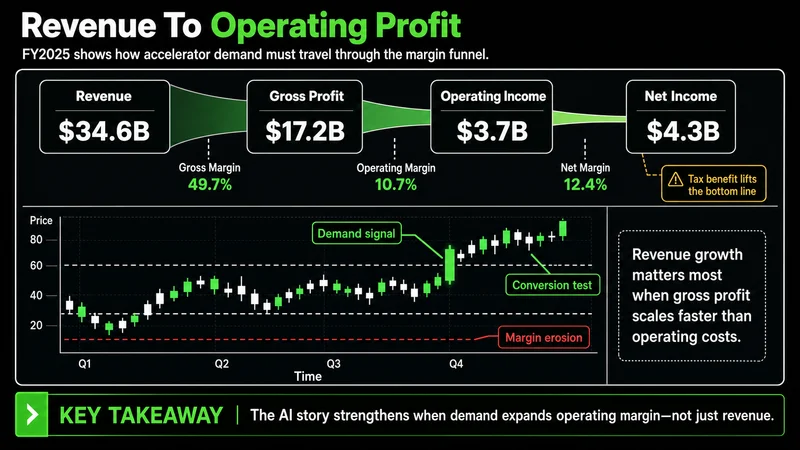 The margin funnel shows why operating income is the cleaner measure of business scaling.
MRPNL operating rule: Watch operating margin as AI scales.
The concrete example is straightforward. For every dollar of revenue in this snapshot, roughly 50 cents survived cost of sales as gross profit, but only about 11 cents remained as operating income after major operating expenses. AMD can improve that outcome through higher gross margin, faster revenue growth relative to expenses, or both. If revenue rises while operating expense rises just as quickly, the AI story may expand without creating meaningful operating leverage.
Research spending is not automatically a weakness. Semiconductor competition requires sustained investment, and the $8.1 billion expense represents an attempt to close product and ecosystem gaps. The question is whether that spending produces a better revenue mix and wider margins over time. Cost becomes productive when it creates durable earnings power. Until then, it remains a drag that must be measured.
Valuation versus Nvidia and chip peers changes the hurdle
The valuation comparison in the supplied material places AMD near 165 times depressed 2025 earnings, versus roughly 31 times for Nvidia and 21 times for Qualcomm. Intel is marked as not generating earnings in that comparison, making a conventional price-to-earnings multiple unavailable.
These figures are a snapshot, not permanent values. Share prices and earnings estimates move, and trailing earnings can make a rapidly changing business look unusually expensive. Still, the comparison identifies the market’s hurdle. AMD was priced as a future AI winner before its current profits matched that expectation, while Nvidia combined a lower cited multiple with much higher margins and greater scale.
Calling the stock overvalued solely because its multiple is high is too shallow. A high multiple can compress through earnings growth even if the share price remains stable. The useful question is what operating result would make the premium reasonable. That shifts the analysis from opinion toward measurable confirmation.
The bull and bear cases depend on different evidence
The bull case requires the AI accelerator ramp to convert into data-center revenue, share gains, and expanding operating margin. Hyperscaler adoption would improve visibility, while stronger server and PC processor share could reduce dependence on a single product cycle. Positive free cash flow and rising earnings would support the claim that heavy development spending is beginning to pay off.
The bear case starts with today’s thin profits. Gross margin near 50% remains well below the roughly 70% or higher comparison shown for the AI leader. An 11% operating margin leaves less room for execution errors. Customer concentration among a few hyperscalers, China export restrictions, Nvidia’s CUDA ecosystem advantage, and cyclical PC, gaming, and embedded markets can all interrupt the expected path.
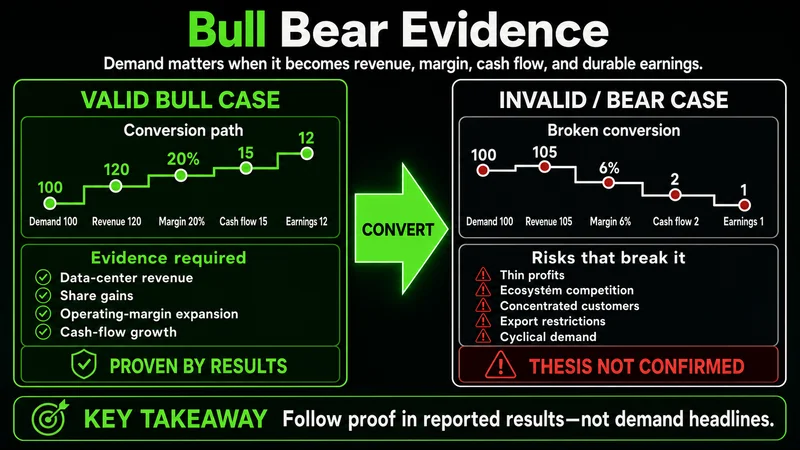 The thesis depends on measurable confirmation, while each risk has a defined warning signal.
The most useful practical application is a two-column scorecard. On the confirmation side, track data-center revenue growth, accelerator guidance, major customer adoption, gross margin, operating margin, and free cash flow. On the risk side, track export restrictions, customer concentration, development spending, competitive ecosystem gaps, and weakness in cyclical segments. Update the thesis only when one of those measures changes, not whenever price becomes volatile.
The thesis has a defined invalidation point
The growth thesis weakens when AI revenue rises but consolidated operating margin fails to improve across a meaningful reporting sequence. It is further invalidated if customer wins do not convert into recognized revenue, gross margin remains structurally compressed, or free cash flow deteriorates while development spending stays elevated.
The bearish valuation argument also has an invalidation point. If accelerator revenue scales faster than expected, gross margin expands, operating expenses grow more slowly than revenue, and earnings close the valuation gap, the current multiple becomes less informative. Bears cannot keep using depressed earnings after the earnings base has materially changed.
Defined invalidation prevents the analysis from becoming identity. The objective is not to remain bullish or bearish. It is to specify what evidence must appear, what evidence would contradict the view, and how much uncertainty remains between those points.
When this framework does not work
This framework becomes less reliable when a one-time tax item distorts net income, a product transition temporarily shifts revenue timing, or export policy changes the addressable market faster than financial statements can reflect it. A trailing price-to-earnings comparison also breaks down when earnings are unusually depressed or negative. In those conditions, forward estimates, cash flow, and segment-level evidence deserve more weight, though each introduces additional uncertainty.
It also does not work as a short-term price forecast. Stocks can rise on improved expectations before margins expand, and they can fall despite solid results when expectations were higher. The framework evaluates business confirmation and valuation risk. It does not predict the next price swing.
What disciplined investors should monitor next
AMD’s FY2025 numbers describe a profitable semiconductor company with a large data-center business, positive cash generation, and substantial AI potential. They also describe a company spending heavily to compete while retaining only about 11 cents of operating income from each revenue dollar.
The decisive evidence will not be another broad AI claim. It will be the conversion of accelerator demand into revenue, revenue into gross profit, and gross profit into a wider operating margin. Until that sequence appears, the valuation remains a bet on execution. If it does appear, the earnings base can change quickly enough to make today’s snapshot obsolete.
Worth the read?