Is Cisco Stock Overvalued? A Business Breakdown
Is Cisco stock overvalued? Strong margins support the case, but slow networking growth and an AI premium leave little room for weak execution.

The question is Cisco stock overvalued cannot be answered by looking at one price-to-earnings ratio. Cisco combines a mature networking operation, recurring services revenue, expanding security exposure, and an emerging AI infrastructure narrative. The valuation depends on whether those newer drivers can offset slower growth in the core business.
Cisco makes money through five connected revenue streams
Cisco generated $56.65 billion in revenue in the period shown. Networking remained the core engine at $28.3 billion, or roughly half of total revenue. Services contributed another $15.0 billion, while security produced $8.1 billion. Collaboration and observability added $4.2 billion and $1.1 billion, respectively.
A useful mental model is to treat networking as the installed base, services as the recurring layer around that base, and security as the principal growth pivot. The investment case becomes stronger when those layers reinforce one another. It weakens when security growth merely offsets deterioration elsewhere.
Cisco's $56.65 billion revenue base is led by $28.3 billion of networking and supported by $15.0 billion of recurring services. Security contributes $8.1 billion, but the valuation case depends on whether that growth layer can become large enough to offset pressure in the mature core.
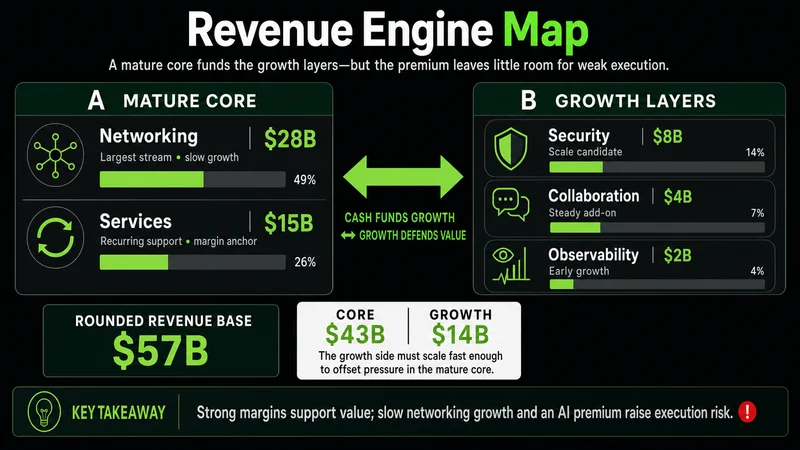 Networking supplies scale, while services and security shape Cisco's recurring revenue and growth profile.
High gross margins make Cisco more than a hardware vendor
Cisco reported $37.15 billion of gross profit after $19.5 billion in cost of sales. That equals a 65.6% gross margin. A margin at that level suggests that software, subscriptions, support, and pricing power materially affect the economics. The company should not be evaluated as a pure equipment manufacturer.
The income statement becomes less exceptional below gross profit. Research and development consumed $9.3 billion, sales and marketing used $11.0 billion, and general and administrative expense reached $3.0 billion. Amortization and restructuring added $1.7 billion. After those costs, operating income was $12.12 billion, equal to a 21.4% operating margin.
Net income reached $10.45 billion, or 18.5% of revenue. That figure benefited from an approximately 8.7% tax rate in fiscal 2025. Investors who capitalize that result without adjustment may overstate the durability of current earnings. A one-period tax benefit can raise trailing earnings without improving the operating business.
The margin funnel explains both the quality and the constraint. Cisco keeps about 65.6 cents of gross profit from each revenue dollar, but operating expenses reduce that to roughly 21.4 cents of operating income. Net margin reaches 18.5%, partly because the reported tax rate was unusually low.
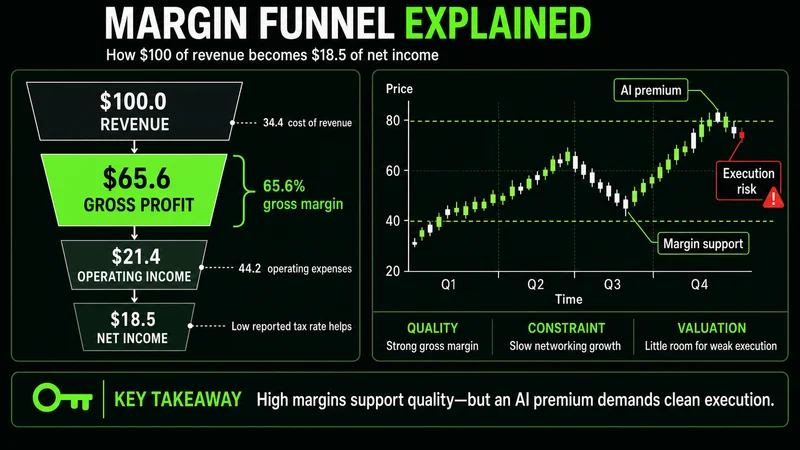 Cisco's high gross margin narrows after research, sales, administration, restructuring, and tax effects.
What could move Cisco's stock higher?
The bullish case rests on several drivers working together. AI infrastructure orders reportedly exceeded $2 billion in fiscal 2025, creating a new demand narrative around data-center networking. Enterprise customers may also enter a networking refresh cycle, while the order backlog and forward guidance can provide evidence that demand is converting into recognized revenue.
Security offers a second route. The slides show security revenue rising 59%, with Splunk identified as an important contributor. If the integration improves the product mix and expands recurring revenue, Cisco may deserve a different valuation than it received as a slower hardware-centered company.
Subscription and annual recurring revenue can improve visibility. Dividends and buybacks also matter for income-oriented shareholders because strong free cash flow can fund capital returns. These features do not create rapid growth by themselves, but they can support the value of a durable cash-generating business.
MRPNL principle: a catalyst matters only when it moves from a compelling narrative into repeatable revenue, stable margins, and cash flow.
The bear case starts with the mature networking core
Cisco's largest segment declined 3% in the period shown. That is the central tension in the thesis. Security, AI orders, and subscriptions may offer growth, but they begin from smaller bases than networking. A modest decline in the largest segment can absorb a meaningful amount of growth elsewhere.
Competition adds pressure. The slides identify Arista, Juniper or HPE, Huawei, and white-box alternatives. Competitive intensity can affect pricing, market share, and product investment. Cisco may preserve revenue by spending more or accepting lower margins, neither of which would support a richer valuation.
The Splunk acquisition introduces integration work and debt. AI orders may also be uneven and may not convert into durable revenue at the pace investors expect. Enterprise technology budgets are cyclical, which means refresh activity can be delayed even when the long-term need remains intact.
The bull case is invalidated if the growth businesses fail to offset continuing contraction in networking while operating margins deteriorate. More specifically, repeated core declines, weak conversion of AI orders into revenue, and rising integration costs would show that the mix shift is not improving the economics.
The real question: is Cisco stock overvalued?
The slides place Cisco near 40 times trailing earnings. Arista is shown near 53 times, Palo Alto Networks near 239 times, and HPE near 46 times. On that comparison, Cisco appears cheaper than two prominent networking and security peers and slightly cheaper than HPE.
That conclusion needs context. A lower multiple does not automatically mean a stock is inexpensive. Cisco's revenue growth is shown near 5%, and its largest segment contracted. A roughly 40-times trailing multiple can still be demanding for a slow-growing company, especially when trailing earnings benefited from a low tax rate.
The forward multiple, shown near 25 times earnings, presents a more moderate picture. It may better reflect normalized expectations, but only if the forecast earnings arrive. The gap between trailing and forward valuation implies that investors expect earnings to improve or normalize. That expectation is part of the price.
Valuation should therefore be framed as a conditional comparison:
| Condition | What it supports | What would challenge it |
|---|---|---|
| AI orders convert into recurring revenue | A higher growth multiple | One-time or uneven deployments |
| Security growth remains strong | A software and platform re-rating | Growth fades after acquisition effects |
| Networking stabilizes | Durable cash flow and operating scale | Continued core contraction |
| Operating margin holds or improves | Better earnings quality | Integration costs and pricing pressure |
| Tax expense normalizes cleanly | Confidence in forward earnings | A sharp decline from the trailing baseline |
Cisco's valuation is neither obviously cheap nor automatically excessive. It reflects a mature company being priced partly for a transition. The evidence must show that the transition is real.
Cisco's valuation decision can be organized as a simple tree: sustained security growth, converted AI orders, stable networking, and protected operating margins support the forward case. Failure in several branches leaves investors paying a growth-oriented multiple for a slow-growing core.
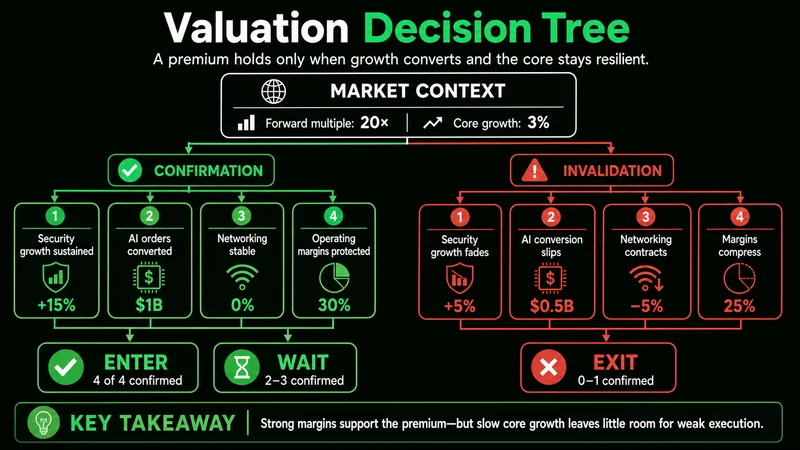 The valuation case depends on several operating conditions holding at the same time.
The common mistake is comparing multiples without earnings quality
Investors often place several P/E ratios side by side and select the lowest number. That skips the variables that determine why the multiples differ. Growth rate, recurring revenue, competitive position, margins, balance-sheet obligations, and earnings quality all affect what a dollar of earnings may be worth.
Cisco's trailing earnings deserve particular care because the low fiscal 2025 tax rate helped net margin. The cleaner process starts with operating income, tests a more normal tax burden, and then asks whether AI and security can produce enough growth to justify the resulting multiple.
Another mistake is counting the same catalyst twice. Splunk-supported security growth may improve revenue and influence the valuation narrative, but it should not be treated as two independent sources of value without separating organic growth from acquisition effects.
A practical Cisco valuation checklist
Start with revenue conversion rather than headlines:
- Track whether AI orders become recognized revenue and repeat purchases.
- Compare security growth with the continuing change in networking revenue.
- Watch operating margin as Splunk integration progresses.
- Normalize the tax rate before relying on trailing earnings.
- Compare the resulting growth and margin profile with the multiple investors are paying.
- Define invalidation before treating a lower peer-relative P/E as a bargain.
This process keeps the analysis reactive, not predictive. A stronger thesis requires improving evidence across revenue, margins, and cash generation. A weaker thesis appears when the narrative strengthens but the operating numbers do not.
When this framework does not work cleanly
This framework becomes less useful during a sharp enterprise spending shock or a major acquisition transition. Revenue timing, backlog conversion, restructuring charges, and tax effects can distort several periods at once. In those conditions, a single-year income statement and a point-in-time P/E comparison may describe accounting timing more than underlying earning power.
It also breaks down if peer businesses are treated as identical. Arista, Palo Alto Networks, HPE, and Cisco have different mixes, growth rates, and margin structures. Their multiples provide reference points, not direct answers.
The disciplined conclusion is conditional. Cisco's recurring services, high gross margin, security expansion, and AI demand support a credible transition case. The defined invalidation is persistent networking decline combined with weak AI revenue conversion and lower operating margins. Until the operating evidence resolves that tension, the valuation is best understood as a price placed on execution, not certainty.
Worth the read?