Meta Stock Bull Case and Bear Case Explained
Meta stock bull case and bear case explained through ad revenue, margins, AI spending, Reality Labs losses, catalysts, and relative valuation.

The Meta stock bull case and bear case begins with a simple conflict. Meta’s advertising operation produces exceptional revenue and margins, while AI infrastructure and Reality Labs require heavy spending with uncertain payback. The stock depends on which side compounds faster.
Start with the income statement. Then separate operating catalysts from headlines, test the risks, and judge whether the valuation leaves enough room for error.
Meta stock bull case and bear case starts with one engine
Meta generated $201.0 billion in revenue, with $196.2 billion coming from advertising. That means ads represented about 98% of total revenue. Other Family of Apps revenue contributed $2.6 billion, while Reality Labs added $2.2 billion. The practical point is clear: Meta may own several products and fund several projects, but one revenue stream still carries almost the entire company.
That concentration supports both sides of the thesis. Bulls see a proven advertising system with scale, engagement, pricing power, and substantial cash generation. Bears see dependency. If ad demand, impressions, pricing, or platform access weakens, smaller business lines cannot replace the lost economics quickly.
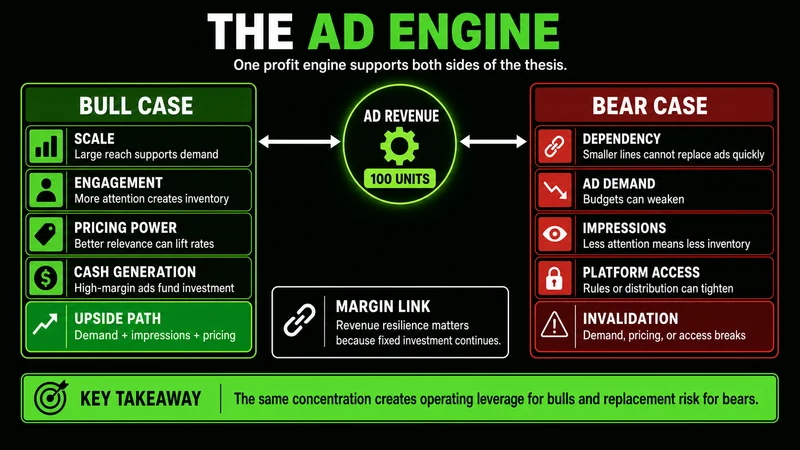 One dominant advertising stream funds Meta’s profitable operations and long-term bets.
The Family of Apps segment produced $102.5 billion in operating income. That profit funds research, infrastructure, artificial intelligence, and the Reality Labs bet. Investors are not evaluating separate projects with separate pools of capital. They are evaluating whether the advertising engine can keep financing all of them without losing momentum.
The profit funnel shows where Meta’s strength lives
The income statement turns $201.0 billion of revenue into $164.8 billion of gross profit after $36.2 billion in cost of revenue. That is an 82% gross margin. After operating expenses, the company retains $83.3 billion of operating income, equal to a 41% operating margin. Net income finishes at $60.5 billion, or roughly 30% of revenue.
Those margins are the strongest evidence for the bull case. Meta keeps about 82 cents of gross profit from each revenue dollar before operating expenses. It then retains about 41 cents at the operating level despite substantial investment. Few businesses can absorb that degree of spending while preserving such a wide operating margin.
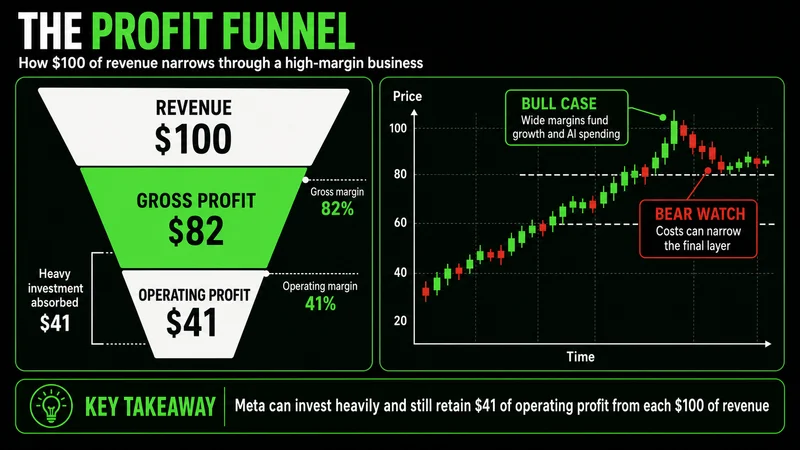 Meta retains wide margins even after research, marketing, administrative, and other costs.
The main operating expense buckets shown are $57.4 billion for research and development, $12.0 billion for marketing and sales, and $12.2 billion for general and administrative costs. Research and development is the largest bucket. That is not automatically negative. The real question is whether the spending protects the ad franchise, improves targeting, creates useful products, or merely raises the cost base.
The 30% net margin also requires context. The supplied figures identify a one-time tax charge as the reason net margin dipped from its prior trend, rather than deterioration in the core business. A common mistake is to treat every decline in reported net margin as equal. Recurring operating weakness and a discrete tax effect do not deserve the same interpretation.
“A high margin is evidence of strong economics, not proof of a fair price.” — MRPNL
What moves Meta stock after earnings
Price often reacts to the gap between expectations and new information, not to whether the reported numbers look large in isolation. An earnings beat can support the stock. A miss can pressure it. The more important details are usually forward-looking: advertising growth, engagement, ad pricing, expense discipline, and capital-spending guidance.
Ad revenue growth and AI capital-expenditure guidance are the two figures that deserve the closest attention. Strong ad guidance can imply that demand, impressions, pricing, or targeting efficiency remains healthy. Higher capital spending can pressure the stock when investors cannot connect that spending to stronger revenue, better margins, or a defensible operating advantage.
Other catalysts matter because they change that balance:
- Daily active users and engagement indicate whether the advertising inventory remains durable.
- Ad pricing and impression trends show how effectively attention converts into revenue.
- Operating-margin guidance reveals whether expense growth is outrunning sales growth.
- Reality Labs losses measure the continuing cost of the long-duration bet.
- Regulatory and antitrust developments can affect distribution, data access, and business flexibility.
- New AI products can help sentiment, but durable economics matter more than launch excitement.
A strong quarter can still produce a selloff if spending guidance rises faster than expected. A weaker headline quarter can recover if management shows improving ad demand and tighter expense control. Context decides which number matters.
The bull case requires profitable reinvestment
The bull case is not simply that Meta earns a large profit today. It is that the Family of Apps continues to compound advertising revenue while AI investment improves engagement, recommendations, targeting, and monetization. If those improvements support revenue faster than expenses grow, Meta can preserve strong margins while building new capabilities.
Large cash flow also gives the company room to fund projects without depending on fragile external financing. That matters during difficult markets. A business that can finance research internally has more control over timing than one that must raise capital whenever conditions change.
The practical bull-case checklist is straightforward:
- Advertising growth remains healthy across impressions and pricing.
- Engagement supports a stable or expanding pool of monetizable attention.
- AI spending produces measurable operating or revenue benefits.
- Operating margins remain disciplined despite infrastructure investment.
- Reality Labs losses stay contained relative to Family of Apps profit.
The thesis strengthens when these conditions improve together. One strong metric cannot carry the full case. Revenue growth with uncontrolled expense growth is weaker than it first appears. Cost control paired with falling engagement can also be temporary.
The bear case is concentration plus uncertain payback
Reality Labs generated $2.2 billion in revenue but recorded a $19.2 billion operating loss. That difference is central to the bear case. Family of Apps funds the entire bet, and the timing of any meaningful return remains uncertain.
The risk becomes more serious when combined with heavy AI infrastructure spending. Datacenters, models, and technical talent require capital before their future returns are known. If these investments improve the core ad system, the spending can be rational. If the benefits remain difficult to measure while depreciation and operating costs rise, margins can compress.
Meta also faces external dependencies. Advertising is cyclical. Privacy changes by major mobile platforms can affect measurement and targeting. Antitrust and regulatory action can restrict operating choices. Competition from short-form video and AI-driven search can pull attention away from existing products.
The dependency chain is therefore simple: ads fund AI spending, AI spending competes with Reality Labs losses, and both can create margin pressure. The bear case gains force when any link weakens while management continues spending as though the ad engine were unchanged.
Relative P/E cannot answer whether Meta is overvalued
Comparing Meta’s price-to-earnings ratio with Alphabet, Pinterest, and Reddit can provide a useful starting point, but it is not a complete valuation. Each company has different margins, growth rates, business concentration, capital needs, and risk. A lower multiple may reflect slower expected growth. A higher multiple may already assume successful execution.
The common mistake is choosing a peer multiple first and building the story around it. A better process starts with operating assumptions. Estimate whether ad growth can persist, whether margins can hold, and whether AI and Reality Labs spending will create returns. Only then ask whether Meta’s relative P/E compensates for the uncertainty.
No precise peer multiples are needed to apply the method. The important question is what the market must believe for the current valuation to make sense. If the price requires resilient ad growth, stable margins, and improving investment returns at the same time, the margin for error is narrow.
A decision framework turns the story into a thesis
A disciplined review separates confirmation from invalidation. The bull thesis receives confirmation when ad revenue and engagement remain firm, operating margins hold near strong levels, and higher investment produces visible commercial benefits. The bear thesis receives confirmation when ad growth slows as capital spending and Reality Labs losses remain elevated, creating sustained margin pressure.
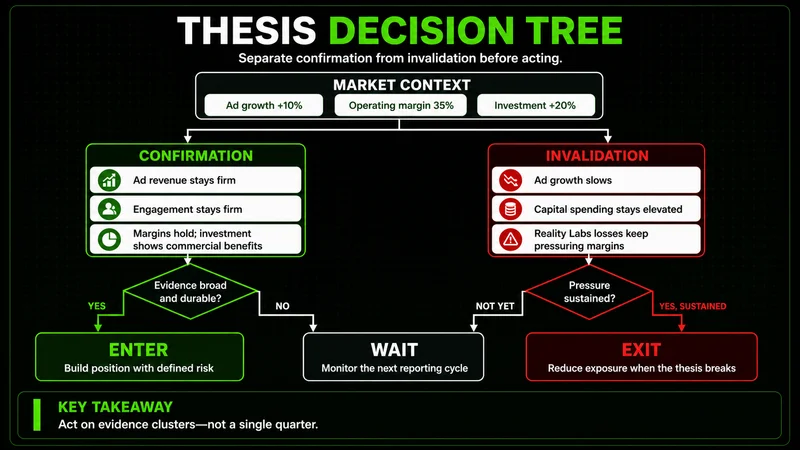 Ad growth, spending returns, margins, and Reality Labs losses determine which thesis receives confirmation.
Defined invalidation matters because a thesis without it becomes an opinion that can survive any evidence. The bull case is invalidated if the core advertising engine weakens for a sustained period while spending continues to rise and management cannot show improving returns. The bear case is invalidated if AI investment lifts monetization or efficiency enough to offset its cost while Reality Labs losses become less material.
When this framework does not work
This framework is less useful during a short-lived market shock that moves large technology stocks together without changing company fundamentals. It also becomes unreliable when accounting charges, tax effects, or unusual timing distort comparisons between periods. In those conditions, one quarter can create a false signal.
It does not work when investors treat every AI announcement as immediate proof of revenue or every spending increase as waste. Both conclusions skip the required operating evidence. The framework needs several reporting periods to distinguish a durable trend from normal quarterly variation.
The decision rests on the spread
Meta is a highly profitable advertising business funding expensive long-term bets. Its 82% gross margin, 41% operating margin, and $60.5 billion of net income show the strength of the core engine. Its advertising concentration, AI spending, Reality Labs losses, and regulatory exposure define the risk.
The practical application is to track the spread between ad growth and investment cost. When the engine compounds faster than the bets consume capital, the bull case improves. When spending rises without measurable returns and the ad engine slows, the bear case takes control. Valuation should reflect that evidence, not replace it.
Worth the read?