What Moves Goldman Sachs Stock After Record Earnings
Learn what moves Goldman Sachs stock, how its FY2025 earnings engine works, and when a premium valuation can become a peak-cycle risk.

The question of what moves Goldman Sachs stock starts with earnings quality, not the headline revenue number. Goldman Sachs produced $58.28 billion in FY2025 net revenue, but roughly 71% came from Global Banking & Markets. The stock therefore depends heavily on whether trading, underwriting, and advisory activity can remain productive after a record year.
That distinction matters because a strong income statement can support the shares while making the next comparison harder. Investors are not only paying for current earnings. They are paying for an earnings mix that must survive changing deal volume, market volatility, interest rates, regulation, and capital-return decisions.
How Goldman Sachs makes money from markets and clients
Goldman Sachs generated $41.45 billion from Global Banking & Markets, its largest operating engine. Within that segment, equities produced a record $16.54 billion, fixed-income, currency, and commodities trading produced $14.52 billion, and investment-banking fees contributed $9.34 billion. Asset & Wealth Management added $16.68 billion through fees and lending, while Platform Solutions contributed only $150 million after the firm exited GreenSky and cards.
The practical lesson is that Goldman Sachs is not valued like a manufacturer with stable unit sales. Its revenue follows client activity. Trading desks earn more when clients reposition and markets provide usable volatility. Investment banking improves when mergers, underwriting, and initial public offerings move from discussion into completed transactions. Asset and wealth fees can add stability, but they do not remove the dependence on capital-markets activity.
The answer to "what moves Goldman Sachs stock"
Capital-markets activity is the clearest operating driver. A recovering merger pipeline, stronger underwriting volumes, an open IPO window, and productive trading conditions can lift revenue and confidence at the same time. The FY2025 mix makes this sensitivity visible: Global Banking & Markets represented about 71% of total revenue, so changes inside that segment can outweigh progress elsewhere.
Interest rates matter through more than net interest income. The rate path affects financing demand, deal economics, valuations, and the willingness of corporate clients to issue securities or complete acquisitions. A higher-for-longer environment can suppress transaction volume and valuation multiples even when trading desks remain active. Conversely, a more supportive rate backdrop may help the deal backlog convert into fees, but only if business confidence also holds.
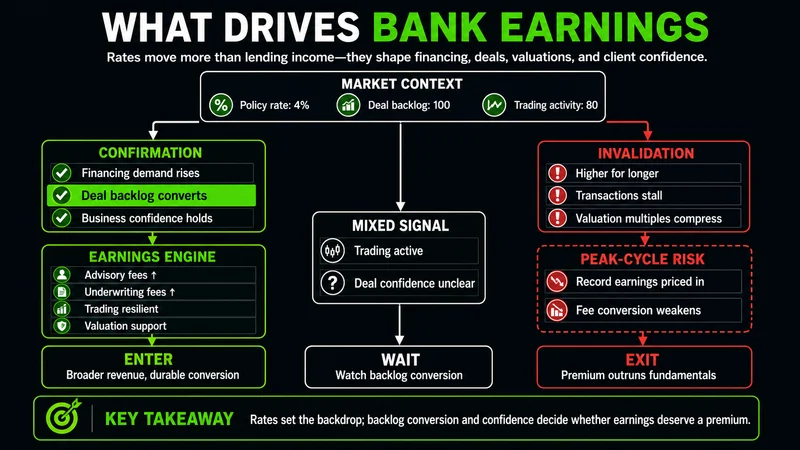 Capital-markets activity affects revenue directly and through confidence, capital, and valuation.
Trading results need context. Volatility is useful when it produces client flow, financing demand, and executable markets. Disorderly conditions can instead reduce risk appetite, delay deals, and pressure asset values. The common mistake is treating every rise in volatility as automatically positive for a trading franchise. The quality of the flow matters more than the size of the market move.
Capital returns form another catalyst. Buybacks and dividends can support per-share value when earnings and regulatory capital permit them. The annual Federal Reserve stress-test process also matters because it influences how much capital can be returned. Strong operating results do not guarantee aggressive buybacks if required capital rises.
Profitability is strong, but its composition matters
Goldman Sachs reported $21.85 billion of pre-tax earnings, equal to a 37.5% pre-tax margin, and $17.18 billion of net earnings, equal to a 29.5% net margin. Return on equity was 15.0%, while net earnings increased 20% from FY2024. Those figures show strong conversion from revenue into shareholder earnings.
Bank margins require careful interpretation. Goldman Sachs does not report a conventional cost-of-goods line, so a product-style gross margin is not useful. The more relevant operating measure is the efficiency ratio: operating expenses of $37.54 billion consumed 64.4% of revenue, leaving 35.6% before provisions. Compensation was the largest single outflow at $18.91 billion, or roughly one-third of revenue. Transaction expenses were $8.0 billion, technology costs were $2.17 billion, depreciation and amortization were $2.18 billion, and other expenses were $6.28 billion.
A bank can report excellent margins and still face a difficult setup if those margins were earned near the top of its cycle.
The $1.11 billion credit-loss benefit also improved pre-tax results. That benefit is real in the reported period, but it may not repeat. If reserves later rebuild, the direction can reverse. A disciplined analysis therefore separates recurring operating strength from a favorable provision effect.
Goldman Sachs valuation carries a peak-cycle question
The supplied comparison places Goldman Sachs near 20 times trailing earnings, above Bank of America near 14 times and JPMorgan near 15 times, and slightly above Morgan Stanley near 18 times. The premium can reflect Goldman Sachs' record return on equity, strong franchise, and capacity to repurchase shares. It can also reflect confidence that capital-markets activity will remain constructive.
The valuation risk is that trailing earnings describe the year already completed. If a stock trades near 20 times earnings after a record period, the multiple can understate the effective price investors are paying for normalized earnings. A slowdown in trading, fewer completed deals, or the loss of the credit provision benefit could reduce the earnings denominator without any initial change in the share price.
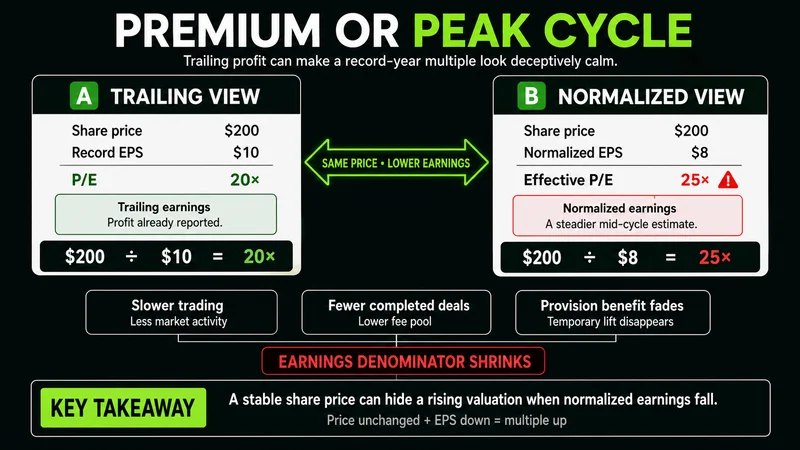 A trailing valuation premium becomes fragile when record earnings begin to normalize.
Consider the peer comparison as a concrete example. Paying roughly 20 times for Goldman Sachs instead of roughly 15 times for JPMorgan means accepting a meaningful premium. That premium is rational only if Goldman Sachs sustains superior profitability, converts its banking backlog, and returns capital without taking disproportionate risk. If those conditions weaken, the same share price becomes harder to defend.
The bear case begins with earnings cyclicality
Goldman Sachs has a top-tier investment-banking franchise, a strong capital-return engine, and record profitability. The bear case does not deny those strengths. It argues that they may be reflected in the price while the earnings base remains unusually favorable.
Several risks deserve direct attention:
- Deal and underwriting revenue can contract when business confidence falls.
- Trading revenue can swing with client activity and market conditions.
- Higher capital requirements can restrict returns to shareholders.
- Compensation can remain elevated because talent is a major operating cost.
- Credit reserves can rise after a period that included a provision benefit.
- The business is less diversified than a universal bank with a broader consumer franchise.
The defined invalidation for the premium thesis is a sustained break in the conditions supporting it. If return on equity falls materially, the deal pipeline fails to convert, buybacks slow, and the stock retains a premium multiple, the argument that investors are paying for durable quality becomes weaker. One disappointing quarter is not enough. A repeated deterioration across profitability, capital returns, and fee activity is the more useful signal.
A practical framework separates results from expectations
Start with the revenue mix, then test the durability of each driver. Global Banking & Markets should be evaluated through trading productivity, advisory fees, underwriting volume, and the deal backlog. Asset & Wealth Management should be evaluated for fee growth and its ability to moderate the cycle. Expenses should be tested against revenue, with particular attention to compensation. Finally, compare return on equity and capital returns with the valuation premium.
A compact review can use five questions:
- Is the investment-banking backlog converting into completed fees?
- Are trading gains supported by client activity rather than one unusual period?
- Does return on equity remain near the level supporting a premium valuation?
- Can buybacks continue after stress tests and higher capital requirements?
- Are credit provisions normalizing without erasing operating progress?
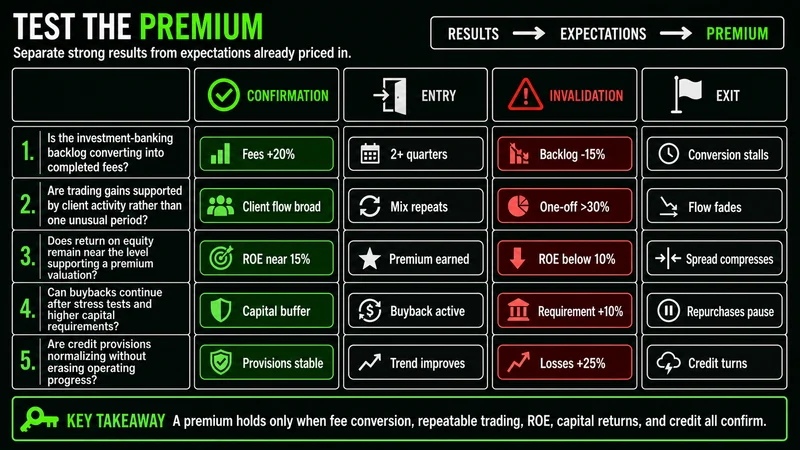 The premium holds only while fee conversion, trading quality, returns, buybacks, and provisions remain supportive.
This framework keeps the analysis reactive, not predictive. It does not require guessing the next market move. It requires watching whether the operating evidence continues to support the price investors are being asked to pay.
When this framework does not work cleanly
Quarterly bank results can be distorted by timing. A large advisory fee may move between reporting periods, a volatile trading quarter may not represent the full year, and reserve changes can obscure the operating trend. During abrupt macro stress, the relationship between volatility and revenue can also invert because deal activity freezes while risk rises.
In those conditions, a single-period efficiency ratio or trailing P/E can provide false precision. The framework works better across several reporting periods, with attention to the capital-markets cycle and management's actual capital actions. It becomes less reliable when the earnings base changes faster than trailing figures can capture.
The stock needs durable earnings, not another record
Goldman Sachs entered the valuation debate with strong FY2025 profitability, a dominant markets franchise, and a premium trailing multiple. The central question is whether trading, deal fees, asset-management growth, and buybacks can sustain that premium as favorable comparisons become harder.
The cleanest conclusion is conditional. Strong return on equity and renewed capital-markets activity can justify paying more than for some peers. Weak deal conversion, normalized trading revenue, tighter capital rules, or rising provisions can expose the risk of valuing peak-cycle earnings as though they were permanent.
Worth the read?